

Instructional Systems Design plays a crucial role across various sectors of training, including education, corporate learning, healthcare training, and numerous other industries. With “90% of the organizations concerned about employee retention and finding providing learning opportunities is the No.1 retention strategy”, instructional systems design is irreplaceable in learning and development. (Source: LinkedIn Workplace Learning Report, 2024).
Table of Contents
Instructional systems design is not just about creating content. There’s much more to it! Read on to explore what instructional systems design is, its importance, principles, and future.
What is Instructional Systems Design?
Instructional Systems Design is a systematic process of applying learning theories and strategies to develop and assess training solutions that are engaging, goal-oriented, and aligned with learner needs. This structured process converts learning into a practical, active learning experience, rather than passive information consumption. For instructional systems design, there are mainly two models prevalent today; the ADDIE Model and the Agile Model.
ADDIE Model
The traditional model developed in the 1970s has five phases namely Analysis, Design, Development, Implementation, and Evaluation. The analysis phase identifies learning needs, audience, and objectives, the design phase plans instructional strategies and content structure, the development phase includes creating learning materials and activities, the implementation delivers training utilizing various formats, and the evaluation assesses the effectiveness of the training and brings improvements. This model is widely used for designing training as it is dynamic and flexible.
Agile Model
Unlike the linear ADDIE model, agile models follow a cyclical process that involves continuous collaboration, rapid prototyping, and ongoing feedback. This is not a single model but refers to any approach emphasizing speed, flexibility, and collaboration. The notable benefits of the agile model are that it is interactive and iterative and can repurpose existing content. Some variations of the agile model are the Successive Approximation Model (SAM), Rapid Application Development, and Rapid Content Development.
Importance of Instructional Systems Design
Instructional systems design is crucial to creating high-quality training solutions that match the learner’s requirements and organizational goals. Let’s analyze the importance of instructional systems design.
Improves Learning Outcomes
Every training program centers around a set of learning outcomes expected from the participants undertaking the course. Instructional systems design ensures the training is built around SMART objectives and offers active learning opportunities to easily attain the learning outcomes.
Efficiency and Consistency
A major benefit of Instructional systems design is that it standardizes content delivery offering top-notch training that benefits each learner. Effective designing and developing training content eliminates unnecessary and repetitive content to offer learners the necessary content.
Engaged Learning
Instructional systems design elevates learner engagement by providing interactive, immersive, learner-centered strategies such as role-plays, videos, microlearning, gamification, extended reality, scenarios, and simulations. Moreover, regular quizzes and knowledge checks assess learner progress and reinforce learning.
Adaptability and Flexibility
Instructional Systems Design offers customizable and personalized training content to the learners based on their needs, skills, preferences, and areas of improvement. It further provides learners the autonomy to progress their learning at their own pace while offering scalable training content integrated across various platforms.
Facilitates Assessment and Improvement
An unstructured approach to learning not utilizing proper instructional systems design is inconsistent and fails to assess the effectiveness of the program. However, utilizing instructional design utilizes data analytics to identify gaps in comprehension, metrics to measure performance, gather learner feedback, and offer personalized assessment presented in an engaging tone.
Principles of Instructional Systems Design
When designing and developing content, learning and development professionals should be aware of the core principles of instructional systems design. The principles are:
Objective-Driven
Instructional systems design should be objective-driven, i.e., designing a training program must ensure well-defined learning objectives align with organizational goals and focus on attaining measurable performance outcomes. These objectives specify the aim of the training on what the learner should attain after undertaking the program.
Learner-Centeredness
The principle of learner-centeredness in instructional systems design means that the learning content, instructional strategies, and delivery methods should be designed based on the learner’s needs and proficiency. Moreover, learners can be encouraged to learn themselves by promoting hands-on experiences.
Efficient Pace
Instructional systems design should proceed at an efficient pace. This can be ensured by considering learner styles and needs, incorporating supplementary resources, using a clear and understandable format alongside engagement, and promoting strategies like microlearning. Because of the fast pace and flexibility, “the microlearning industry is projected to expand by 13% in 2025” (Source: Vouch).
Contextualize Information
Another major principle of instructional systems design is that learning should be contextualized. This means the information must be presented in a relevant and meaningful manner that connects with the learner’s real-world experiences. This can include scenarios, case studies, or real-world examples that boost learner engagement, improve retention, and encourage the application of the knowledge in real situations.
Continuous Evaluation and Improvement
The instructional design should incorporate assessment and feedback for maximized effectiveness. Regular assessments allow instructional materials to adapt to the evolving industry developments and changes and ensure learning effectiveness by integrating the latest trends. In addition, monitor the efficiency of the assessment by regularly testing and gathering feedback from the peers during pilot testing and learners for making alterations.
Future of Instructional Systems Design
Instructional Systems Design is evolving and transforming along with the changes in technology, learner needs, and behaviors. The shift has begun focussing on offering personalized experiences, adoption of the latest technologies for maximized engagement, and adaptive learning experiences.
The future of instructional systems design is expected to largely rely on Artificial Intelligence and machine learning systems for easy content generation and predictive analysis, immersive learning technologies such as VR and AR for highly interactive simulations promoting hands-on learning experience, gamification involving challenges, leaderboards, and rewards, microlearning offering learners to comprehend the most suitable information, data analytics to track learner behavior and suggest training solutions, mobile learning opportunities, increased accessibility in the courses beneficial for diverse learners. With expertise in evolving technology, instructional systems design will continue to grow, shaping the future of learning and development.
Conclusion
In a nutshell, instructional systems design is a structured process that converts learning into an active learning experience, rather than passive consumption of information. Considering the instructional design models, there are mainly two models prevalent in the training landscape; the ADDIE model and the agile model. Instructional systems design is essential as it improves the learning outcomes, ensures efficiency and consistency while designing training, creates an engaged learning experience, is adaptable and flexible, and facilitates assessment and improvement.
The core principles of instructional systems design are that it is objective-driven, offers learner-centeredness, proceeds at an efficient pace, contextualizes information, and incorporates continuous evaluation and improvement. Instructional systems design has already started focussing on offering personalized experiences, adoption of the latest technologies, and adaptive learning experiences. In the future, the growing technological trends such as artificial intelligence, AR/VR, gamification, simulations, microlearning, data analytics to monitor the progress, mobile learning opportunities, and increased accessibility in the courses beneficial for diverse learners are expected to be integrated into the design and development processes. It is suggested that every organization should adopt strategies to integrate training programs that are well-designed and developed for maximized organizational outcomes.
Infographic
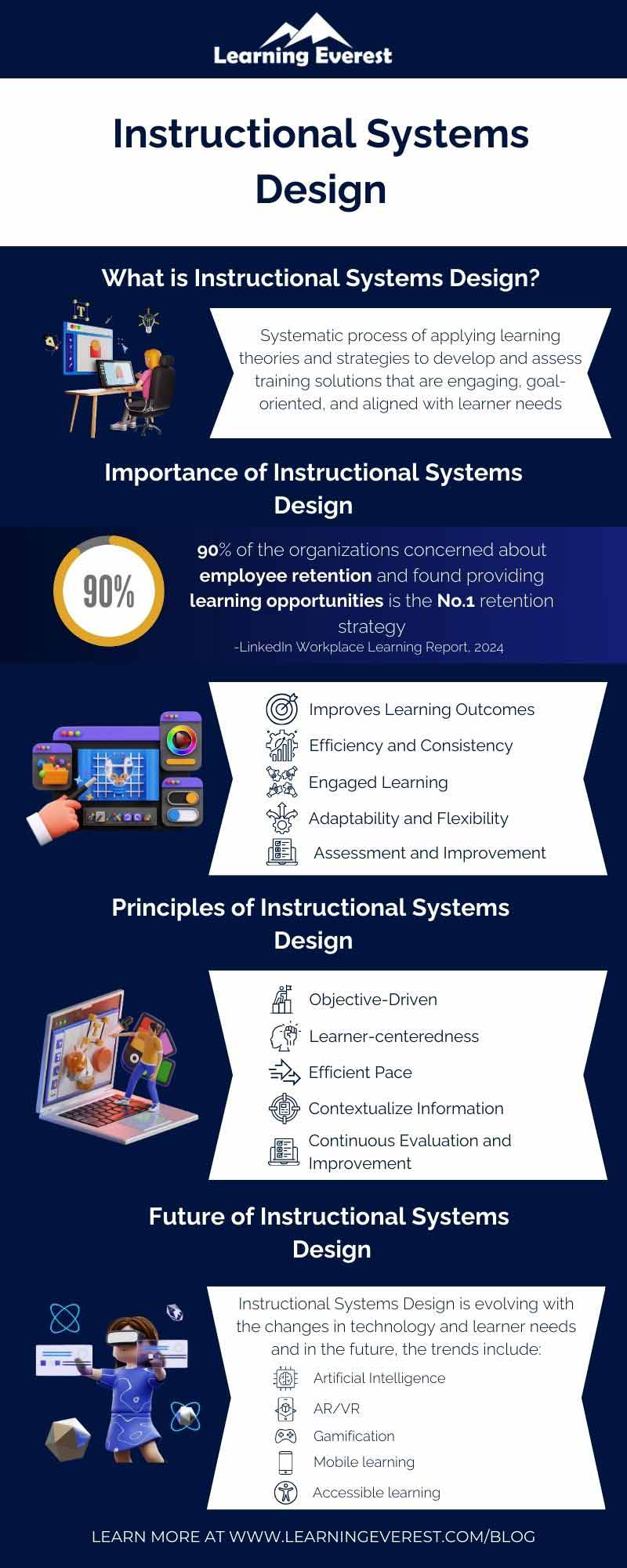
Instructional Systems Design
Knowledge Check!
Frequently Asked Questions (FAQs)
What is instructional systems design?
Instructional Systems Design is a systematic process of applying learning theories and strategies to develop and assess training solutions that are engaging, goal-oriented, and aligned with learner needs. This structured process converts learning into a practical, active learning experience, rather than passive information consumption.
What are the models of instructional design?
For instructional systems design, there are mainly two models prevalent today; the ADDIE Model and the Agile Model.
What is the importance of instructional systems design?
Instructional systems design is essential as it improves the learning outcomes, ensures efficiency and consistency while designing training, creates an engaged learning experience, is adaptable and flexible, and facilitates assessment and improvement.
What is the future of instructional systems design?
In the future, the growing technological trends such as artificial intelligence, AR/VR, gamification, simulations, microlearning, data analytics to monitor the progress, mobile learning opportunities, and increased accessibility in the courses beneficial for diverse learners are expected to be integrated into the design and development processes.
Live Online Certification Trainings




Our Clients Our Work
