

With the advancement in Artificial Intelligence taking over every sector, organizations are considering developing ready-made AI courses. However, amidst the fast-paced development, these courses lacking human expertise fail to effectively address learner needs.
Table of Contents
This blog offers insights into the importance of instructional design over AI-generated eLearning along with elaborating how instructional design and AI-generated eLearning work. Keep Reading!
Understanding Instructional Designing
Instructional Design or Instructional Systems Design refers to the process of designing and developing learning experiences and programs for engaging learners. The approach involves determining the needs and preferences of the learners and developing instructional content that offers lasting impact. An Instructional Designer is the ‘architect’ or the ‘director’ of the learning process and applies learning theories in designing course content, incorporating interactive learning activities to support the acquisition and retention of learning.
In addition to designing the content, instructional designers evaluate the measurable outcomes of the training. The steps involved in instructional designing involve conducting a needs assessment to identify the organizational and learner needs, understanding training objectives and desired outcomes, content creation utilizing appropriate methodologies, strategies, and interactives, and evaluating the outcomes.
Instructional Designers use adult learning theories or combine the theories while designing training programs. The common learning theories include Knolwes’ Andragogy, Constructivism, David Kolb’s Experimental Learning, Social Learning, Situated Learning, etc. In addition, instructional designers utilize different models to plan and structure the eLearning. Some common Instructional Design Models are:
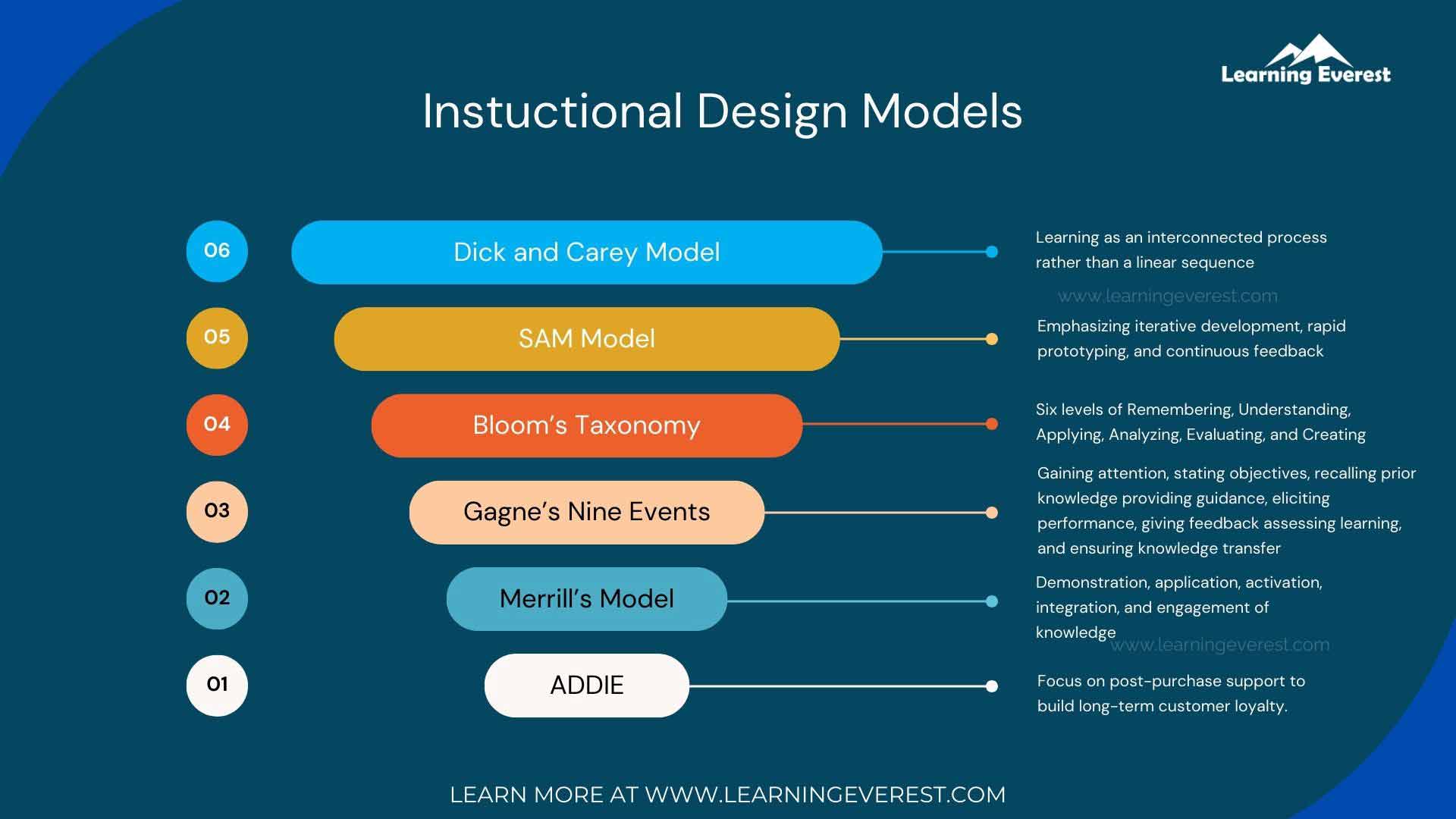
Instructional Design Models
- ADDIE Model: A systematic instructional designing framework consisting of the phases of Analysis, Design, Development, Implementation, and Evaluation to create effective learning experiences.
- Merrill’s Instructional Model: Merrill’s First Principles of Instruction is a learner-centered model emphasizing problem-solving through demonstration, application, activation, integration, and engagement of knowledge.
- Gagne’s Nine Events of Instruction: A structured model for effective learning including gaining attention, stating objectives, recalling prior knowledge providing guidance, eliciting performance, giving feedback assessing learning, and ensuring knowledge transfer.
- Bloom’s Taxonomy: A model benefitting designers to create learning objectives classifying cognitive learning into six levels of Remembering, Understanding, Applying, Analyzing, Evaluating, and Creating.
- SAM Model: Successive Approximation Model is an agile approach emphasizing iterative development, rapid prototyping, and continuous feedback.
- Dick and Carey Model: Also called Systems Approach views learning as an interconnected process rather than a linear sequence consisting of nine steps of identifying instructional goals, conducting instructional analysis, identifying entry behaviors, writing performance objectives, developing criterion tests, developing instruction strategy, developing and selecting instructional materials, developing and conducting formative evaluation, and developing and executing a summative assessment.
Utilizing the insights from analysis and appropriate models and theories, instructional designers create storyboards and scripts utilizing the suitable approaches and leverage eLearning authoring tools or graphic design tools for crafting engaging learning experiences.
Understanding AI-Generated eLearning
AI-generated eLearning utilizes machine learning algorithms to create an automated learning experience. AI automates content generation, curation, and development by saving time and personalizing learning. Professionals can utilize AI for script generation or storyboarding based on learning objectives, text-to-speech (TTS) technology that converts the script into natural-sounding audio, generating visual design, accessibility tools for generating closed captioning and voice-overs, auto-translating content for multilingual users, and automated assessments and scene creation. The rapid content creation and distribution capability of AI reduces manual effort in content writing, voiceovers, and graphic design encouraging the creation of eLearning at a quicker pace.
The Importance of Instructional Design over AI-Generated eLearning
Although Artificial Intelligence can create eLearning courses in a shorter span with less human effort, the strategic crafting of eLearning courses with sound instructional designing stands superior. With Experts in the field carefully designing the training content identifying the needs of the learners, incorporating the blend of learning theories and models, and crafting content utilizing technology, instructional designing stays ahead of automated learning content. According to Discover Learning, “By incorporating various instructional design principles, such as clear learning objectives, engaging content, and interactive learning sessions, a 40% increase in employee productivity post-training” is witnessed. Let us now analyze the importance of instructional designing over AI-generated eLearning courses.
Instructional Design over AI-Generated eLearning #Reason 1: Clarity and Logical Flow
Instructional designers create effective eLearning solutions by ensuring analytical clarity and organizing information with precision. The courses that are created are structured ones following a logical flow of information encouraging knowledge retention and comprehension. In contrast, AI-generated eLearning relies on generic learning without deep, contextual meaning leading to content appearing superficial.
Instructional Design over AI-Generated eLearning #Reason 2: Application of Learning Theories
With instructional designing relying on pedagogical theories, designers create eLearning courses that are goal-oriented and learner-centered instead of mere information loads. The content created utilizing the learning theories understands learner needs and personas along with offering maximum impact. On the contrary, AI does not inherently use learning theories but craft content based on data patterns that fails to support deep learning.
Instructional Design over AI-Generated eLearning #Reason 3: Imagination Leading to Innovation
Human imagination is the driving force behind innovation in instructional design. Instructional designers use creativity, imagination, and critical thinking, alongside deep comprehension to create innovative and engaging eLearning courses. This imagination answers what strategy suits best to convey a particular content. While AI-generated learning incorporates interactivity, it lacks human thinking leading to courses misaligned with learner needs. Furthermore, AI-generated courses often lack situational appropriateness leading to courses that disengage learners.
Instructional Design over AI-Generated eLearning #Reason 4: Quality and Accuracy
AI-generated eLearning courses can be developed rapidly but contain a lot of factual errors, irrelevant content, and misinterpreted information. This points out the importance of human-designed courses that undergo multiple quality assurance checks, ensuring the content is factually correct and well-structured. Even when instructional designers rely on AI for certain aspects of content creation, for instance, creation of voice-overs, a thorough human eye is needed.
Instructional Design over AI-Generated eLearning #Reason 5: Ethical Considerations
Instructional designing is preferred over AI-generated eLearning courses due to ethical considerations such as bias or stereotypes, cultural sensitivity, learner privacy, and accuracy of information associated with the latter.
Instructional Design over AI-Generated eLearning #Reason 6: Customization and Branding
Instructional designers tailor learning content based on the target audience and business objectives and AI can personalize learning but fail to truly resonate with learners. Moreover, instructional designers stress crafting consistent learning experiences for learners ensuring the courses reflect company culture, mission, and brand voice.
While AI can assist with content generation, instructional designing is vital for creating learning programs that truly engage learners and retain knowledge.
Integrating AI in Instructional Design: The Judicious Approach
Understanding the purpose of AI is to enhance, not to replace ensures a judicious manner to incorporate the present-day technology in the learning experience. Instructional designers can utilize the automation capabilities of AI and the wider possibilities while ensuring human oversight for creativity, ethics, and pedagogy to promote a better learning culture.
Conclusion
To sum up, although AI-generated courses are becoming largely popular nowadays, the importance of instructional design over AI-generated eLearning makes it superior. The reasons include clarity and logical flow of content, the application of learning theories, human imagination leading to innovation, quality, and accuracy, ethical considerations of AI, and the ability to customization and branding associated with instructional designing. Organizations can uphold instructional design to incorporate strategic thinking, creativity, and human insight in their learning and development initiatives.
Transform your training with cutting-edge instructional design, tailored for maximum impact and engagement. Connect with us!
Infographic
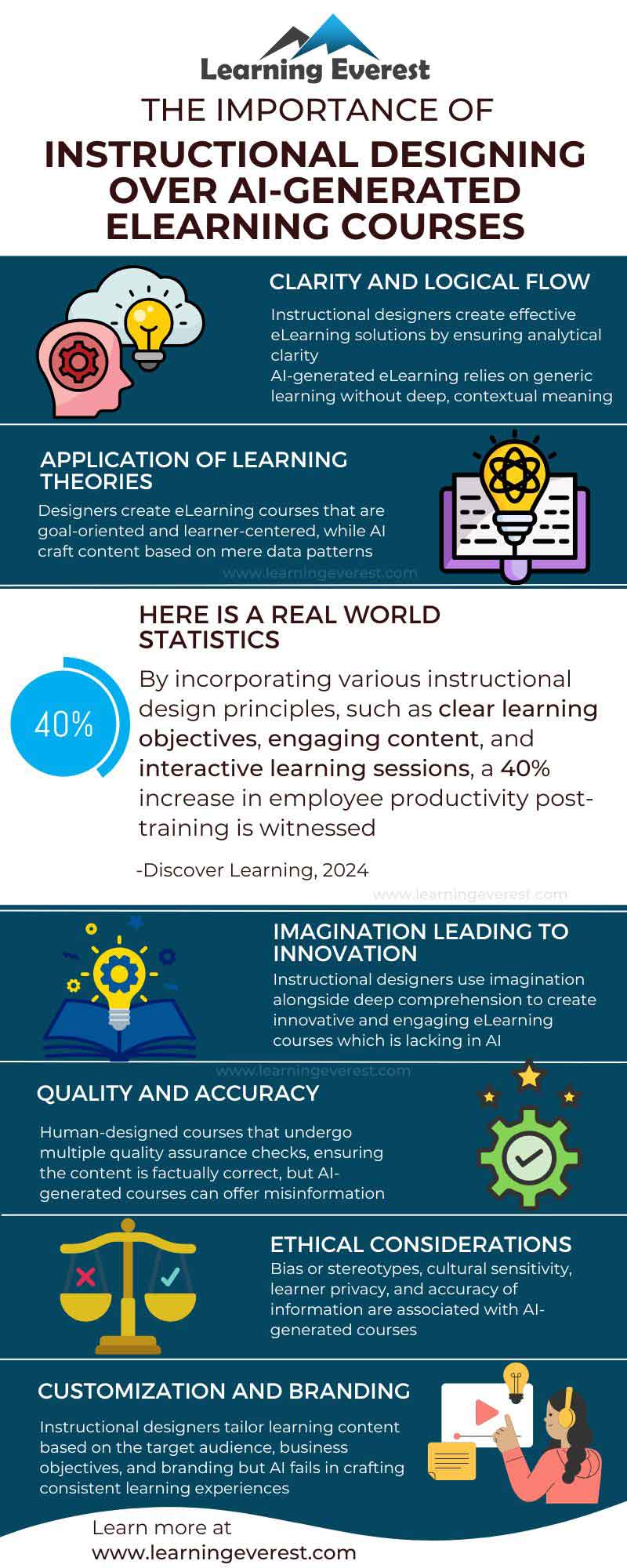
The Importance of Instructional Designing over AI-Generated eLearning Courses
Knowledge Check!
Frequently Asked Questions (FAQs)
What is Instructional Designing?
Instructional Design or Instructional Systems Design refers to the process of designing and developing learning experiences and programs for engaging learners. The approach involves determining the needs and preferences of the learners and developing instructional content that offers lasting impact.
What are the major theories of instructional design?
Instructional Designers use adult learning theories or combine the theories while designing training programs. The common learning theories include Knolwes’ Andragogy, Constructivism, David Kolb’s Experimental Learning, Social Learning, Situated Learning, etc.
What is the importance of instructional design over AI-generated eLearning courses?
The reasons for preferring instructional design over AI-generated eLearning courses are clarity and logical flow of content, the application of learning theories, human imagination leading to innovation, quality, and accuracy, ethical considerations of AI, and the ability to customization and branding associated with instructional designing.
Live Online Certification Trainings




Our Clients Our Work
