

The 7C’s of Resilience offer essential principles for fostering emotional strength and adaptability for facing challenges in the workplace. An employee might encounter a wide range of challenges in the workplace and being resilient helps overcome adverse situations.
Table of Contents
This blog explores the concept of resilience, delves into the 7C’s of resilience, and discusses how implementing these principles can boost productivity in the workplace.
What is Resilience?
Do you know that “around 34% of adults report that stress is completely overwhelming for them on most days”? (Source: Forbes, 2024). Are you aware that “51% of adults who felt stressed reported feeling depressed, and 61% reported feeling anxious.” (Source: Mental Health Foundation, 2018). To navigate and recover from the challenges and stress factors, an individual must possess the quality of resilience. Resilience is defined as the trait that enables individuals to adapt to adverse life situations, recover from setbacks and failures, and strengthen themselves to face challenges and difficulties.
It is imperative to possess resilience as it enables individuals to cope with hardships in their personal as well as professional journey making them stronger. Resilience is not an innate quality, but the mental and emotional behavior that can be acquired and developed through varied experiences, guidance, learning, and support.
What are the 7C’s of Resilience?
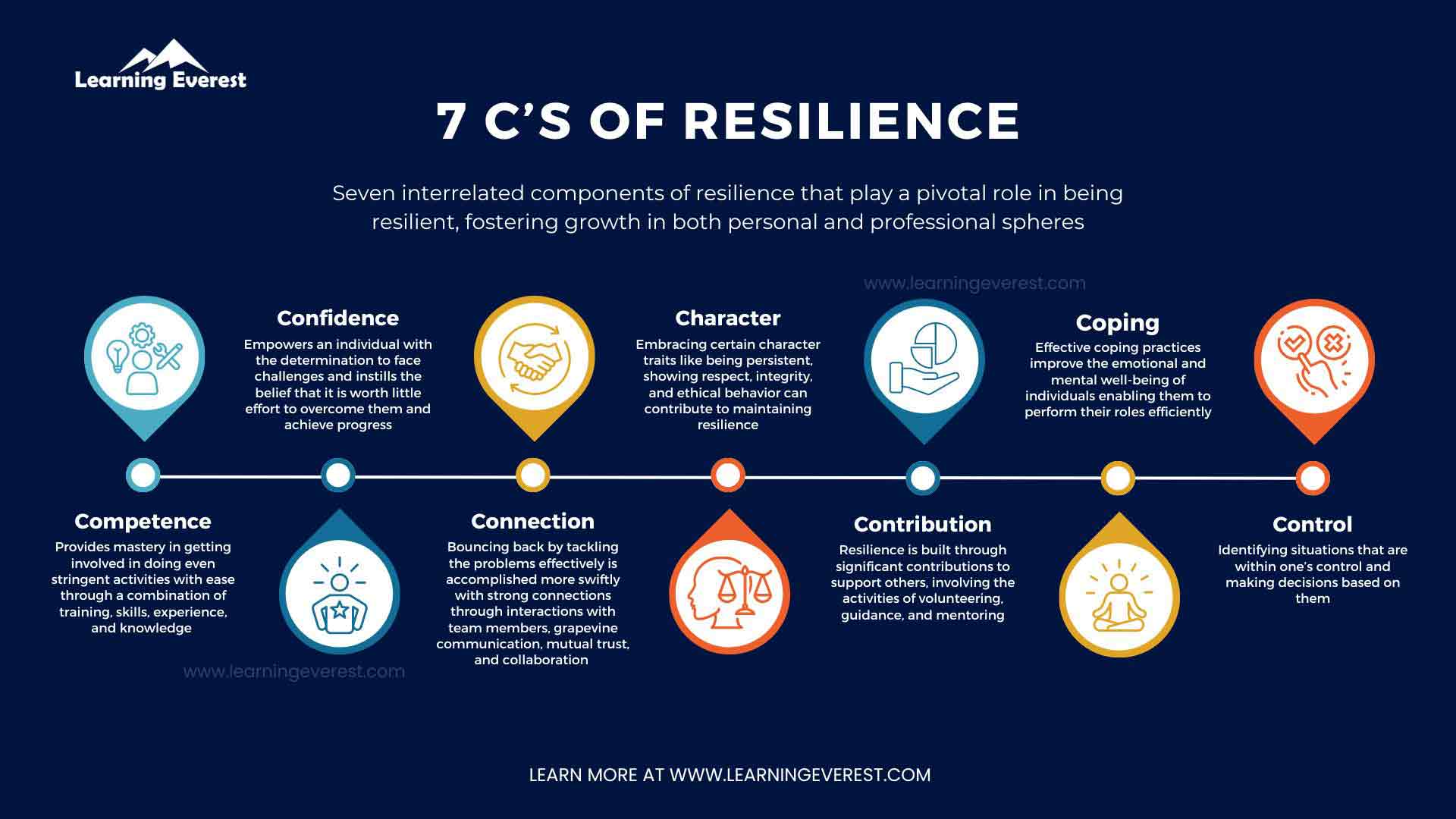
To attain resilience, individuals must possess seven interrelated components. Each of these components plays a pivotal role in being resilient, fostering growth in both personal and professional spheres. The 7C’s of resilience that contribute to achieve resilient quality are:
7 C’s of Resilience
Competence
Competence is “the combination of training, skills, experience, and knowledge that a person has and their ability to apply them to perform a task safely.” (Source: Health and Safety Executive). To be resilient in the workplace, an employee must possess competence leading them to do even stringent activities with ease. The key benefits of being competent are that it boosts self-belief and provides mastery in getting involved in tasks thereby supporting employees to work proficiently.
Confidence
Confidence is the most critical factor that motivates an individual to move forward to achieve their milestones. In an organization, an employee may encounter various obstacles that hinder the process of realization of goals. A survey conducted by Indeed found that “98% of workers say they perform better when they feel confident.” Being confident empowers an individual with the determination to face challenges and instills the belief that it is worth little effort to overcome them and achieve progress.
Connection
Bouncing back by tackling the problems effectively is accomplished more swiftly with strong connections. Resilience in personal space is achieved through a supportive network of close kins and friends, while in the workplace interactions with team members, grapevine communication, mutual trust, and collaboration enhance resilience. Cultivating healthy connections not only improves teamwork but also acts as a pillar of support to cope with difficult situations.
Character
Character refers to the mental qualities unique to an individual. A person’s character is detrimental in determining the mental power of the person in tackling situations effectively. In the workplace, embracing certain character traits like being persistent, showing respect, integrity, and ethical behavior can contribute to maintaining resilience. Strong character guides employees to act best, handle stress and pressure, and stay optimistic thereby overcoming challenges effortlessly.
Contribution
Resilience is built through significant contributions to support others, involving the activities of volunteering, guidance, and mentoring. This enhances the self-esteem of the individuals motivating them to perform the best. Furthermore, in the workplace employees are engaged more when they feel that their contributions are acknowledged and it gives meaning to the organization.
Coping
How effectively a person can cope with challenges and negative conditions reflects the immanent ability of the person to be resilient. Coping refers to the strategies to handle stress, pressure, and challenges. Effective coping practices improve the emotional and mental well-being of individuals enabling them to perform their roles efficiently. These strategies equip employees with mindfulness to manage workplace stress and put forward productive outcomes.
Control
An individual’s capability to foresee and manage their actions makes them equipped to overcome challenges. Controlling involves identifying situations that are within one’s control and making decisions based on them. In addition, managing emotions falls in the category of control helping an employee to maintain a sense of stability in the workplace.
How do the 7’s of Resilience enhance productivity?
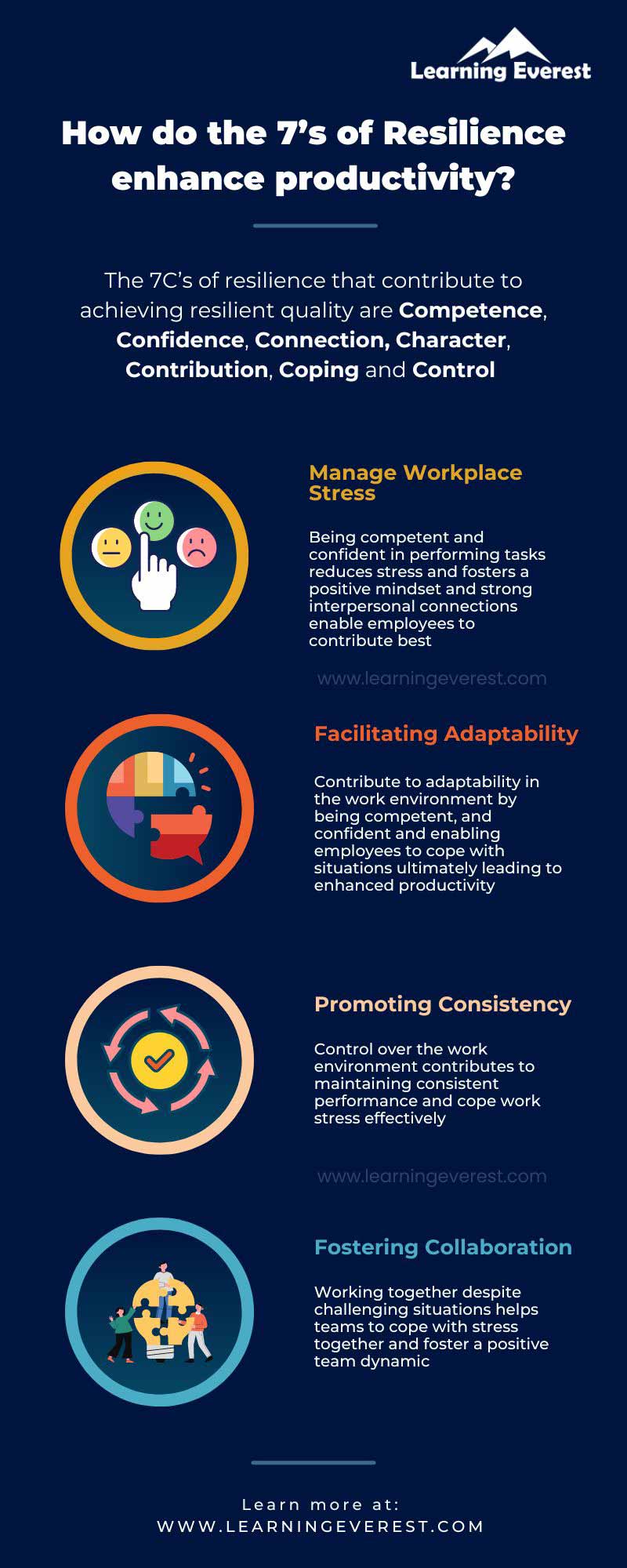
Resilience is a significant quality required for employees to be productive in their workplaces. Inheriting the 7C’s of resilience molds the overall nature of employees enabling them to provide significant contributions to the firm. Here are the four major manners in which 7C’s contribute to enhanced productivity.
Managing workplace stress
The 7C’s of resilience contribute to organizational productivity by managing workplace stress. Being competent and confident in performing tasks reduces stress and fosters a positive mindset. Strong interpersonal connections in the organization are a prominent factor that helps reduce workplace stress and enable employees to contribute best to organizational growth. In addition, resilience training can empower an individual to attain objectives and refrain from undesirable pressures promoting a better workplace culture.
Facilitating Adaptability
Adaptability is closely linked to resilience as both involve steps to combat challenging situations. The major difference between adaptability and resilience, according to Jacqueline Brassey, chief scientist at McKinsey & Company’s People and Organizational Performance Practice is that “Resilience is about bouncing back…in contrast, adaptability is about bouncing forwards.” (Source: BBC). However, the 7C’s of resilience contribute to adaptability in the work environment by being competent, and confident and enabling employees to cope with situations ultimately leading to enhanced productivity.
Promoting Consistency
Consistency is the key to success in every organization. An employee upholding the 7C’s of resilience can be consistent in their work thereby improving productivity. This can further enhance the work-life balance leading to reduced absenteeism and employee retention. Moreover, control over the work environment contributes to maintaining consistent performance and cope work stress effectively.
Fostering Collaboration
The 7C’s of resilience contribute to fostering collaboration in the workplace and promoting better outcomes. This is possible by improved connections that support each other and building confidence to get involved in teamwork. Employees with honest character are trustworthy and they contribute fruitfully to the team’s success. In addition, working together despite challenging situations helps teams cope with stress together and fosters a positive team dynamic.
Conclusion
In conclusion, the 7C’s of resilience are interrelated and integral components of the quality of resilience, a trait that enables individuals to adapt to adverse life situations, recover from setbacks and failures, and strengthen themselves to face challenges and difficulties. One can attain resilience as it is not an innate quality, but the mental and emotional behavior that can be acquired through experiences, guidance, learning, and support. The 7 C’s are competence which helps individuals perform even stringent tasks with ease, confidence to face challenges and achieve goals, connection to build mutual trust and collaboration, character that promotes optimism, contribution to support others, coping with stress and pressure, and control over the situations.
They contribute to enhancing workplace productivity by helping manage workplace stress, facilitating adaptability, promoting consistency, and fostering collaboration. Individuals must possess the quality of resilience for personal and professional success and organizations can contribute to enhancing the resilience of employees by providing training and guidance.
Infographic
How do the 7’s of Resilience Enhance Productivity
Knowledge Check!
Frequently Asked Questions (FAQs)
What is Resilience?
Resilience is defined as the trait that enables individuals to adapt to adverse life situations, recover from setbacks and failures, and strengthen themselves to face challenges and difficulties.
Is resilience an innate quality?
Resilience is not an innate quality, but the mental and emotional behavior that can be acquired and developed through varied experiences, guidance, learning, and support.
What are the 7 C’s of resilience?
The 7C’s of resilience that contribute to achieving resilient quality are Competence, Confidence, Connection, Character, Contribution, Coping, and Control.
How do the 7’s of Resilience contribute to workplace productivity?
The 7 C’s of resilience contribute to enhancing workplace productivity by helping manage workplace stress, facilitating adaptability, promoting consistency, and fostering collaboration.
Live Online Certification Trainings



Our Clients Our Work
