

Ever wondered about what sets high performers apart from others? Could it be specific skills and competencies? If so, what are the differences between competencies and skills? If you are eager to uncover the answers to these questions, this blog is tailored for you.
Table of Contents
The article will delve into the details of differentiating competencies vs skills and the need to understand the differences. Keep going and read on!
Competencies vs Skills: Definitions
Competencies and skills are two often confused interrelated terms required by individuals in their personal and professional lives. Understanding competencies vs skills is important to appropriately implementing them in the workplace leading to optimized organizational performance. Skills are specific learned abilities that are vital to performing activities and tasks. Employees attain the skills needed for their workplace through training, experimentation, and experience. Skills are usually categorized into two types: soft skills and hard (technical) skills.
Soft skills are workplace skills that are transferable regardless of the role a person is employed in. For instance, skills like communication, critical thinking, problem-solving, time management, leadership, etc. may be considered soft skills. The importance of soft skills for enhanced organizational outcomes was noted by the 2019 Global Talent Trends Report by found that “92% of talent professionals and hiring managers agree that candidates with strong soft skills are increasingly important.” Hard or technical skills are acquired abilities related to the job. For example, in the field of learning and development, the specific hard skills can be instructional design, assessment skills, content development skills, facilitation skills, etc.
Competencies, on the other hand, is a broader term that encompasses a combination of skills, knowledge, attitudes, and behaviors. In this regard, skills can be considered a subset of competencies. Competencies fall into three categories: functional or technical competencies which are competencies needed for specific job roles, organizational competencies that align with the overall organizational values and goals, and general competencies that are highly needed in every industry.
In the professional scenario, competencies are aligned with the vision and values of the organization. An example of competencies concerning the learning and development field may be instructional design (skills), knowledge of learning theories (knowledge), preparing content based on varied learning styles (behavior), and attention to minute details (attitude). All these elements constitute competencies making it a comprehensive cluster of related skills.
Competencies vs Skills: Differences
Understanding the difference between competencies and skills is crucial for attaining professional growth and the high-yielding performance of an employee. An individual needs to adopt the skills and competencies relevant to the organizational goals keeping in mind, the essential differences between them. They differ in terms of the focus, role, manner of acquisition, and measurement.

Competencies vs Skills- Differences
Competencies vs Skills Difference: Focus
The focus of both competencies and skills varies as the former is stressed on total performance and the latter for specific tasks. Competencies involve the overall ability to do the job by effectively integrating all aspects of the work. Skills focus on performing particular activities rather than broader application in different situations.
Competencies vs Skills Difference: Role
The roles of competencies and skills are different in the sense that competencies ensure employees perform tasks conforming to organizational objectives and are tied to long-term professional development while skills help individuals to complete allotted tasks and responsibilities.
Competencies vs Skills Difference: Acquisition
Competencies differ from skills in their manner of acquisition. Competencies are not learned but acquired through experience. It takes a longer time frame for an individual to attain competencies through experience, practice, and reflection. On the contrary, skills are acquired through learning involving training programs and workshops, and takes a shorter time to be proficient in a skill.
Competencies vs Skills Difference: Measuring
Measuring competencies and skills is a major difference that distinguishes the two. Skills can be measured easily through tests and assessments while measuring competencies is difficult. For measuring attainment and implementation of competencies, strategies such as observations, feedback, and metrics like key performance indicators (KPIs) can be adopted.
Competencies vs Skills: Understanding the necessity to differentiate
Understanding the differences between competencies and skills is crucial in an organization as it contributes to its outcomes. Both employees and the management should be aware of the various skills and competencies required for the fulfillment of the projects and be able to distinguish one from the other. The reasons why it is important to realize the differences between competencies vs skills in an organization are:
Contribute to target attainment
To attain the goals of an organization in terms of specific projects or holistic attainment employees as well as top-tier management must analyze and distinguish specific skills and competencies. This will equip individuals to polish skills based on the immediate demands of the role and integrate wider competencies to achieve long-term organizational targets. In addition, the expertise in skills and overall competencies provides increased value to the organization.
Boost individual performance
Knowledge and implementation of relevant competencies and skills boost employee performance and engagement. To cite an example, for effective communication within an organization, the employee must possess the skills of public speaking, writing, active listening, and non-verbal communication while the competencies can be interpersonal communication, persuasion, and providing feedback. For enhanced performance, an employee must know and distinguish these skills and competencies as well as possess them.
Career progression
Advancing in specific technical skills crucial for the role encourages opportunities for attaining higher levels and promotions in the profession. More than attaining specific skills, individuals possessing competencies such as industry-specific competencies and leadership competencies have greater chances to advance in their careers.
Acquire training
Understanding and differentiating competencies and skills helps employers and employees analyze the skills that need to be acquired and opt for appropriate training. Training can help the existing employees improve the technical and soft skills they lack. According to the LinkedIn 2022 Workplace Learning Report, “79% of L&D pros agree: It’s less expensive to reskill a current employee than to hire a new one.” Training can upskill and reskill the workforce leading to developing competencies.
Conclusion
Differentiating competencies vs skills is crucial for achieving organizational goals and targets. Employees possessing relevant competencies and skills can contribute best to the growth and development of the organization. Although the terms competencies and skills appear similar and are used interchangeably in many situations, there are significant differences between them. Skills are specific learned abilities essential for a role categorized as soft skills and hard (technical) skills. Competencies are broader abilities encompassing a combination of skills, knowledge, attitudes, and behaviors and are categorized as functional, organizational, and general competencies.
The major differences between competencies and skills are that competencies focus on overall performance while skills on specific goals, competencies ensure employees perform while conforming to organizational objectives and the role of skills is to complete allotted tasks and responsibilities, the manner of acquisition also varies that competencies are not learned but acquired through experience, and measuring the two; the former is difficult to measure while the latter can be measured easily.
The importance of distinguishing competencies from skills helps in the attainment of the targets, boosts employee performance and engagement, provides opportunities to progress in their career, and opts for appropriate training. It is suggested that individuals should recognize and polish their skills and overall competencies for attaining professional growth leading to higher organizational outcomes.
Infographic
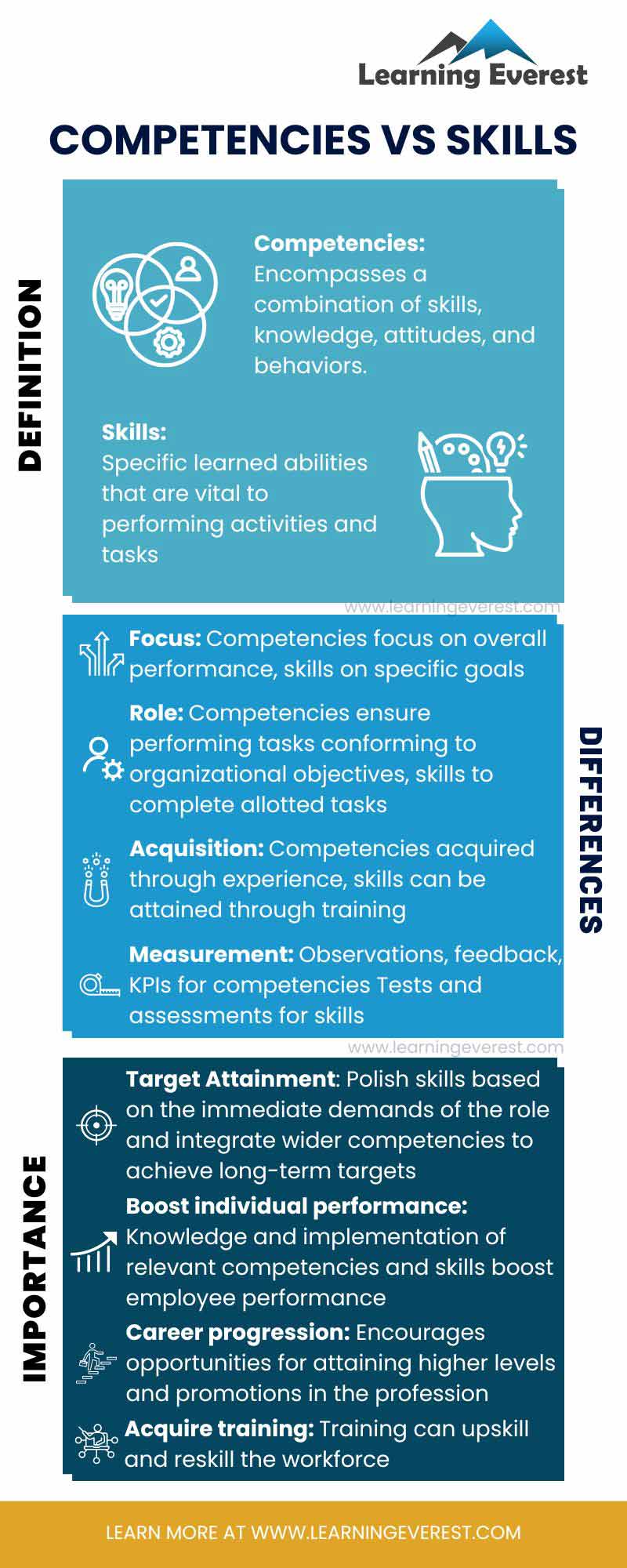
Competencies vs Skills
Knowledge Check!
Frequently Asked Questions (FAQs)
What are skills?
Skills are specific learned abilities that are vital to performing activities and tasks. Employees attain the skills needed for their workplace through training, experimentation, and experience.
What are competencies?
Competencies is a broader term that encompasses a combination of skills, knowledge, attitudes, and behaviors.
Are competencies and skills same?
Although the terms competencies and skills appear similar and are used interchangeably in many situations, there are significant differences between them. Competencies are broader abilities encompassing a combination of skills, knowledge, attitudes, and behaviors and are categorized as functional, organizational, and general competencies. Skills are specific learned abilities essential for a role categorized as soft skills and hard (technical) skills.
What are the differences between competencies and skills?
The major differences between competencies and skills are that competencies focus on overall performance while skills on specific goals, competencies ensure employees perform while conforming to organizational objectives and the role of skills is to complete allotted tasks and responsibilities, the manner of acquisition also varies that competencies are not learned but acquired through experience, and measuring the two; the former is difficult to measure while the latter can be measured easily.
Live Online Certification Trainings
Our Clients Our Work
