

AI in corporate training is revolutionizing workplace learning, much like its transformative impact across other industries. With growing concerns about the significant impact of AI and suspicions surrounding this rapidly evolving technology, learning and development professionals doubt the extent of the potential of AI in corporate training.
Table of Contents
If you are skeptical about the scope of integration of AI in corporate training, this blog will offer you significant insights into the role, challenges, benefits, and best practices of AI in corporate training. Read on!
Understanding the Role of AI in Corporate Training
AI plays a crucial role in global businesses that “83% of executives believe AI is a strategic priority for their businesses today.” (Source: Transforming Businesses with Artificial Intelligence, CISCO). In the field of corporate training, the role of AI is rising in content creation, development, delivery, and analysis of effectiveness. Generative AI such as Scribe, Synthesia, Vyond, Filmora, ChatGPT, GPT-3, and AI-generated text-to-speech systems designed to offer data and content from existing information are utilized by designing and developing effective content.
Integrating AI tools in LMSs to identify the learner’s needs and preferences can help personalize the courses. Regarding the delivery of the courses, some platforms offer real-time feedback and assessment, AI-powered virtual instructors for efficient tutoring sessions, and AI tools to analyze the efficiency of the training avoiding biases and human errors. Thus, AI plays an integral role in corporate training from content generation to execution and feedback.
Analyzing the Challenges of AI in Corporate Training
Even when AI has seamlessly integrated into the corporate training space, lingering uncertainties still challenge the effective implementation of AI-driven training. Some of these challenges are:
Ethical Considerations
Being machine intelligence, there are concerns regarding privacy and security, when AI processes personal data for assessing the learner needs. Moreover, the transparency of the data and over-reliance on technology with AI makes professionals hesitant to adopt this game-changer that eases their work. To ensure fairness in using AI in corporate training, organizations can implement data protection laws, and utilize open-source AI.
Human Intervention
Another major challenge posed by the implementation of AI in corporate training is the extent of human intervention in the entire process. According to LinkedIn Workplace Training Report 2024, “91% of L&D pros agree that human skills, or soft skills are increasingly important.” However, concerns such as whether the evolution of AI in designing, development, and delivery including AI instructors will replace human beings, and whether the machines understand human emotions and needs prevail. A valuable solution for this is to incorporate policies that bridge the gap between AI and human roles leading to the best outcomes.
Investment Costs
The investment costs of integrating AI in corporate training are high as it requires the purchase and integration of AI tools, infrastructure costs, training costs for existing employees, and recruiting new employees with the necessary skills. In addition, easy integration of the AI tools into the existing LMS along with the maintenance costs is a crucial challenge.
Translation Challenges
Accessibility of the training content across various global locations incorporating AI causes challenges such as literal translations without understanding the context leading to loss in translation, difficulty in translating industry and culture-specific jargon, and lack of emotions.
Exploring the Benefits of AI in Corporate Training
Although there are challenges in using AI in corporate training, these hurdles can be addressed through consistent strategies and by embracing the transformative benefits of AI. The major benefits of AI in corporate training are:
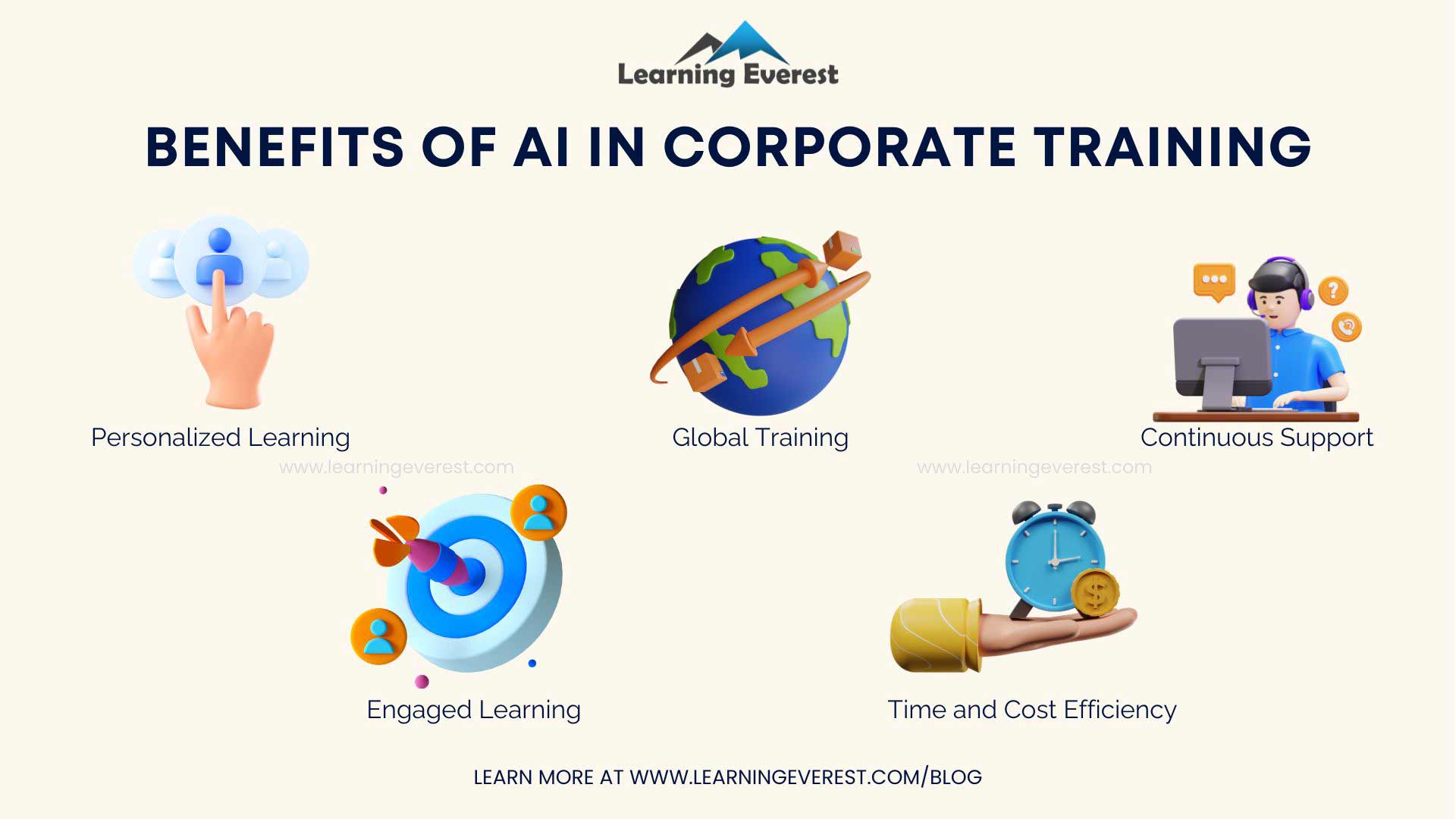
Benefits of AI in Corporate Training
Promotes Personalized Learning
AI provides a pathway to custom the learning experiences by analyzing the learners’ needs and aspirations and suggesting training courses, modules, and resources best suited for them—this automation recommends the content and adapting training modality based on learner style. With learners widely preferring personalized learning, “the global personalized learning market is estimated to surpass $2 billion by 2024.” (Source: IndustryArc). AI enhances customized learning experiences by easing corporate training opportunities.
Global Training
AI enables global training by overcoming geographical barriers in corporate training. Although there are significant challenges in translation using AI, it simplifies the human efforts in spending valuable time in translation. Machine learning technology like NLP (Natural Language Processing) has the application of text translation making the content available to diverse audiences. Moreover, AI supports accessibility helping learners from diverse backgrounds learn at their own pace.
Continuous Support
AI chatbots and virtual assistants offer 24/7 support to learners to clarify their doubts and concerns, gather feedback, and have real-time feedback on their assessments and assignments enabling continuous improvement. Furthermore, AI-enabled platforms allow the participants to share their insights on various aspects of their respective topics. AI can monitor the learner’s progress and the extent to which the desired outcomes are a
Engaged Learning
AI integrates interactive elements in the learning experience such as gamification, simulations, and scenario-based learning motivating learners to engage with the learning material. With elements such as leaderboards, badges, and other rewards gamification immerses learners in the learning experience. Simulations and scenarios offer real-world insights making the learners enjoy the learning process. In addition, AI-enabled AR and VR are largely gaining prominence in learning situations.
Time and Cost Efficiency
Integrating AI in corporate training offers time and cost efficiency by reducing the efforts of the designers and developers in creating learning content. Automating administrative tasks such as enrolling, scheduling sessions, and tracking learner progress reduces human efforts and offers time and cost efficiency. It further eliminates the significant sum spent on translation experts, voiceover artists, and even trainers to a certain extent. It ensures a smooth onboarding process enabling new hires to learn at their convenience.
Recognizing the Best Practices for AI in Corporate Training
AI-enabled corporate training yields the best outcomes in the overall design and delivery process. However, there are challenges and concerns regarding the smooth integration of the training that require resolution. Recognizing and adopting certain best practices is imperative in this regard. They are:
Appropriate Selection of Tools
To maximize the learning process’s outcome, select the best tools that suit the learner’s needs and styles. For instance, some courses require accessibility features as it is intended for diverse learners while some training programs integrate only video lessons, all depending on the learner preferences. When utilizing AI in corporate training, make sure to select the most appropriate tool suitable for the program.
Balance Human Element
Integrating the human element is essential when considering AI in corporate training to avoid the misinterpretation and misrepresentation that may arise due to automation and to eliminate ethical concerns. Professional expertise must be offered along with AI in addressing complex topics and issues and establishing an emotional connection with the learners.
Ensure Data Privacy
While providing AI with information to analyze the trends and ease administrative tasks, ensure that the data is protected using advanced encryption. The leadership should also ensure that the AI tools used are secure that avoid misuse of the personally identifiable information of the individuals.
Evaluation and Updation
AI tools should be evaluated and updated by analyzing the performance of the tools, updating for new features, and assessing the present tools to identify the gaps and collaborate with vendors for updates expected.
Conclusion
AI in corporate training offers various benefits such as promoting personalized learning, global training, continuous support, engaged learning, and time and cost efficiency. Nevertheless, integrating AI faces significant challenges including ethical considerations, human intervention, investment costs, and translation challenges that can be resolved using appropriate selection of tools, balancing the human element, ensuring data privacy, and offering continuous evaluation and updation.
Infographic
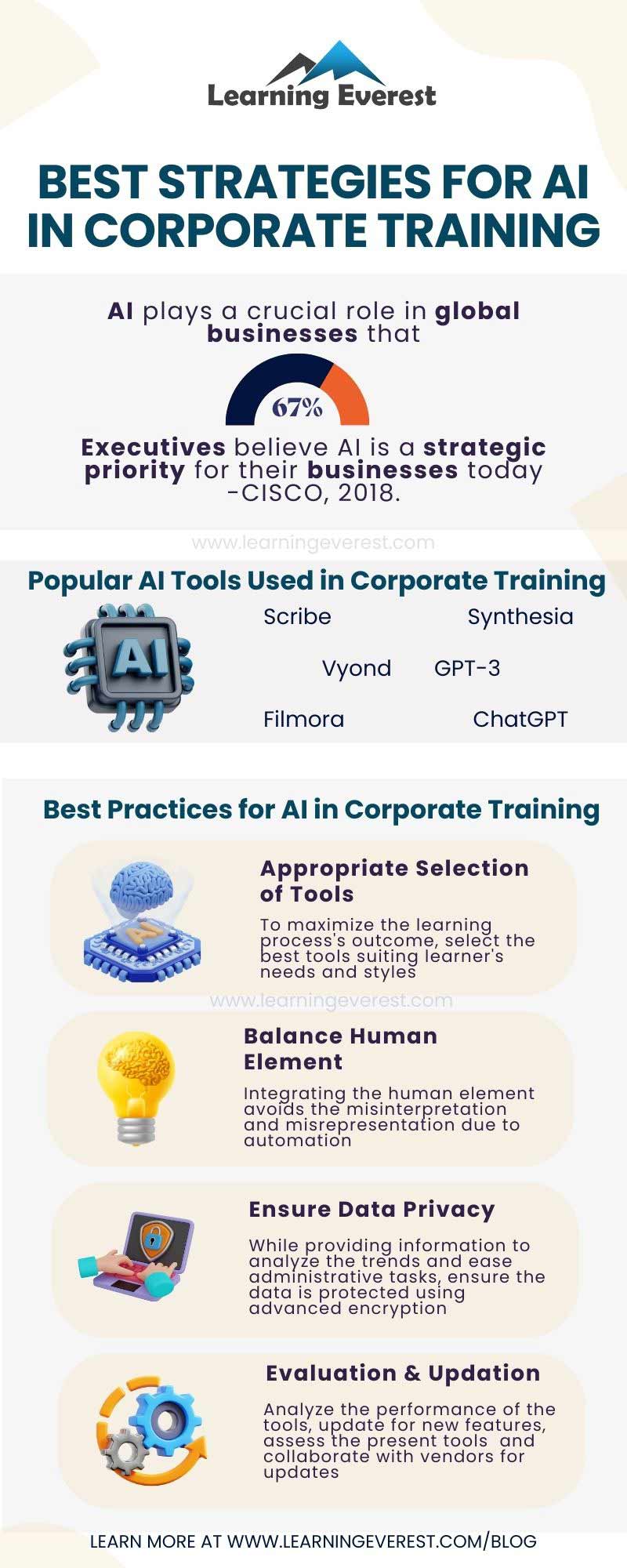
Best Strategies For AI in Corporate Training
Knowledge Check!
Frequently Asked Questions (FAQs)
What is the role of AI in corporate training?
Integrating AI tools in LMSs to identify the learner’s needs and preferences can help personalize the courses. Regarding the delivery of the courses, some platforms offer real-time feedback and assessment, AI-powered virtual instructors for efficient tutoring sessions, and AI tools to analyze the efficiency of the training avoiding biases and human errors. Thus, AI plays an integral role in corporate training from content generation to execution and feedback.
What are the challenges in implementing AI in corporate training?
Integrating AI faces significant challenges including ethical considerations, human intervention, investment costs, and translation challenges.
What are the benefits of implementing AI in corporate training?
AI in corporate training offers various benefits such as promoting personalized learning, global training, continuous support, engaged learning, and time and cost efficiency.
Live Online Certification Trainings




Our Clients Our Work
