

Organizations often experience significant changes that impact their operations, necessitating effective change management training. However, when such training is presented in a mundane or uninspiring way, it can lead to boredom and disengagement among participants, highlighting the need to incorporate interactive and engaging activities.
Table of Contents
The following paragraphs offer insights into seven powerful change management training activities that can be integrated into workplace training.
Why Change Management Training?
With organizations undergoing change in various forms such as technological advancements, shifting policies, sudden environmental disruptions, and global transformations, it can significantly impact operations, workforce dynamics, and strategic direction. Change management refers to an approach to face organizational change by supporting and guiding employees throughout the transition.
The Importance of Change Management Training
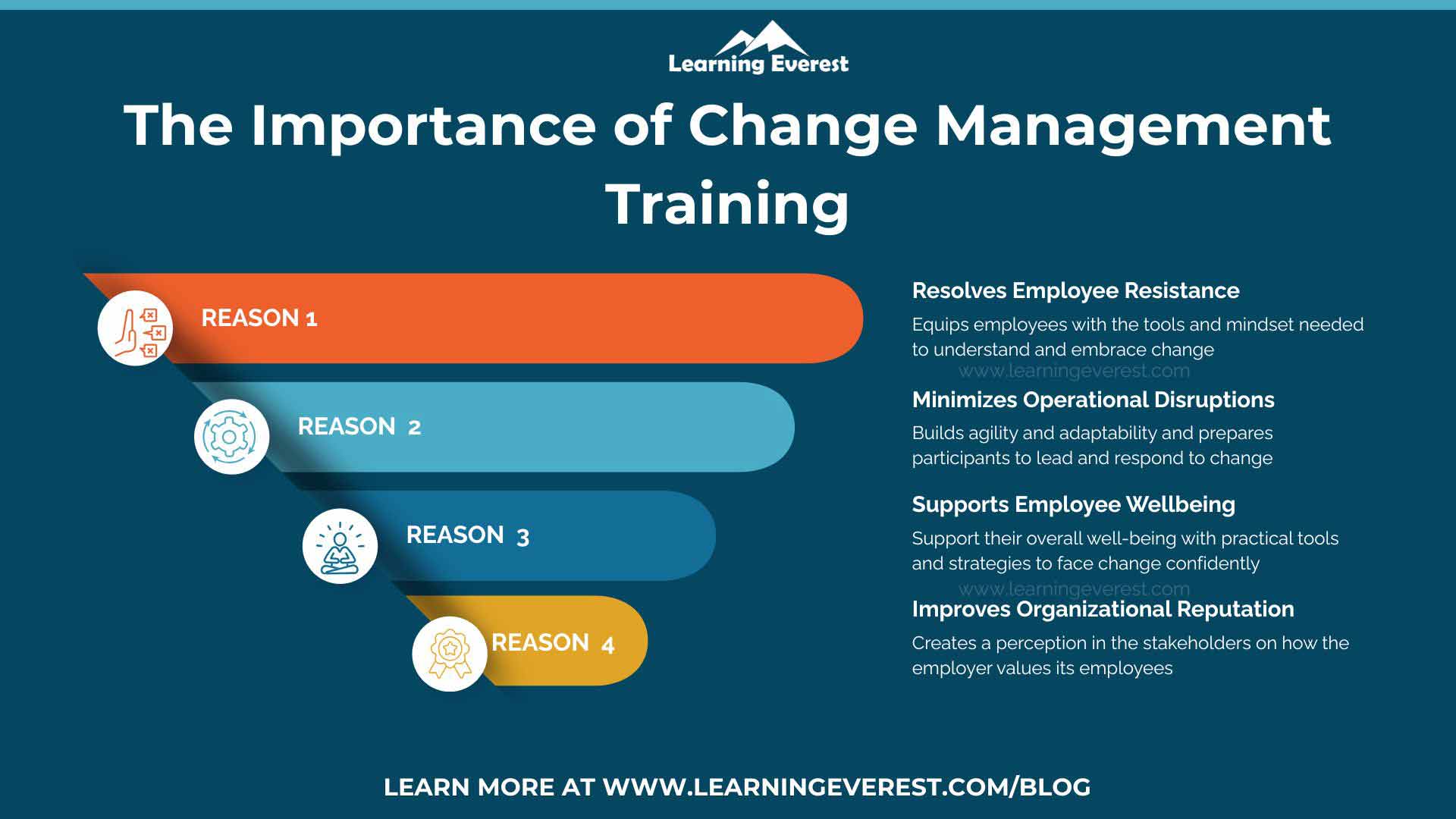
For change management to be effective, it is essential that both employees and top management to be aware of its importance and equipped to respond to change confidently. This underscores the need for comprehensive change management training that prepares all levels of the organization to adapt and thrive in the face of change. Change management training is critical because:
Resolves Employee Resistance
Many employees resist sudden changes within an organization due to a lack of awareness, mistrust, or fear of the unknown. Research suggests that “37% of employees are resistant to change” (Source: Oak Engage), highlighting a significant barrier to successful transformation. To address this challenge, organizations must invest in change management training that equips employees with the tools and mindset needed to understand and embrace change effectively.
Minimizes Operational Disruptions
Organizational changes can disrupt daily operations and hinder productivity of the human resources. However, implementing change management training can help minimize these disruptions by building agility and adaptability in both managers and employees. With the training, participants are better prepared to lead and respond to change effectively, ensuring smoother transitions and operational efficiency.
Supports Employee Wellbeing
According to a significant study by Gartner, “73% of change-effected employees report experiencing moderate to high levels of stress.” With change significantly impacting the stress levels of employees, it is essential to support their overall well-being during times of transition. Change management training plays a vital role in this process by equipping employees with practical tools and strategies to face change confidently. Furthermore, this training fosters resilience and promotes a healthier workplace.
Improves Organizational Reputation
By showcasing clear commitment to employee growth, change management training enhances organization’s reputation. It further creates a perception in the stakeholders on how the employer values its employees by offering them clear insights on managing change.
7 Impactful Change Management Training Activities
An engaging and well-designed training program is key to capturing learners’ interest and encouraging active participation. Here are seven impactful change management training activities that immerses the participants in the learning program through active learning.
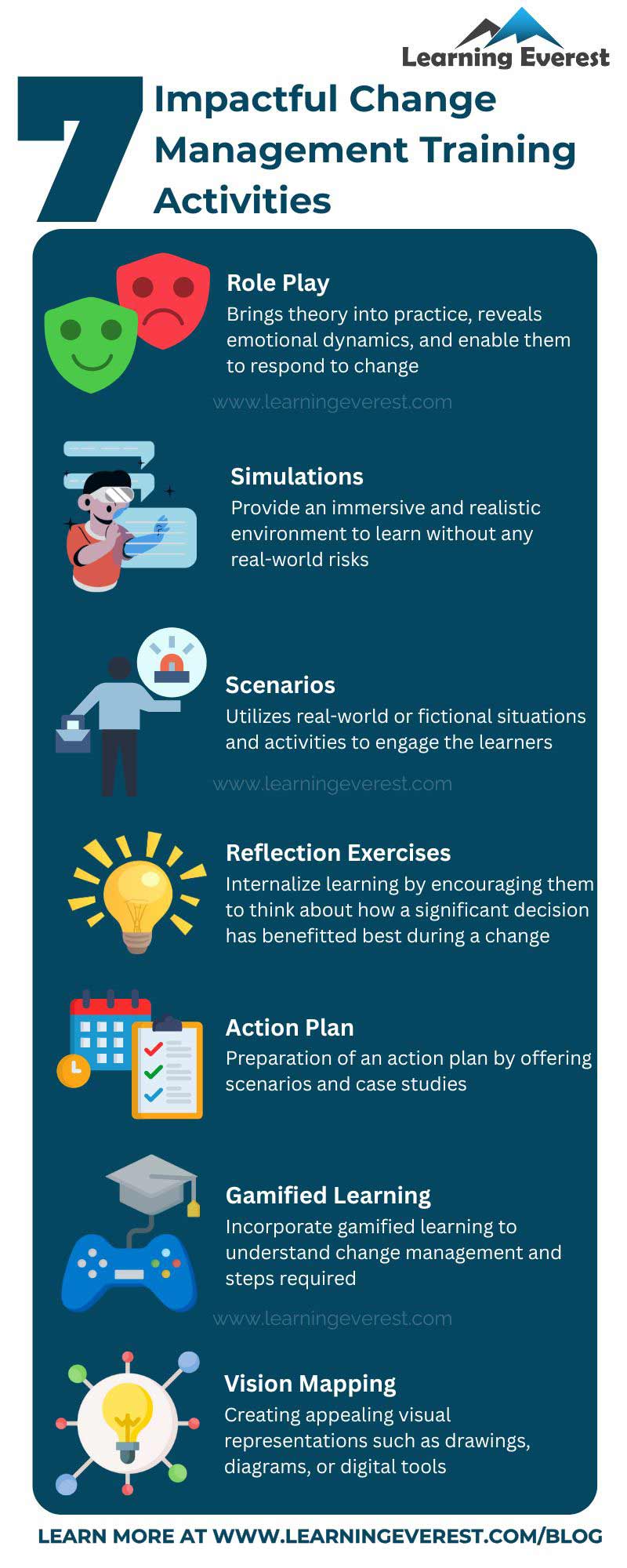
Role Play
Role play is an effective change management training activity that contribute to bringing theory into practice, reveals emotional dynamics, and enable them to respond to change. By providing roles and encouraging action, role play guides change management. For instance, when introducing a topic like Kubler Ross’ Change Curve Model, the five stages of grief, such as denial, anger, bargaining, depression, and acceptance can be best conveyed through role play.
Strategies Involved
- Assigning roles to each member in the learning process and change the roles.
- Providing facilitation or support during role play in clearly communicating the topic.
- Reflection based on what is learnt.
Benefits
- The realistic practice associated with role play enhances learning retention.
- Along with understanding change management, role play equips with the skills of communication skills, empathy, problem solving, and adaptability in participants.
- Role play enables training in a realistic, low risk setting.
Simulations
Simulations are powerful change management training activities that provide an immersive and realistic environment to learn without any real-world risks.
Strategies Involved
- Incorporating scenarios or situations and utilizing technology to mirror realistic scene.
- Real-time feedback on the engagement of the learner
- Data and Metrics to track the learnability of the learner in comprehending change management.
Benefits
- Promotes experiential learning where learners can better understand and retain knowledge.
- Offers situations that mimic the unpredictability and complexity of real organizational change, boosting confidence.
- Prepares participants to face real world challenges and how to incorporate solutions.
Scenarios
Scenario-based learning is a change management training activity utilizing real-world or fictional situations and activities to engage the learners. Some areas where scenarios can be utilized in change management training is to simulate change-related situations, situations demanding strong decision, and exploring consequences of resistance toward change.
Strategies Involved
- Utilizing learning situations and identifying the decisions.
- Role playing on how to face those situations along with feedback.
Benefits
- Encourages critical thinking on how to face a change situation.
- Prepares for real-world challenges by offering safe practice environments.
Reflection Exercises
Reflection exercises are activities that help participants internalize learning by encouraging them to think about how a significant decision has benefitted best during a change. It can involve self- assessment or deeper overall view on managing change.
Strategies Involved
- Pause and think about change management.
- Evaluate overall reactions to change.
- Asking structured questions to foster deep-level thought.
- Guided journaling on responses to thinking and internalizing lessons.
Benefits
- Reinforces learning with deep thinking.
- Enables to link insights into action.
Action Plan
Preparation of an action plan by offering scenarios and case studies is a relevant change management training activity that offers a platform to practice.
Strategies Involved
- Utilizing scenarios and case studies and building action plan.
- Planning how to incorporate resistance activities.
- Tracking key milestones and strategies.
Benefits
- Encourages critical thinking and strategic planning.
- Reinforce learning.
Gamified Learning
Incorporate gamified learning to understand change management and steps required. Some popular games include puzzle in the dark, cross your arms, fishbowl discussion, etc.
Strategies Involved
- Game elements such as points, levels, rewards, and challenges.
- Timed quizzes and knowledge checks that reinforces learning.
- Interactive simulations.
Benefits
- Increases learner engagement and promotes better retention.
- Handles resistance to change through gamified approach.
- Contributes to real-world decision-making.
Vision Mapping
Vision mapping is the process of creating appealing visual representations such as drawings, diagrams, or digital tools to clarify the change and make it easily understood.
Strategies Involved
- Brainstorming on the evident changes alongside the transition.
- Utilizing tools like flip charts, sticky notes, whiteboards, etc. to create a visual map of the vision.
Benefits
- Offers a clear picture on change management removing uncertainty.
- Easy reference to the learning material at every stage of the learning process.
Conclusion
In a nutshell, change management training is essential for every organization as it helps address employee resistance, minimizes operational disruptions, supports employee well-being, and enhances the organization’s reputation. To create an impactful learning experience, organizations should incorporate engaging change management training activities such as role plays, simulations, scenario-based learning, reflection exercises, action planning, gamified learning, and vision mapping. These activities not only immerse learners in the training process but also prepare them to face change confidently, reducing the resistance and disruptions often associated with sudden organizational changes.
Infographic
7 Impactful Change Management Training Activities
Knowledge Check!
Frequently Asked Questions (FAQs)
Why is change management training important?
Change management training is essential for every organization as it helps address employee resistance, minimizes operational disruptions, supports employee well-being, and enhances the organization’s reputation.
What are the change management training activities?
To create an impactful learning experience, organizations should incorporate engaging change management training activities such as role plays, simulations, scenario-based learning, reflection exercises, action planning, gamified learning, and vision mapping.
Live Online Certification Trainings



Our Clients Our Work
