

As industries adapt to rapid technological advancements and evolving workplace advancements, the role of learning and development has become increasingly crucial. The pharmaceutical industry is no exception, offering skills and knowledge to the professionals to stay updated and maintain quality.
Table of Contents
- Importance of Learning and Development in the Pharmaceutical Industry
- Key Areas of Learning and Development in the Pharmaceutical Industry
- Latest Trends of Learning and Development in the Pharmaceutical Industry
- Conclusion
- Infographic
- Knowledge Check!
- Frequently Asked Questions (FAQs)
- What is the importance of Learning and development in the pharmaceutical industry?
- What are the key areas of Learning and development in the pharmaceutical industry?
- What are the latest trends shaping Learning and Development in the pharmaceutical industry?
To gather insights on learning and development in the pharmaceutical industry highlighting its importance, areas covered, and latest trends, delve into the following paragraphs.
Importance of Learning and Development in the Pharmaceutical Industry
Learning and development are not restricted to training but also focus on empowering professionals with skills, offering orientation, and elevating employee engagement. In the pharmaceutical industry, learning and development is crucial for
- Informing employees about the regulatory requirements and knowledge about Good Manufacturing Practices (GMP), Good Distribution Practices (GDP), and pharmacovigilance.
- Equipping professionals to stay ahead of emerging trends in biotechnology, drug discovery, and other processes.
- Ensuring quality assurance and quality control along with thorough labeling of drugs, their uses, and adverse effects.
- Improving work efficiency and reducing delays.
- Addressing the growing demand for employees in specialized fields and offering upskilling.
Key Areas of Learning and Development in the Pharmaceutical Industry
Learning and development in the pharmaceutical industry offers specialization across multiple domains ensuring compliance and elevated operations. The key areas of learning and development in the pharmaceutical industry are:
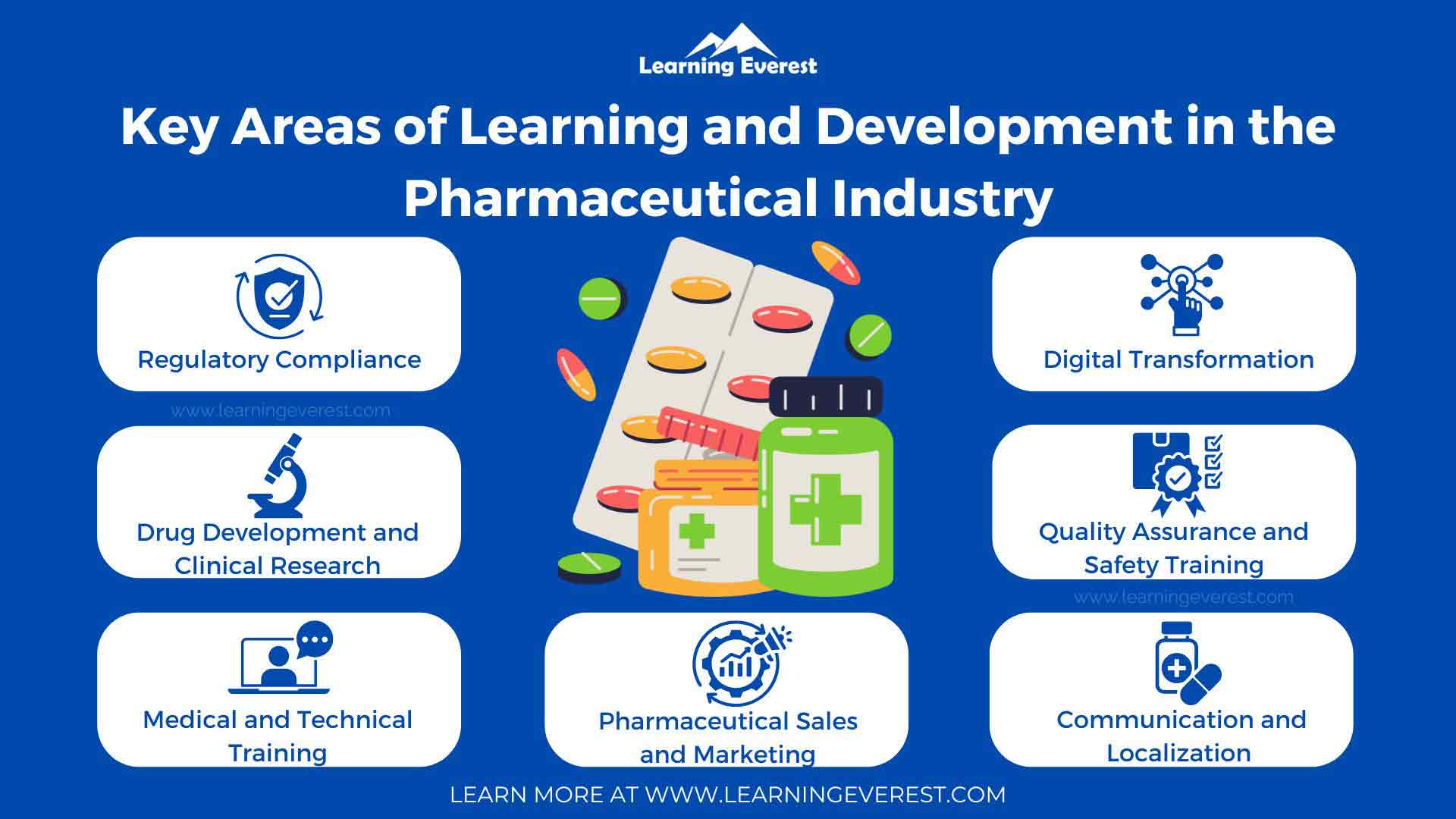
Key Areas of Learning and Development in the Pharmaceutical Industry
Regulatory Compliance
As the pharmaceutical industry operates within a strict framework to ensure ideal operations, it is vital for learning and development to design training that educates on compliance standards. Ensure the training maintains quality, integrity, and transparency while developing and distributing drugs. In addition to incorporating the compliance standards as per the region, innovative strategies to inform about GMP, Good Clinical Practice (GCP), Pharmacovigilance, and GDP for maintaining ethical practices. Moreover, informing the professionals on administrative practices such as new drug applications before the clinical trial of a new drug is crucial.
Drug Development and Clinical Research
Gathering, sorting, creating, designing, and delivering training content related to drug development and clinical research is key to learning and development in the pharmaceutical industry. This involves offering in-depth insights into preclinical and clinical trial design, gene expression, clinical data management, High-Throughput Screening (HTS), New Drug Application (NDA) process, etc.
Medical and Technical Training
A major area of focus of Learning and Development in the pharmaceutical industry is offering medical and technical training on the latest advancements in the field, along with the knowledge of terminologies related to the production of drugs such as ADMET (absorption–distribution–metabolism–excretion–toxicity) of drugs, small molecule products, pipeline drugs, in-line drugs, etc.
Pharmaceutical Sales and Marketing
Pharmaceutical sales and marketing involving ethical promotion and distribution of the drugs need to be included in the learning and development to prevent adverse event reporting, deal with Group Purchasing Organizations (GPOs), and integrate omnichannel marketing strategies.
Communication and Localization of Descriptions
Miscommunication in the pharmaceutical industry has adverse effects such as misunderstandings or even patient harm. Learning and development in the pharmaceutical industry equip professionals with the skills to clear and concise medical communication, perform medical translation, prepare product labels and packaging, and encourage meeting global standards.
Quality Assurance and Safety Training
Ensuring that the drugs are developed, manufactured, and distributed based on high-quality standards and preventing professionals from risks associated with manufacturing is imperative in the pharmaceutical sector. This includes equipping employees with skills to confirm that the products meet safety and quality standards and preventing Hazardous Chemical Reactions (HCR) using microbiological or chemical testing and HTS.
Digital Transformation in Pharma
Statistics suggest that “nearly 1.2 million jobs will be displaced in pharma by 2025 due to AI but 2.4 million new job roles will also emerge” due to digital transformation in pharma. (Source: Draup). Learning and development in the pharma should aid professionals in understanding utilizing machine learning to predict molecular properties, conduct AI-driven case studies, use Natural Language Processing, access digital health records, and understand technological innovations such as automated dispensing systems, 3D printing of medications, digital therapeutics, and pharmacogenomics (personalized medicine for creating medicine based on patient’s genetic makeup).
Latest Trends of Learning and Development in the Pharmaceutical Industry
With the surging changes in the pharma sector, companies need to invest in learning and development. To help professionals stay updated with pharmaceutical breakthroughs, learning and development should embrace the latest trends creating an immersive learning experience for the learners.
Artificial Intelligence
Artificial Intelligence is revolutionizing learning and development in the pharmaceutical industry by answering every query of the learners and offering an adaptive learning platform. Moreover, designers make use of NLP in content creation, utilizing AI-powered assets and automation for content authoring such as Articulate 360 (not fully AI-driven), and AI tools for content enhancement, narration, and gamification.
Immersive Learning Technologies
To enhance the engagement and retention of the participants, incorporating immersive learning technologies such as simulations, Virtual Reality, Augmented Reality, and Mixed Reality is important. These offer hands-on learning experiences in a risk-free environment where the learners can utilize AR/VR to learn in-depth drug manufacturing processes, drug discovery, and predicting drug behavior and toxicity.
Personalized Learning
Similar to other industries where one size doesn’t fit all, learning and development in the pharmaceutical industry must adopt personalized learning based on the needs and roles of the learners. This encourages individuals to identify their knowledge gaps and incorporate learning based on the learner’s preferences and prior knowledge.
Case Studies and Scenario-based Learning
Case studies and scenario-based learning is a trend that prepares learners to identify the real-world challenges in the pharma sector and overcome them. For instance, interactive scenarios for predicting risks or adverse effects and implementing pharmacovigilance strategies.
Microlearning
Microlearning is the learning process involving converting the content into short, easily digestible training content for learners to gather the knowledge easily and retain the information. For medical professionals undergoing training, microlearning enables them to consume the information at their convenience without disrupting work.
Collaborative Learning
Collaborative learning involves individuals learning together by sharing their knowledge and exchanging ideas, thereby enhancing comprehension. This can include discussion forums, interdisciplinary workshops, networking, etc, to share ideas and perspectives on every aspect of the pharma industry.
Conclusion
Learning and development in the pharmaceutical industry is essential for regulatory compliance, staying ahead of industry advancements, ensuring quality assurance, improving efficiency, and addressing the shortage of skilled professionals. The key areas include regulatory compliance, drug development and clinical research, medical and technical training, pharmaceutical sales and marketing, communication and localization, quality assurance and safety training, and digital transformation. The latest trends shaping Learning and Development in the pharmaceutical industry include AI-driven learning, immersive technologies like AR/VR, personalized learning, case studies and scenario-based training, microlearning, and collaborative learning.
These innovations enhance engagement, knowledge retention, and real-world application, ensuring professionals remain skilled and compliant. By integrating these approaches, pharmaceutical companies can build an effective workforce, improve operational efficiency, and drive innovation in drug development, distribution, and delivery. Embracing learning and development in the pharmaceutical industry enables professionals to have sound knowledge of drugs, comply with regulations, and deliver high-quality healthcare solutions.
Infographic
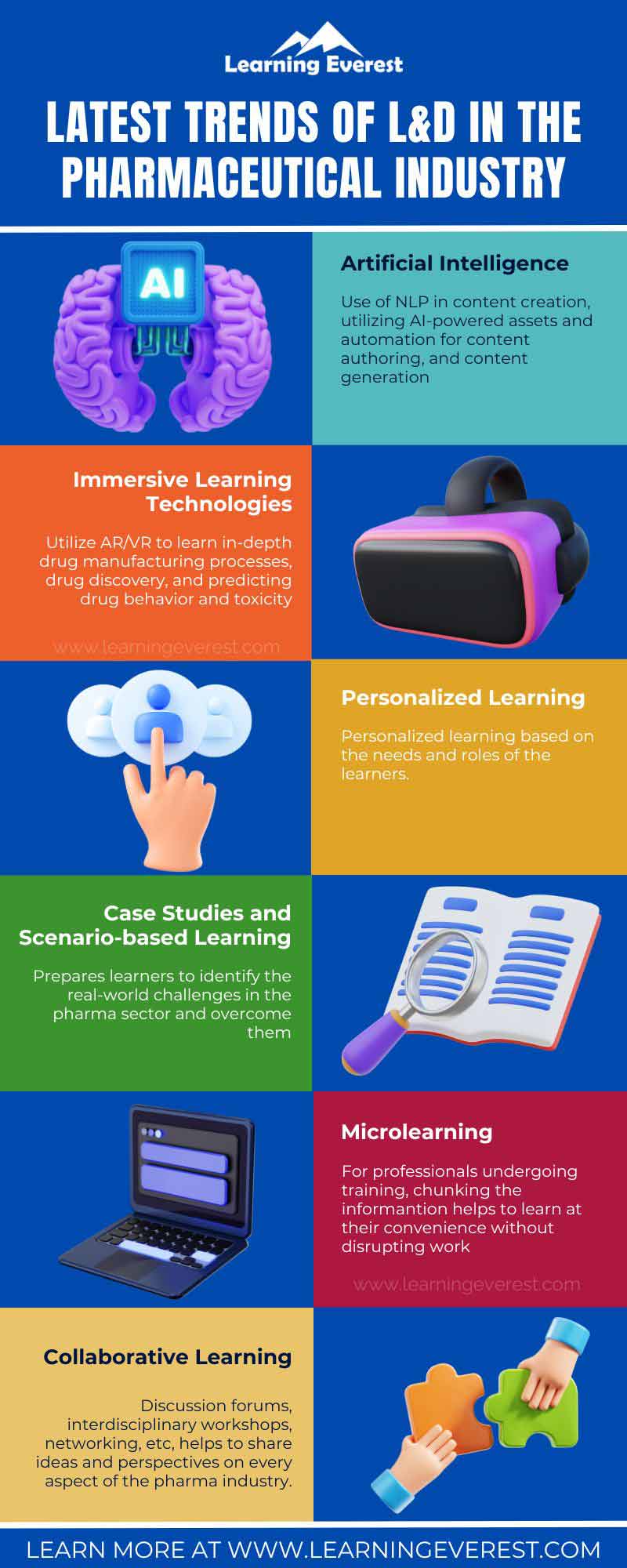
Latest Trends of Learning and Development in the Pharmaceutical Industry
Knowledge Check!
Frequently Asked Questions (FAQs)
What is the importance of Learning and development in the pharmaceutical industry?
Learning and development in the pharmaceutical industry is important for regulatory compliance, staying ahead of industry advancements, ensuring quality assurance, improving efficiency, and addressing the shortage of skilled professionals.
What are the key areas of Learning and development in the pharmaceutical industry?
The key areas include regulatory compliance, drug development and clinical research, medical and technical training, pharmaceutical sales and marketing, communication and localization, quality assurance and safety training, and digital transformation.
What are the latest trends shaping Learning and Development in the pharmaceutical industry?
The latest trends shaping Learning and Development in the pharmaceutical industry include AI-driven learning, immersive technologies like AR/VR, personalized learning, case studies and scenario-based training, microlearning, and collaborative learning.
Live Online Certification Trainings

Our Clients Our Work
