

Enterprise learning management system plays a significant role in efficiently managing training and development. But, how does it differ from traditional LMS? What are the distinct benefits offered by enterprise learning management systems? The following paragraphs will offer insights into enterprise learning management system, its difference from other LMSs, benefitsb, and best practices. Keep Reading!
Table of Contents
What is an Enterprise Learning Management System?
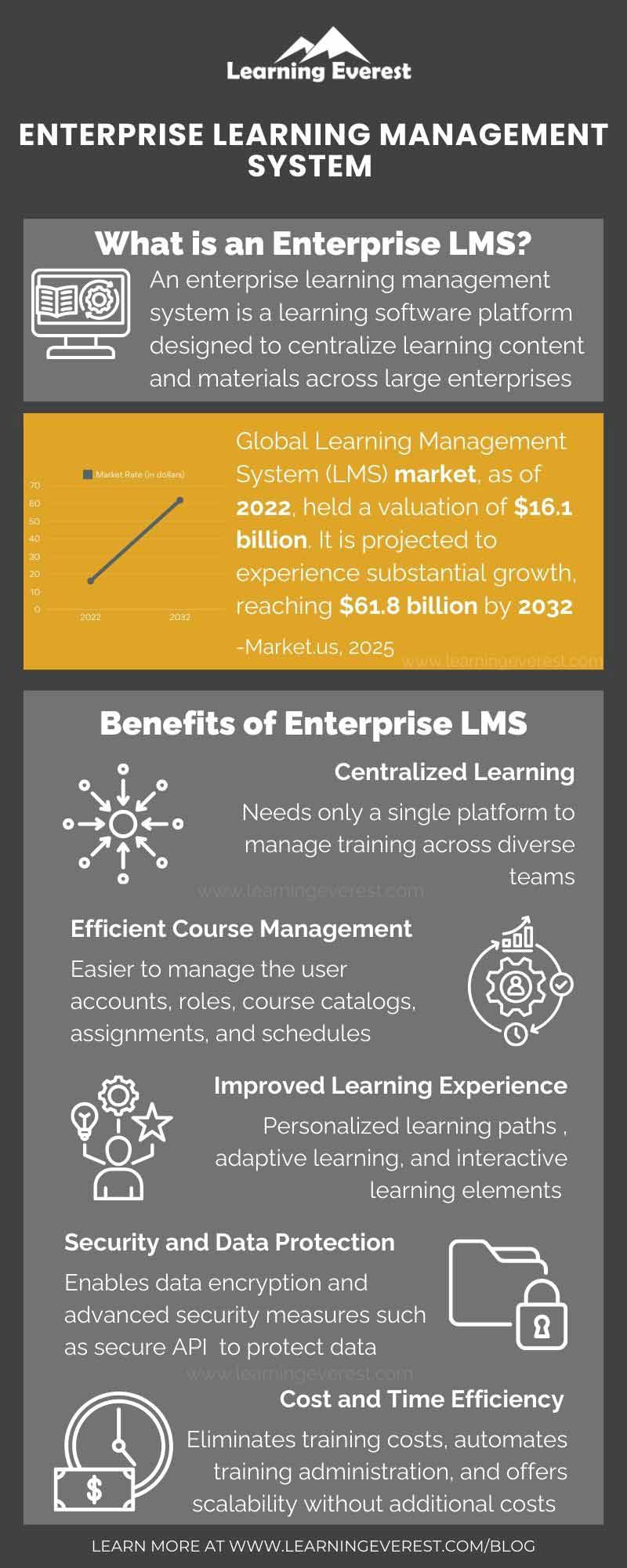
An enterprise learning management system is a learning software platform designed to centralize learning content and materials across large enterprises. With the ability to manage, deliver, and track training programs, “the global Learning Management System (LMS) market, as of 2022, held a valuation of $16.1 billion. It is projected to experience substantial growth, reaching $61.8 billion by 2032.” (Source: Market.us). Enterprise learning management systems are utilized in organizations to train employees, improve employee performance and career development, and standardize learning across departments, and regions. Apart from training employees and tracking their learning progress, an enterprise LMS handles complexity, is scalable, and integrates with large organizations’ needs.
Enterprise Learning Management System vs Basic LMS
To comprehend the distinct features of enterprise LMS, it is essential to distinguish it from basic LMS. The following are the major differences between the two.
Scalability
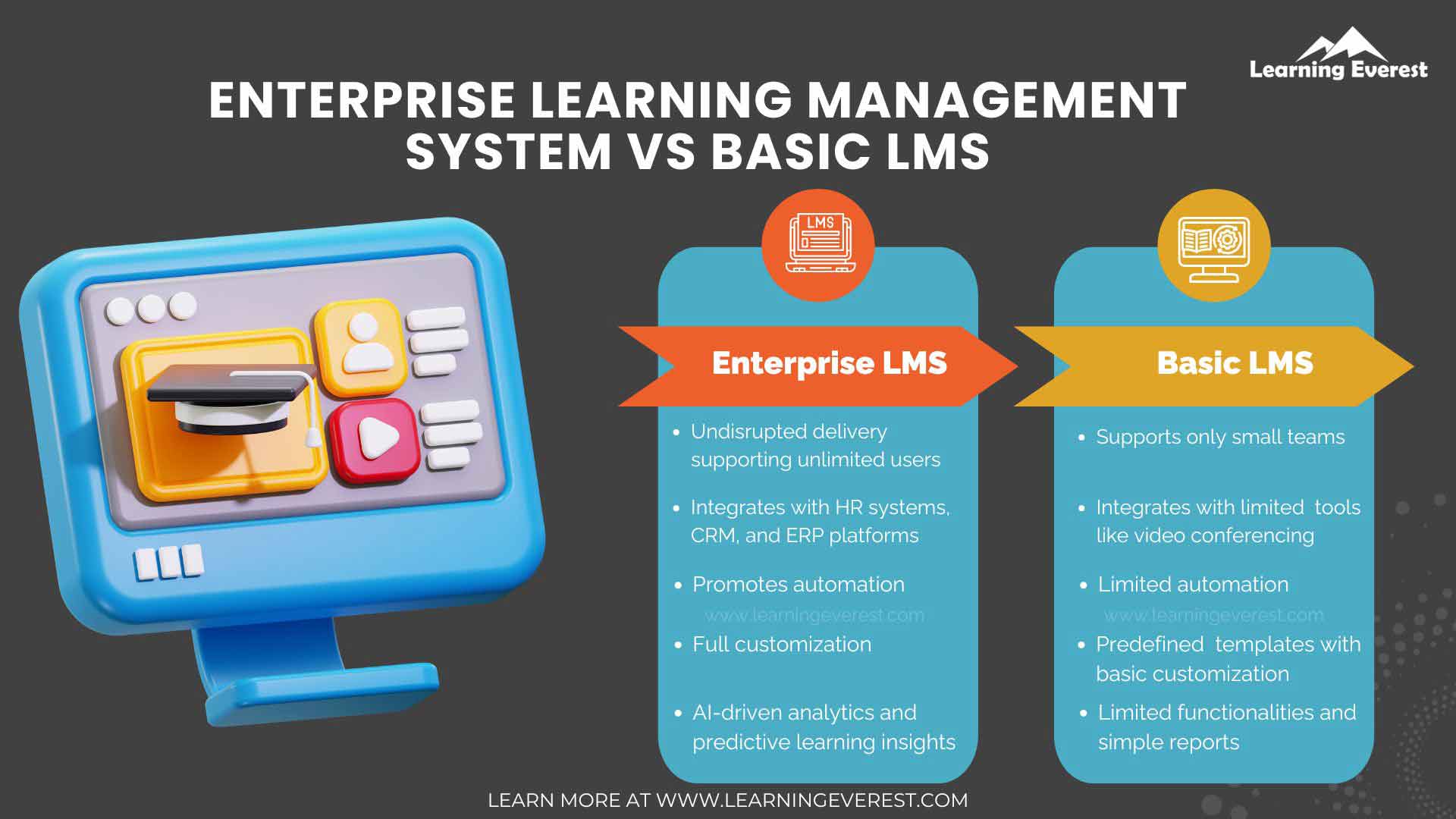
As enterprise-level organizations have large workforces across various departments and geographical locations, enterprise learning management system provides undisrupted training delivery supporting unlimited users. Moreover, it offers customized training portals for all stakeholders under a single roof. On the contrary, a basic LMS supports only small teams and a single learning environment.
Enterprise Learning Management System Vs Basic LMS
Integration
An enterprise learning management system fits into an enterprise software suite by integrating with HR systems, CRM tools, ERP platforms, and compliance management software enabling the training to sync with the performance of the employees. However, basic LMSs lack deep integrations but may integrate with limited third-party tools like video conferencing and basic HR software and therefore, rely on manual data entries for advanced tasks.
Automation
Basic LMSs often lack automation and AI-driven capabilities and are largely dependent on human feedback while enterprise LMSs promote automation in administrative tasks, provide AI-driven recommendations, automate training schedules, and monitor progress.
Course Management and Customization
While basic LMS could only provide predefined templates with basic customization for course creation, the enterprise learning management system supports full customization including personalized learning paths, gamification, and collaboration tools.
Reporting and Analytics
Limited functionalities and offering simple reports about learner progress and course completion are associated with basic LMS. On the other hand, enterprise LMS features AI-driven analytics, and predictive learning insights to track performance and course effectiveness.
Benefits of Enterprise Learning Management System
Understanding the differences between basic LMS and enterprise learning management systems reveals the latter’s benefits. Here are the benefits offered by enterprise learning management systems.
Centralized Learning
The major benefit of enterprise LMS is that it needs only a single platform to manage training across diverse teams and locations resulting in consolidating training materials, and standardized learning along with providing opportunities for localization. Moreover, it is scalable to support thousands of users across different locations and can easily adapt to the changing training needs of diverse learners.
Efficient Course Management
Another critical benefit of an enterprise learning management system is that makes it easier for organizations to manage the user accounts, roles, course catalogs, assignments, and schedules offering the best learning experience to the learners. In addition, it ensures quick distribution of new courses, offers updations of already existing content, and provides continuous support to learners across different locations.
Improved Learning Experience
An enterprise learning management system improves the learning experience by embracing technology, automation, and analytics. This includes personalized learning paths supporting self-paced learning and aligning to the skills and progress of the learner, adaptive learning, interactive learning elements such as advanced gamification, AR/VR integration, scenarios, and videos, mobile learning, remote training, instant feedback, and AI-powered recommendations.
Security and Data Protection
Protection of personally identifiable information and performance data is a major concern of employees while managing large-scale training programs. An enterprise LMS protects sensitive employee data, and training content by enabling data encryption and advanced security measures such as secure API to ensure protection against cyber threats.
Cost and Time Efficiency
Organizations benefit in saving valuable cost and time by eliminating training costs supporting self-paced and automated learning, pre-built integrations offering quick implementation, automating training administration reducing admin workload by offering self-enrollment and automated progress tracking, and offering scalability without additional costs. Furthermore, the highly engaging and structured training experience ensures knowledge retention and productivity leading to reduced employee turnover and better job performance promoting cost savings.
Best Practices in Enterprise Learning Management System
Although these significant benefits affirm the necessity of implementing an enterprise learning management system, there are certain challenges it faces such as employee resistance, fear of system downtime and performance issues, and cybersecurity threats hindering the effective utilization of this LMS. Here are some best practices for ensuring smooth integration of enterprise learning management systems.
- Align LMS with overall business goals and customize training depending on the roles, geographies, departments, skills, and learning styles of the learner.
- Monitor enrolment, training progress, completion rates, and engagement tools used through real-time analytics and update content accordingly.
- Provide comprehensive training to all stakeholders on LMS features by incorporating interactive tutorials, step-by-step instructions, and FAQs. Moreover, provide mentorship support, if necessary.
- Ensure the selected LMS vendor provides all the support and features needed for your enterprise. Furthermore, pilot tests the LMS with a potential group before full implementation.
- Enable a responsive design to optimize the enterprise learning management system for different screen sizes such as mobile, tablet, or desktop.
- Offer offline access to the LMS to encourage enhanced learning despite the location.
- Encourage collaborative and peer learning by providing discussion forums, peer assessments, and group work.
- Stay updated with the latest trends in LMSs to implement the new features that benefit the workforce.
Conclusion
In a nutshell, an enterprise learning management system is designed to centralize learning content and materials across large enterprises. The basic differences between enterprise LMS and basic LMS are that an enterprise learning management system provides undisrupted training delivery supporting unlimited users while basic LMS supports only small teams and a single learning environment.
An enterprise learning management system fits into an enterprise software suite by integrating with HR systems, CRM tools, ERP platforms, and compliance management software while basic LMSs lack deep integrations, enterprise LMSs promote automation that is lacking in basic LMS, enterprise learning management system supports full customization when basic LMS have only limited templates, enterprise LMS features AI-driven analytics, and predictive learning insights to track performance which is not possible to extent for basic LMS.
Enterprise LMS comes with benefits such as centralized learning, effective course management, improved learning experience, security and data protection, and cost and time efficiency. Even though there are challenges organizations face in implementing the LMS, relying on certain best practices is a valuable solution. It is recommended that large organizations adopt enterprise LMSs for smooth functioning in their enterprise leading to higher productivity.
Struggling to find the LMS that suits your needs or customizing your LMS? Connect with us!
Infographic
Enterprise Learning Management System Infographic
Knowledge Check!
Frequently Asked Questions (FAQs)
What is an enterprise learning management system?
An enterprise learning management system is a learning software platform designed to centralize learning content and materials across large enterprises.
What are the benefits of an enterprise learning management system?
Enterprise LMS comes with benefits such as centralized learning, effective course management, improved learning experience, security and data protection, and cost and time efficiency.
How is enterprise LMS different from basic LMS?
The basic differences between enterprise LMS and basic LMS are that an enterprise learning management system provides undisrupted training delivery supporting unlimited users while basic LMS supports only small teams and a single learning environment, enterprise learning management system fits into an enterprise software suite by integrating with HR systems, CRM tools, ERP platforms, and compliance management software while basic LMSs lack deep integrations, enterprise LMSs promote automation that is lacking in basic LMS, enterprise learning management system supports full customization when basic LMS have only limited templates, enterprise LMS features AI-driven analytics, and predictive learning insights to track performance which is not possible to extent for basic LMS.
Live Online Certification Trainings

Our Clients Our Work
