

AI in pharma is transforming every facet of the industry revolutionizing workflows, minimizing human effort, and safeguarding operations. The pharmaceutical sector is ever-growing, bringing with it numerous innovations and challenges that underscore the importance of effective training.
Table of Contents
If you are a professional yearning to gather insights on how AI in pharma benefits employee training, this blog discusses the areas of the pharmaceutical industry where AI-enabled training is required, the challenges commonly faced in the sector, and overcoming these challenges.
Key Areas of Training with AI in Pharma Industry
The pharmaceutical industry allocates employee training to essential areas, aligning with their roles and operational needs. According to the EY Parthenon-OPPI Report, “India’s pharma sector is set for explosive growth, 79% of CXOs see AI/ML as key.” These include drug development training, regulatory compliance, quality assurance and control, medical and technical skills training, use of digital tools, safety training, GMP training, and sales and marketing training. Integration of AI has a significant impact on all these training areas, benefitting the employees and the organization.
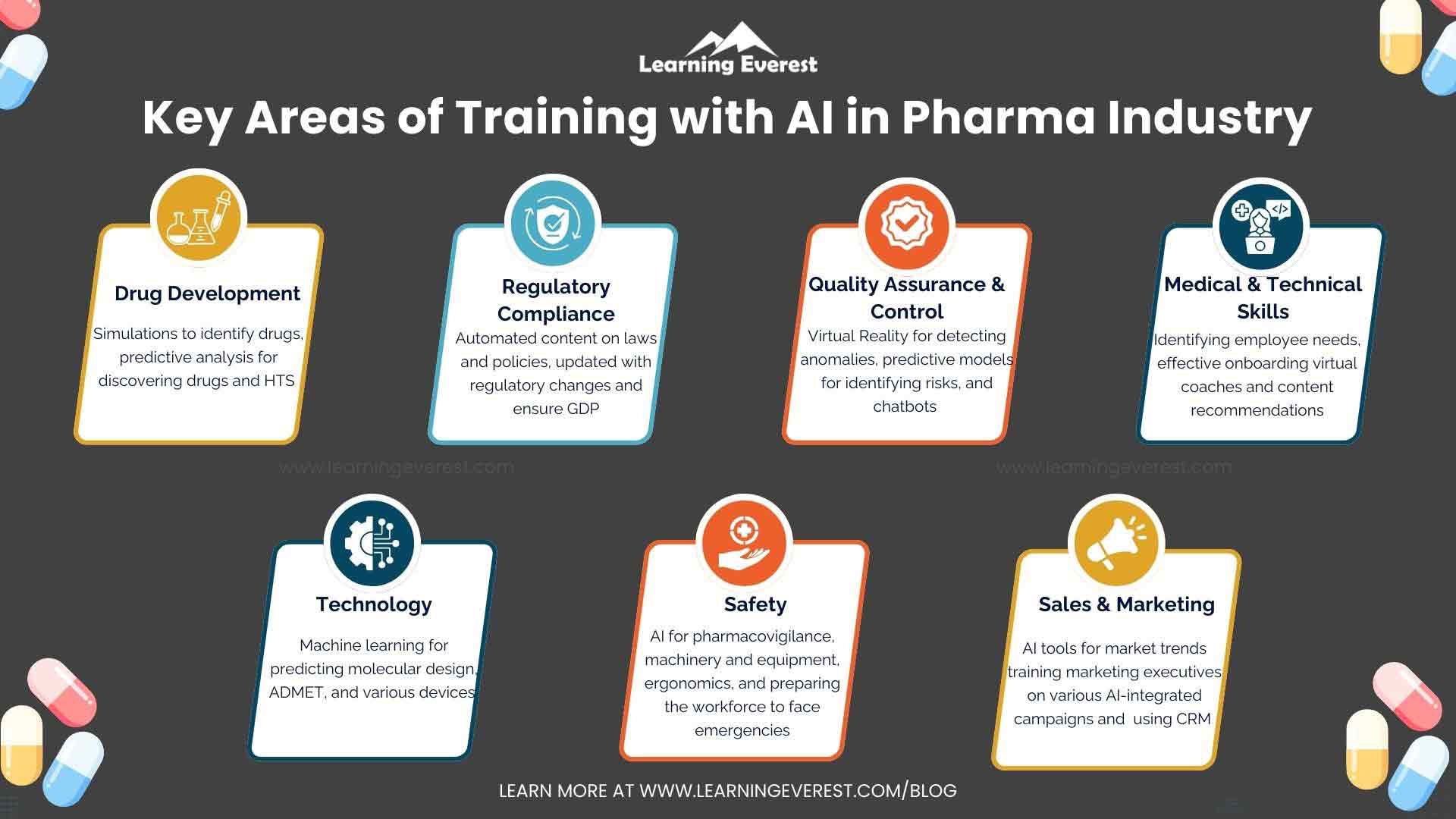
Key Areas of Training With AI in Pharma Industry
AI in Drug Development Training
Drug development training focuses on the stages of drug discovery, predicting the molecular properties, clinical trial design, approval, and manufacturing. AI can be integrated into drug development training to equip the workforce with the skills to effectively perform these tasks. These can include simulations to identify drugs, utilizing predictive analysis for discovering drugs, how to manufacture the finished product including the small and large molecular products, and conducting High Throughput Screening (HTS) for drug discovery using advanced AI.
AI in Regulatory Compliance Training
Pharma organizations must adhere to the laws, rules, regulations, and policies of the FDA (Food and Drug Administration) or similar global agencies. To equip the employees on compliance, AI can be integrated into compliance training through interactive scenarios, automated content on different laws and policies, practicing AI to avoid fraudulent activities, staying updated with regulatory changes and ensure Good Distribution Practice (GDP), and creating rules and regulations for Group Purchasing Organizations (GPO) such as hospitals.
AI in Quality Assurance and Control Training
Along with compliance training, Quality Assurance and Control are crucial components in the pharma industry. It involves preventing defects from occurring and identifying and eliminating defects. AI in pharma training involving Virtual Reality for detecting anomalies in product development, predictive models for identifying threats and future risks, and AI-powered chatbots and virtual assistants providing feedback to learners helping them eliminate their doubts. GMP training is an aspect of Quality Assurance training that includes hygiene practices, documentation, record-keeping, and equipment maintenance that can be enhanced through AI.
AI in Medical and Technical Skills Training
Medical and technical skills training is vital for equipping professionals with required and updated knowledge in the pharmaceutical industry. This includes both personalized and group training on drug knowledge, clinical trials, and laboratory instruments. Integrating AI by incorporating personalized learning paths by identifying the needs of employees, encouraging effective onboarding through skills training, virtual coaches to offer insights, and offering content recommendations for upskilling.
AI in Technology Training
Digital tools form an indispensable part of the pharmaceutical industry. It is imperative that the employees need to be proficient in using technology-oriented tools and devices, thereby highlighting the training need. Integrating AI in on-the-job training is the best strategy by enabling automated experiences to learn the workings of devices such as chromatography devices, spectrometers, and drug dispensers and providing real-time assistance in using them. Many pharmaceutical companies use AI to perform their roles like machine learning for predicting molecular design, and ADMET (Absorption, Distribution, Metabolism, Excretion, and Toxicity).
AI in Safety Training
Another critical training that involves AI in pharma is safety training for ensuring a safe and protective work environment. These can involve AI-integrated case studies, AR/VR scenarios, and tools for hazard identification and prevention. The safety training can encompass pharmacovigilance, chemical and biological safety, machinery and equipment, ergonomics, and preparing the workforce to face emergencies. For instance, the pharma industry can face HCR (Hazardous Chemical Reaction) which needs preparedness to avoid and prevent such incidents.
AI in Sales and Marketing Training
Similar to production, design, and manufacturing training, sales and marketing training is imperative to the pharma sector. This can be enhanced by utilizing AI tools to gather data on market trends and customer behaviors, training marketing executives on various AI-integrated campaigns that would benefit them, and practical insights on using CRM to personalize medicines. Concerning the pharmaceutical market, studies suggest that “from 2024 to 2028, the market is projected to experience an annual growth rate of 5.96%.” (Source: Statista).
Challenges of AI in Pharma Training
Pharmaceutical industry training faces a wide range of challenges such as problems with onboarding new hires, retaining existing employees, burnout, and lack of readiness to upskill. AI in pharma training can resolve these challenges to an extent, yet faces significant challenges themselves.
AI in Pharma Training #Challenge 1: Data Privacy
A major concern of integrating AI in pharma training is handling the personal data of the employees as many AI-driven platforms have cloud storage, and can therefore encounter cyberattacks. In addition, incorporating AI solutions from third-party vendors leads to misuse of personally identifiable information of the individuals.
AI in Pharma Training #Challenge 2: High Costs
Incorporating AI-driven practices and tools is of high cost and can create budgetary concerns in employers while traditional training delivery systems are not that costly. For instance, simulations using AI are effective but are a pricy affair. This prevents learning and development professionals from refraining from AI tools in pharma industry training.
AI in Pharma Training #Challenge 3: Adherence to Pharmaceutical Regulations
AI in pharma training sometimes fails to adhere to global pharmaceutical regulations such as FDA as the algorithms might not comply with the global standards and fail to provide appropriate documentation. Moreover, overreliance on AI can result in flaws leading to violation of regulations.
Overcoming Challenges of AI in Pharma Training
For every challenge, there is a solution. Similarly, for the challenges of AI in pharma training there are valuable solutions to overcome them. They are:
Overcoming Challenges of AI in Pharma Training #Solution 1: Secure AI
Ensure that the AI platforms and solutions offered are secure and encrypted to mitigate the risk of misuse of data. Utilization of blockchain technology is a solution for reducing fraudulent activity when gathering credentials. Furthermore, creating awareness in the employees regarding the AI solutions and gathering their consent is a priority.
Overcoming Challenges of AI in Pharma Training #Solution 2: Customize Training
Customizing training solutions according to the expected ROI is a significant solution for budgetary concerns. Cost-effective open AI platforms and modular training systems can resolve the issue of spending huge sums on the implementation of the tools. Nonetheless, considering the amount and effort spent on creating and designing content on other software without AI integration or the mundanity associated with traditional training, AI is a boon.
Overcoming Challenges of AI in Pharma Training #Solution 3: Adhere to Regulations
Utilizing AI models in training that offer transparent solutions and seeking the help of experts in legal and compliance can ensure adherence to training regulations.
Conclusion
Incorporating AI in pharma training is a great boon to the industry to onboard, reskill, and upskill employees. However, ensure the judicious utilization of Artificial Intelligence in training programs considering the potential risks and solutions.
Infographic
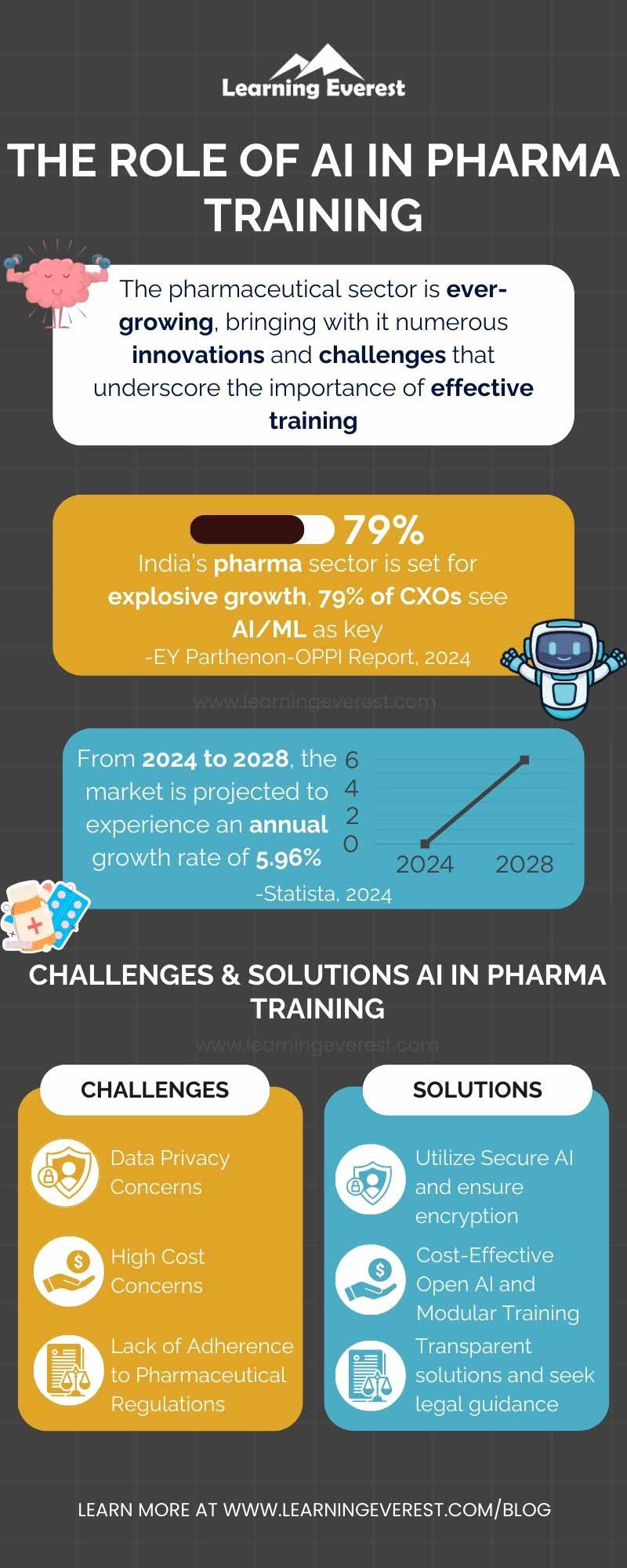
The Role of AI in Pharma Training
Knowledge Check!
Frequently Asked Questions (FAQs)
What are the key areas of training in pharma industry?
The key areas are drug development training, regulatory compliance, quality assurance and control, medical and technical skills training, use of digital tools, safety training, GMP training, and sales and marketing training.
What are the challenges of AI in pharma training?
The challenges of AI in pharma training are high costs, data privacy, and lack of adherence to global pharmaceutical regulations.
Live Online Certification Trainings
Our Clients Our Work
