

Mental health plays a vital role in workplace productivity, yet it is often overlooked. Employees face overwhelming conflicts, workplace conflicts, and constant pressure, straining their mental well-being. This underscores the need to implement mental health training for employees to foster a healthier workforce.
Table of Contents
- What is Mental Health Training for Employees?
- Key Areas of Mental Health Training for Employees
- Benefits of Mental Health Training for Employees
- Practical Steps for Implementing Mental Health Training for Employees
- Conclusion
- Infographic
- Knowledge Check!
- Frequently Asked Questions (FAQs)
- What is mental health training for employees?
- What are the key areas of mental health training for employees?
- What are the benefits of mental health training for employees?
This blog explores what mental health training for employees is, its key areas, benefits, and the practical steps for implementing mental health training for employees. Keep Reading!
What is Mental Health Training for Employees?
Mental health training for employees is a workplace program designed to train the workforce about factors affecting mental health along with creating awareness to tackle them. With “40% of employees saying their jobs have a negative impact on their mental health” (Source: Gallup), mental health training equips them with the skills to handle workplace challenges, prepare for self-care, and support colleagues, thereby creating a thriving workplace environment.
Key Areas of Mental Health Training for Employees
The effectiveness of every training program lies in its ability to address every aspect of the topic. In this regard, effective mental health training addresses the key areas to educate employees in enhancing their overall well-being. The major areas include:
Mental Health Awareness
A fundamental area of mental health training for employees enables them to understand different mental health issues, recognize early signs of burnout and depression, and when and where to reach out.
Stress Management
Enabling individuals to recognize, control, and reduce stress and maintain their physical and mental well-being. Proper training enables employees to identify common stress triggers such as conflicts, deadlines, and workloads and develop coping strategies.
Overcoming Stigma
Stigma refers to a level of prejudice, misunderstanding, unequal treatment, or discrimination toward people with mental health challenges leading to difficulty in openly seeking professional help or discussing their struggles. According to a McKinsey Quarterly published in 2021, “three out of four employees indicated that stigma was present in their workplace.” Mental health training for employees encourages them to break misconceptions, promote open dialogues, reduce discrimination, and seek help.
Work-life Balance and Time Management
Work-life balance and time management are key aspects of mental health training for employees that educate them to prioritize tasks, effective planning to reduce stress from deadlines, and promoting flexible work arrangements leading to job satisfaction.
Mindfulness and Resilience Building
Equipping employees with the focus and clarity to navigate workplace challenges needs to be addressed in the training. Furthermore, the training contributes to developing a growth mindset and problem-solving skills leading to enhanced emotional strength.
Gathering and Offering Support
Apart from self-care, mental health training for employees instills in them the ability to support others in need. By creating safe places that encourage open discussions, employee resource groups, and other support networks, the training enables employees to seek support in need. Furthermore, with a keen knowledge of different mental health issues, they will be equipped to recognize warning signs in their peers, listen to their concerns, and guide them to professional help depending on their concerns.
Mental Health Laws
An essential aspect of mental health training for employees is generating an understanding of mental health laws. It elaborates on the rights and protection of employees and the key responsibilities of employers in ensuring the workforce’s well-being.
Benefits of Mental Health Training for Employees
Investing in mental health training for employees benefits both the individuals and the organization alike. With the training aiming to recognize, manage, and address the mental health concerns of employees, it promotes an impactful work environment. Here are some of the benefits of mental health training for employees.
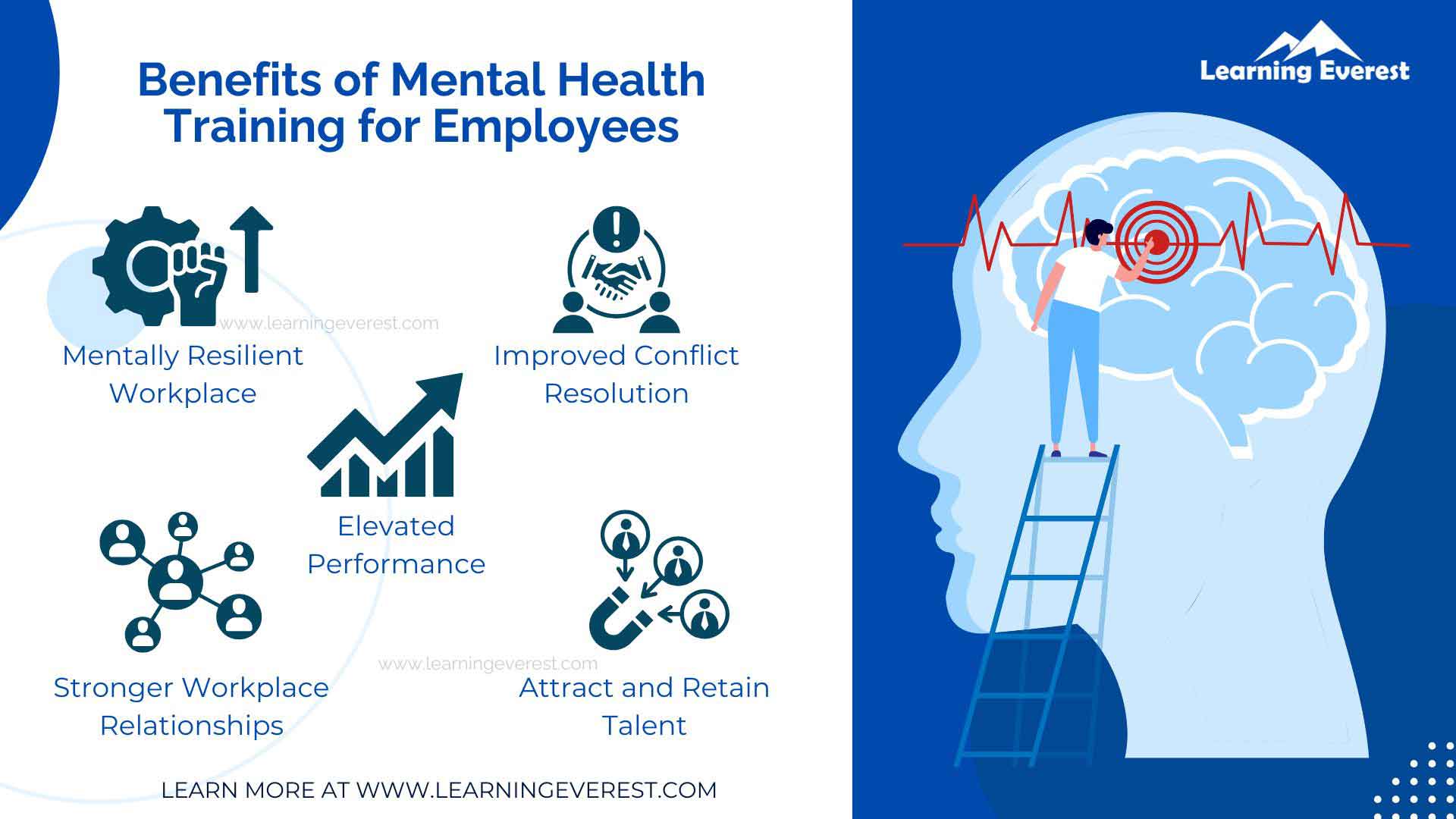
Benefits of Mental Health Training for Employees
Mentally Resilient Workplace
Mental resilience can be defined as the ability to adapt, recover, and thrive in situations of challenges and adversity. Through effective mental health training for employees, they gather the strength to manage setbacks, be prepared to face crises and maintain emotional stability even under pressure.
Improved Conflict Resolution
A harmonious workplace is one where conflicts are resolved constructively without escalating. With mental health training that regulates the emotions of employees, the instances of conflicts as a result of stress and burnout can be prevented. In addition, it improves the communication skills of employees enabling active listening and possessing empathy to understand others’ issues resolving conflicting situations.
Elevated Performance
When employees attain work-life balance, reduced stress, and mindfulness, it directly impacts their performance by letting them stay focused and bringing forth innovation.
Stronger Workplace Relationships
Employees learn to listen with empathy and communicate their concerns as a result of mental health training paving the way for open communication that fosters trust. Moreover, with awareness in the employees and the leadership to support each other, the workforce develops emotional connections and builds relationships.
Attracting and Retaining Talent
Promoting a safe and supportive environment increases employee retention and attracts top talent seeking a positive workplace culture.
Practical Steps for Implementing Mental Health Training for Employees
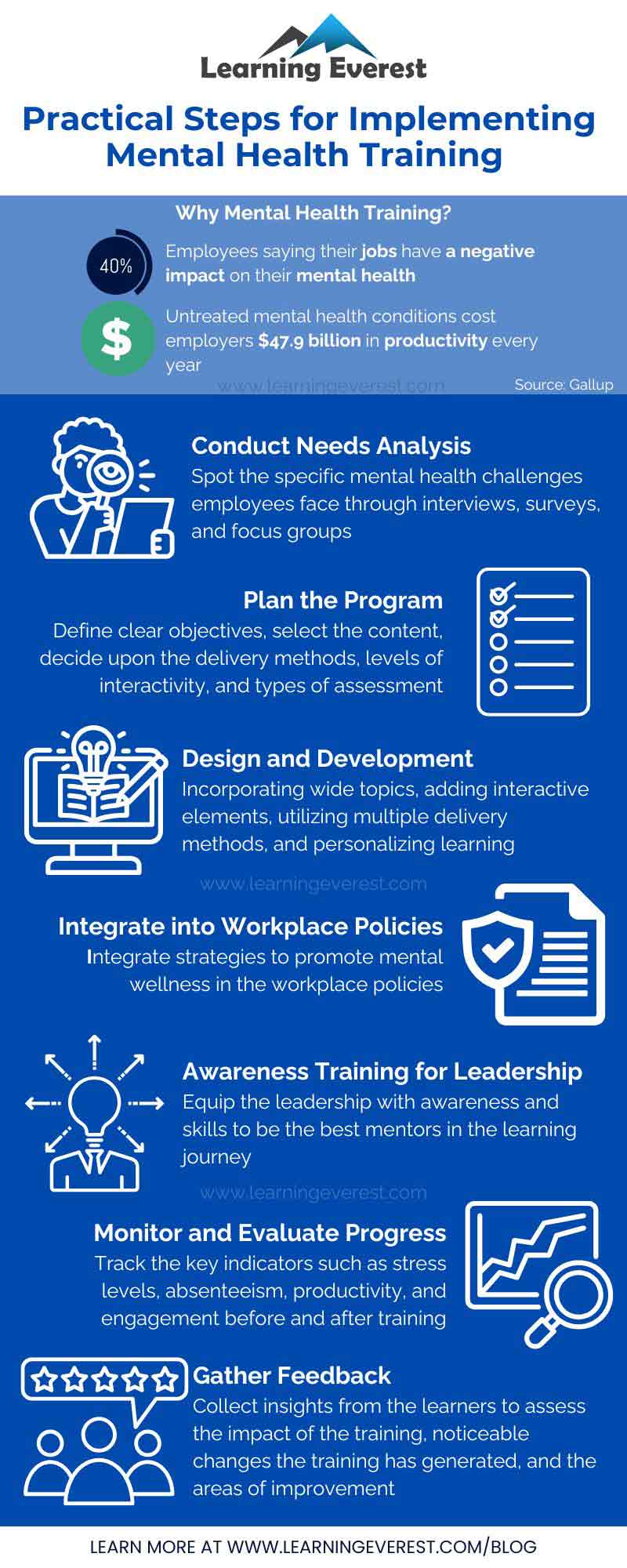
With the immense benefits organizations should focus on implementing effective mental health training. Moreover, it was found that “untreated mental health conditions cost employers $47.9 billion in productivity every year.” (Source: Gallup). The practical steps involved in implementing effective mental health training for employees are:
Conduct Needs Analysis
Before implementing mental health training for employees, conduct a mental health needs analysis to spot the specific mental health challenges employees face through interviews, surveys, and focus groups. After analyzing the needs, decide upon the most relevant training topics.
Plan the Program
The next step in implementing a mental health training program is to plan the training by defining clear objectives, selecting the content, deciding upon the delivery methods, levels of interactivity, and types of assessment. Furthermore, organizations should also consider the frequency, duration, target audience, and desired outcomes of the training program at this stage.
Design and Develop the Training
After planning the training program, designing and developing the mental health training programs is performed. This involves preparing content incorporating wide range of topics from mental health awareness to mental health laws, adding interactive elements such as real-life case studies, role-plays, and scenarios for better comprehension, utilizing multiple delivery methods, and personalizing the learning experiences as per learner needs and comprehension.
Integrate into Workplace Policies
The success of every learning lies in the impact it has on workplace efficiency. Along with offering mental health training for employees, it is important to integrate strategies to promote mental wellness in the workplace policies.
Awareness Training for Leadership
Along with offering mental health training for employees, it is increasingly important to equip the leadership with awareness and skills to be the best mentors in the learning journey. This involves specialized training to recognize signs of mental distress and strategies to support employees in need.
Monitor and Evaluate Progress
Implementation of the training program is completed only when the impact is monitored and evaluated. An effective strategy is to track the key indicators such as stress levels, absenteeism, performance, and engagement before and after training implementation.
Gather Feedback
Collect insights from the learners to assess the impact of the training, noticeable changes the training has generated, and the areas of improvement.
Conclusion
Mental health training for employees is essential in organizations to create mental health awareness, stress management, overcoming stigma, work-life balance and time management, mindfulness and resilience building, gathering and offering support, and mental health laws. Offering mental health training for employees provides significant benefits such as a mentally resilient workplace, improved conflict resolution, elevated performance, stronger workplace relationships, and attracting talent. Utilizing the practical steps of conducting needs analysis, planning, designing, integrating into workplace policies, leadership awareness, monitoring progress, and gathering feedback is essential for effective implementation of the training program. Organizations should invest in mental health training for their employees to foster a productive and healthier work environment.
Infographic
Practical Steps for Implementing Mental Health Training
Knowledge Check!
Frequently Asked Questions (FAQs)
What is mental health training for employees?
Mental health training for employees is a workplace program designed to train the workforce about factors affecting mental health along with creating awareness to tackle them.
What are the key areas of mental health training for employees?
The key areas addressed in mental health training for employees include mental health awareness, stress management, overcoming stigma, work-life balance and time management, mindfulness and resilience building, gathering and offering support, and mental health laws.
What are the benefits of mental health training for employees?
Offering mental health training for employees provides significant benefits such as a mentally resilient workplace, improved conflict resolution, elevated performance, stronger workplace relationships, and attracting talent.
Live Online Certification Trainings




Our Clients Our Work
