

Key account management training is a vital necessity today to ensure growth and excellence by effectively managing key accounts. The following paragraphs discuss key account management, the need for key account management training, and strategies for conducting effective key account management training.
Table of Contents
What is Key Account Management?
Key Account Management is the business process where an organization offers personnel and resources to build mutually beneficial relationships with key accounts. Key accounts refer to the organization’s most valuable customers, who play a significant role in its long-term success. The process is rooted in the Pareto Principle or the 80/20 Rule, named after the Italian economist Vilfredo Pareto, stating that “80% of the results come from 20% of inputs” applicable as “80% of sales come from 20% of customers.” The strategy involves working closely with key accounts to establish trust in the customers contributing significantly to the company’s revenue, profitability, or strategic goals.
The major elements of key account management include identifying and segmenting key accounts based on revenue or growth potential, building trust-based relationships, account planning, and monitoring performance. The features of key account management are that it involves special preferential treatment of major customers in the areas of “pricing, products, services, distribution, and information sharing” and communication between sales and service units. According to Gartner, “Organizations that lean heavily on current customer spend as a metric for selecting key accounts are 51% less likely to see increased customer spend.” The strategy focuses on customer retention and increasing customer value by understanding client needs and establishing strong bonds and loyalty between them, thereby establishing relationships beyond transactions.
What is Key Account Management Training?
Key Account Management training equips professionals with the skills and abilities to develop and expand the best relationships with the organization’s most valuable clients or key accounts. The training encourages building long-term relationships by identifying the client’s needs and offering solutions to the needs. The different aspects covered in key account management training include understanding key accounts, how to establish and build rapport with clients, relationship management strategies, setting long-term and short-term goals for key accounts, improved strategic thinking, customer retention strategies, measurement of performance, and management and resolution of conflicts.
The Need for Key Account Management Training
Organizations need to offer key account management training for employees to identify the key accounts and establish strong client relationships. Let’s identify some of the crucial reasons for offering the training to professionals.
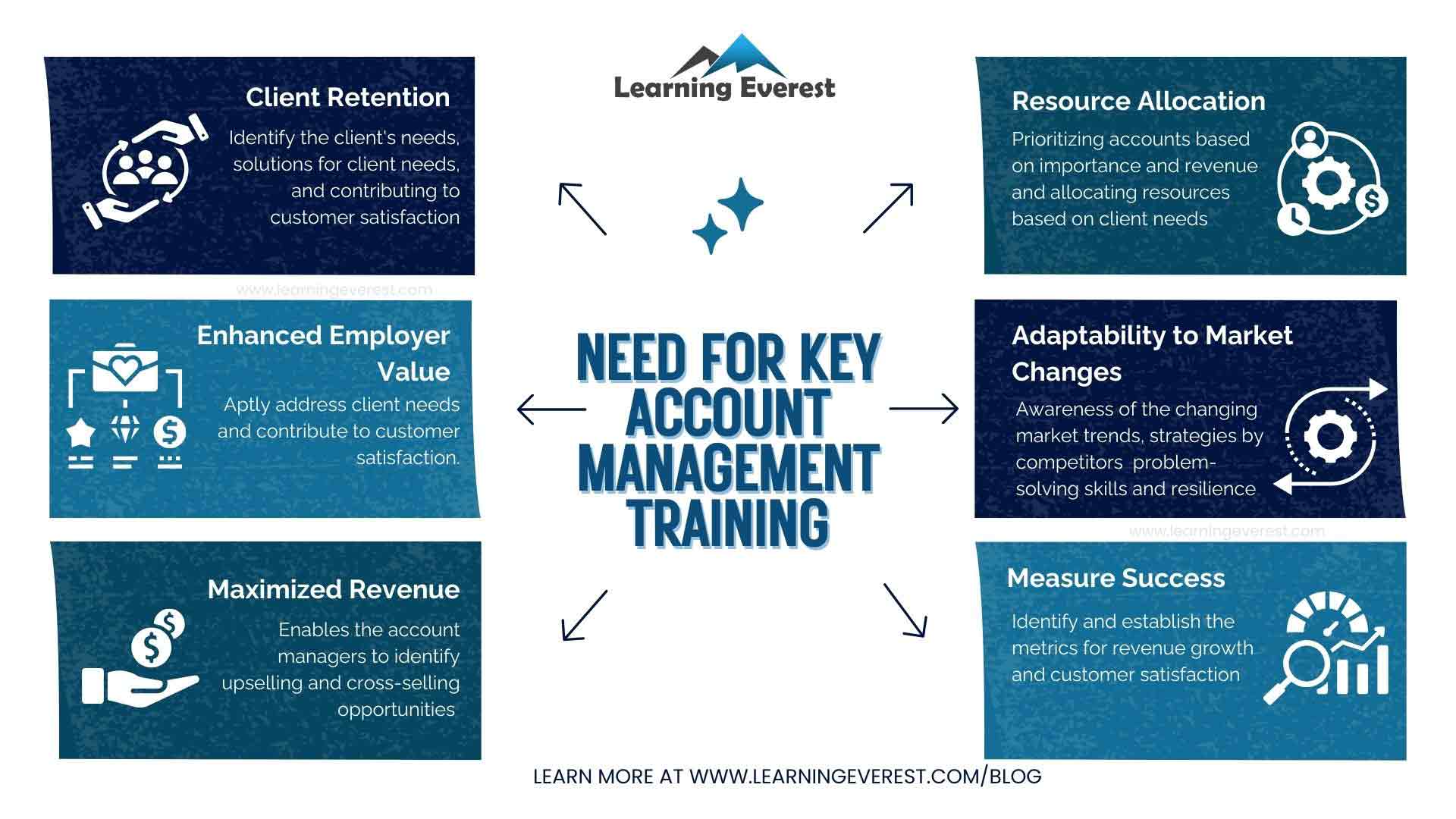
Need for Key Account Management Training
Client Retention
The training aims to foster long-term relationships with key clients by enabling the learners to identify the client’s needs, addressing solutions for client needs aligning with the goals, and contributing to customer satisfaction. It further equips the participants or key account managers with enhanced communication skills, thereby fostering open communication with the clients addressing their concerns, and establishing stronger ties leading to client retention.
Enhanced Employer Value
With the training contributing to retaining important clients, the organization is equipped with a stronger position in the industry. The employer value is enhanced by possessing the skill to aptly address client needs and contribute to customer satisfaction. This further contributes to attracting new clients to the company through an elevated reputation in sufficiently addressing client needs.
Maximized Revenue
Key Account Management training maximizes the revenue of the organization by enabling the account managers to identify upselling and cross-selling opportunities and retain top talent. Furthermore, the training equips the participants to clearly communicate product or service values and practice negotiation, thereby generating elevated revenue.
Resource Allocation
A crucial need for the training is it provides managers with insights on prioritizing accounts based on importance and revenue and allocating resources based on client needs. Proper allocation of resources based on client needs avoids wastage and ensures high returns.
Adaptability to Market Changes
The training benefits learners by creating awareness of the changing market trends, strategies by competitors yielding success and failures, enhanced problem-solving skills and fostering resilience to meet the changes. Account managers are offered opportunities to utilize the products and services aligning with market changes.
Measure Success
Key Account Management training enables the participants, mostly the account managers to identify and establish the metrics for revenue growth and customer satisfaction. The learners are equipped with the ability to align performance with organizational goals and measure progress.
Strategies for Effective Key Account Management Training
Understanding the need for key account management training, it is vital for implementing effective strategies for maximized outcomes. Here are the best strategies for delivering impactful solutions.
Incorporate SMART Objectives
To ensure a clear direction and attain measurable outcomes, incorporating SMART objectives aligning with the organizational goals is beneficial. SMART objectives mean that the training should be Specific, Measurable, Achievable, Relevant, and Time-bound. Keeping the objectives specific and measurable contributes best to tracking the progress, allocating proper resources, and enabling continuous improvement.
Opt Scenarios and Role-play
Choosing scenarios and role-play for Key Account Management Training enables participants to practice real-life situations. The scenarios can utilize real-life case studies to build stronger customer relations and resilience contributing to decision-making and active engagement. For instance, the scenarios such as resolving a key client issue, and problems with sudden market changes can encourage the learners to make relevant decisions.
Utilize Multiple Modalities
For effectiveness and engagement of the training, incorporating multiple training modalities is beneficial as it can cater to the diverse learning preferences of the learners. The modalities can include virtual instructor-led training, eLearning, simulations, microlearning, mentoring, gamification, and webinars. Choosing the appropriate training modality that matches the learner’s needs and styles can benefit an in-depth understanding of key account management training concepts. For instance, a busy account manager may choose small chunks of information rather than huge lumps and may prefer microlearning in a shorter span.
Gamify Assessments
The knowledge gained through the training needs to be assessed to identify the extent to which the learners have understood the key account management concepts. Utilizing game elements such as points, badges, rewards, leaderboards, and challenges makes the assessment process interactive and contributes to knowledge retention. In addition to knowledge retention, gamifying assessments increase the motivation of the learners and contribute to reinforcement.
Offer Personalization
Personalizing KAM training to align the training content based on addressing the individual needs and gaps is a beneficial strategy to enhance effective communication with the client. The customization of content ensures the learners are equipped with the necessary skills to address the client’s needs and build long-term client relationships. Personalized training contributes to enhanced engagement in learning and faster skill attainment.
Conclusion
In a nutshell, key account management offers personnel and resources to build mutually beneficial relationships with key accounts, i.e. organization’s most valuable customers. Offering key account management training encourages building long-term relationships by identifying the client’s needs and offering solutions to those needs. The training is crucial as it contributes to client retention, enhances employer value, maximizes revenue, improves resource allocation, ensures adaptability to market changes, and helps in measuring success.
The strategies for effective key account management include incorporating SMART objectives, opting for real-life scenarios and role plays, utilizing multiple training modalities, gamifying assessments, and personalization. Organizations can ensure best practices are followed in the key account management training programs for ensuring good rapport with long-term clients, ultimately contributing to organizational success.
Infographic
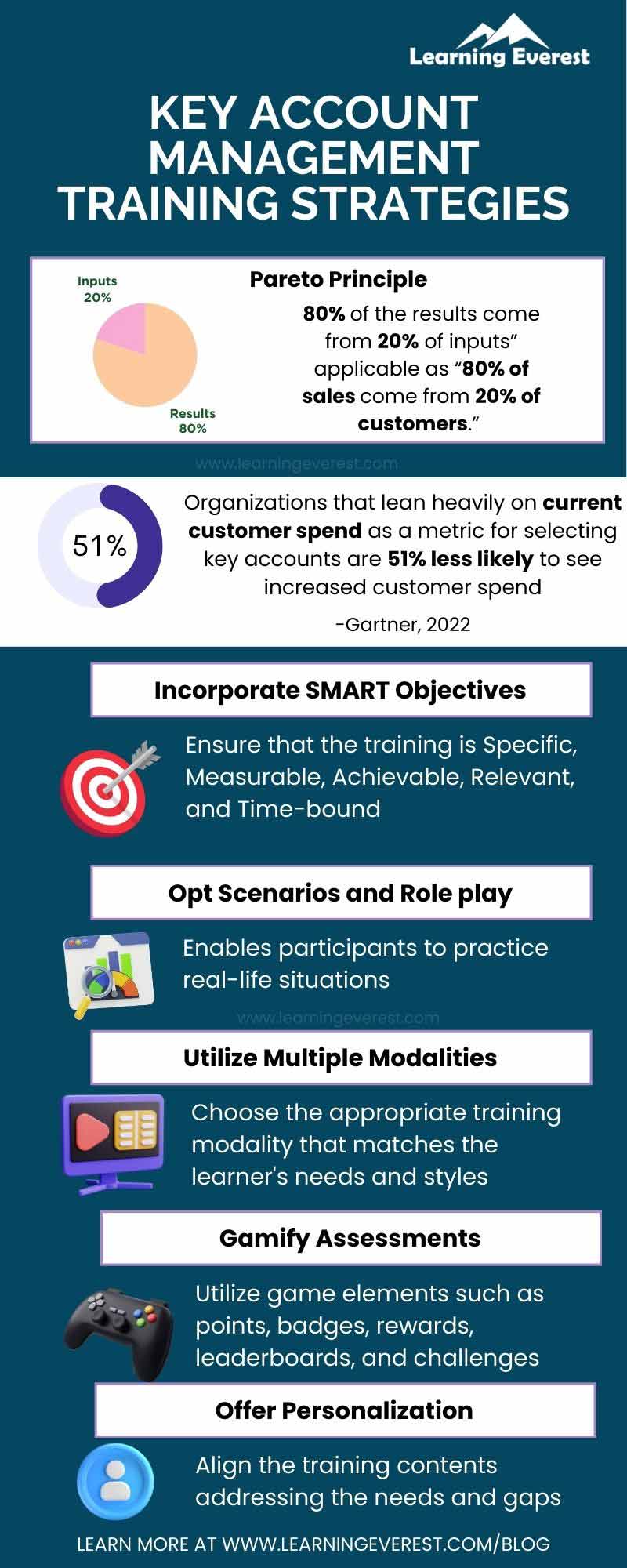
Key Account Management Training Strategies
Knowledge Check!
Frequently Asked Questions (FAQs)
What is Key Account Management?
Key Account Management is the business process where an organization offers personnel and resources to build mutually beneficial relationships with key accounts.
What is Key Account Management Training?
Key Account Management training equips professionals with the skills and abilities to develop and expand the best relationships with the organization’s most valuable clients or key accounts. The training encourages building long-term relationships by identifying the client’s needs and offering solutions to the needs.
What are the strategies for effective Key Account Management Training?
The strategies for effective key account management include incorporating SMART objectives, opting for real-life scenarios and role plays, utilizing multiple training modalities, gamifying assessments, and personalization.
Live Online Certification Trainings




Our Clients Our Work
