

eLearning translation is becoming increasingly essential with the rising demand to reach international audiences across diverse regions and cultures. By breaking down linguistic barriers, eLearning translation enables organizations to deliver effective training that meets the learning needs of learners worldwide.
Table of Contents
This article explores the features, benefits, and key factors to consider while adopting eLearning translation. Read on!
Understanding eLearning Translation
Do you know that “90% of people want to learn in their native language?” (Source: eLearning Industry). This requirement of the availability of courses in multiple languages is resolved by eLearning translation. eLearning translation refers to the process of converting online learning courses and content into another language to make them accessible to diverse audiences.
The primary goal is to ensure that learners from different cultural and regional backgrounds can fully understand and engage with the material, just as effectively as the original audience, without language being a barrier. The major features expected from an eLearning translation include:
- Translating all forms of content in terms of text or multimedia into the target language.
- Utilizing appropriate equivalents and ensuring consistency in using terms in translation.
- Accuracy in terms of semantics, syntax, grammar, spelling, and punctuation.
- Preservation of original layout and course structure.
- Compatibility with content authoring tools to both extract and re-import the content.
eLearning Translation vs eLearning Localization: Key Differences
eLearning Translation vs eLearning Localization
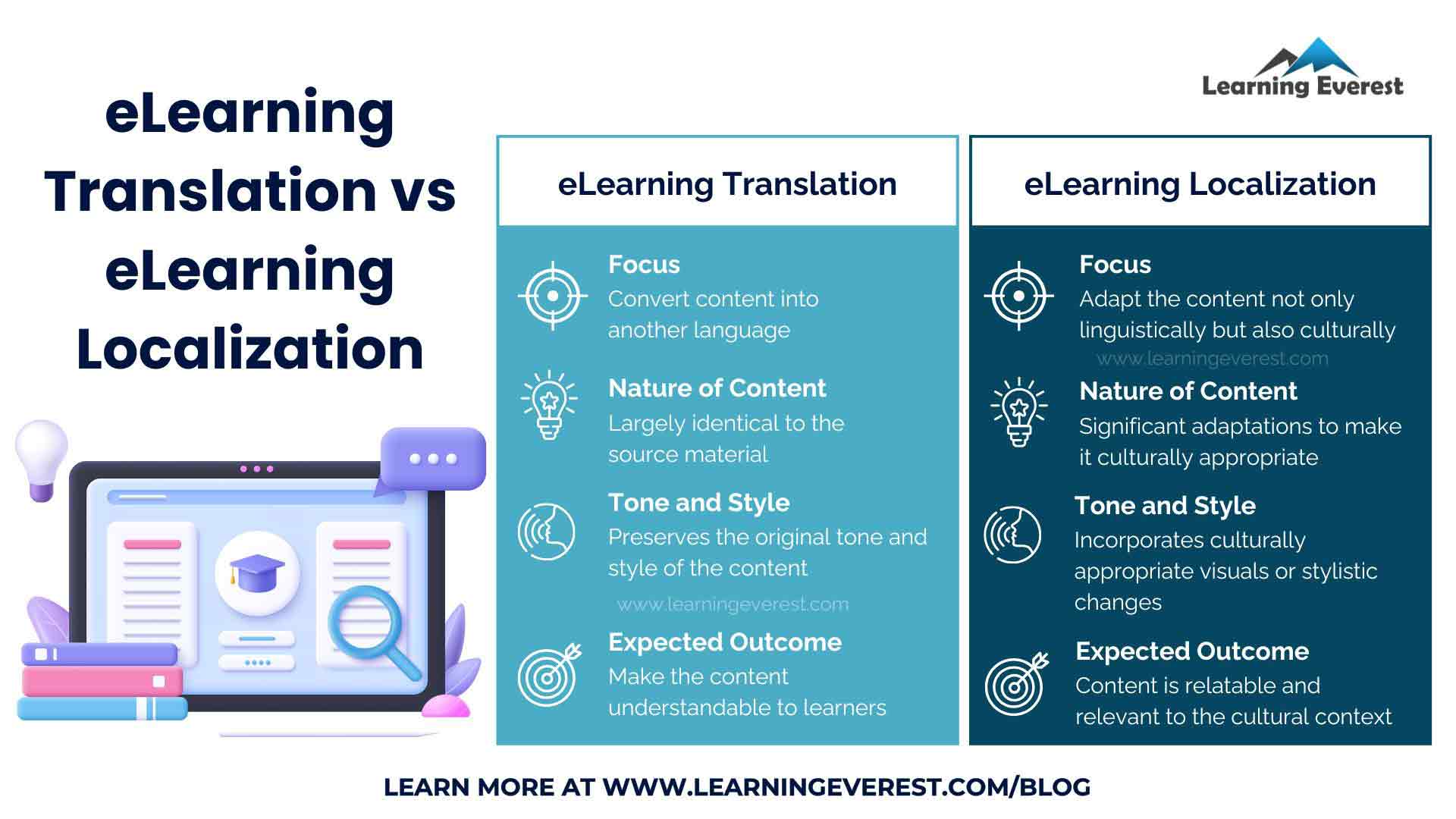
The term ‘eLearning translation’ is often confused with ‘eLearning localization’ amidst some basic differences existing between the two. While eLearning translation focuses on converting course content into another language, eLearning localization goes a step further by adapting the content to fit the specific needs and expectations alongside the regional and cultural characteristics of the target audience. The major differences include:
Focus
The primary focus of eLearning translation is to convert content into another language, whereas eLearning localization aims to adapt the content not only linguistically but also culturally to ensure it aligns with the preferences of the target audience.
Nature of Content
The content in eLearning translation remains largely identical to the source material, while eLearning localization brings forth significant adaptations to make it culturally appropriate to the audience.
Tone and Style
eLearning translation preserves the original tone and style of the content, ensuring that the translated version closely mirrors the source material. In contrast, eLearning localization involves adjusting both the tone and style and incorporating culturally appropriate visuals or stylistic changes to make the learning experience more engaging.
Expected Outcome
In terms of expected outcomes, eLearning translation aims to make the content understandable to learners in a different language. On the other hand, eLearning localization ensures that the content is not only understood but also is relatable and relevant to the cultural context of the audience.
Choosing between eLearning translation and localization depends on the target audience and nature of the content.
The Importance of eLearning Translation
Although an “estimated 1.3 billion English speakers and 85% of multinationals use English as a business language” (Source: EF Corporate Learning), making it the global lingua franca, focusing solely on English in eLearning impacts learning effectiveness. The following are some of the reasons why eLearning translation is important.
Global Outreach
eLearning translation is essential for reaching learners across diverse regions and delivering knowledge effectively to a multilingual workforce.
Accessibility and Inclusion
Along with global outreach comes the responsibility of ensuring accessibility and inclusion. Addressing the language needs of a diverse workforce not only enhances understanding but also fosters a sense of belonging and being valued among the learners.
New Market
From a business perspective, eLearning translation opens the door to new markets and growth opportunities. With training content accessible in multiple languages, the brand can reach a wider audience and expand internationally, building elevated trust.
Engaged Learning
eLearning translation is important because it fosters more engaged and personalized learning experiences. Delivering content in a learner’s native language makes training more accessible and easier to understand, thereby enhancing comprehension and enabling learners to form a personal connection with the material. As a result, learners are more likely to immerse themselves in the content, actively participate, and retain information more effectively.
Key Factors to Consider when Adopting eLearning Translation
Understanding the unique needs, importance, and features of eLearning translation, professionals should carefully consider several key factors before adopting it. The first step is to determine whether eLearning translation or localization best suits their goals, audience, and content. With translation being chosen, attention to certain key factors will ensure the process leads to an effective and engaging learning experience.
Understand the Linguistic and Cultural Differences
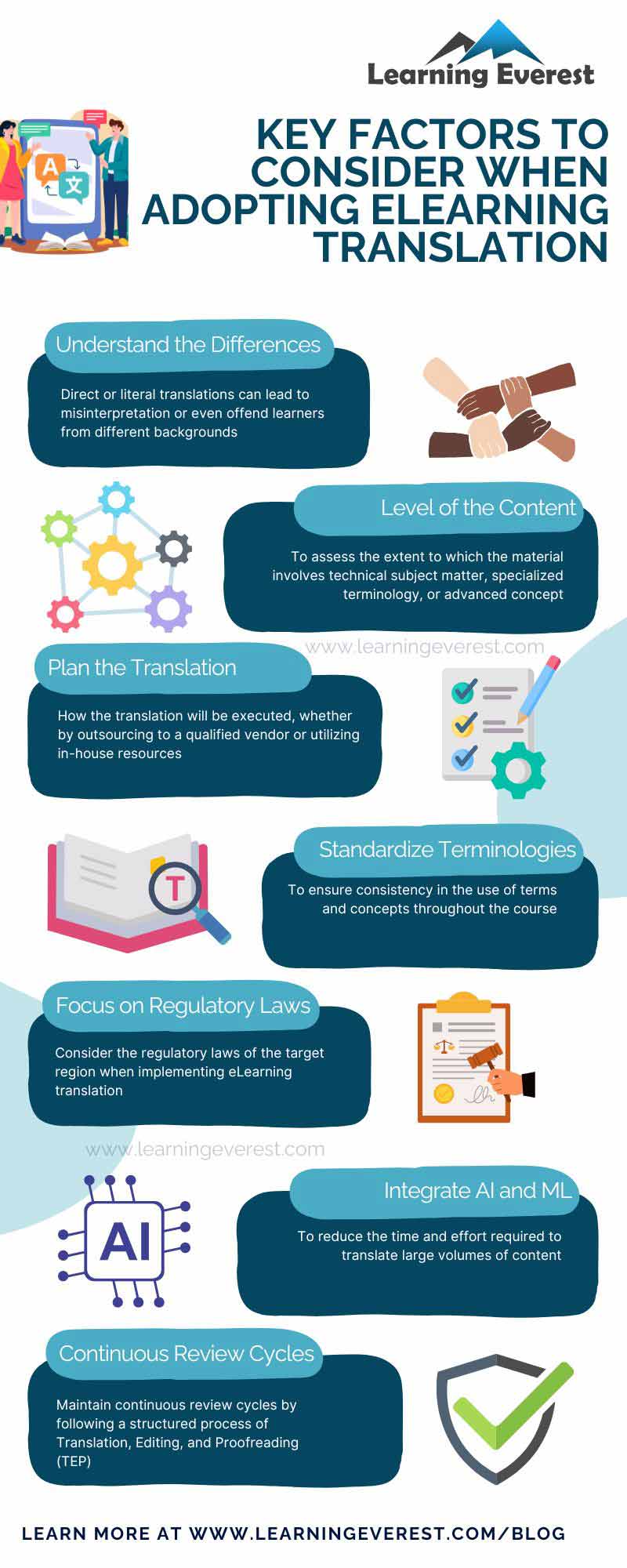
A major factor to consider when adopting eLearning translation is a clear understanding of linguistic and cultural differences. Direct or literal translations, especially of idioms, metaphors, or culturally specific references, can lead to misinterpretation or even offend learners from different backgrounds, making it essential to ensure that translated content is culturally sensitive.
Comprehend the Level of the Content
Understanding the complexity and level of the content is essential to assess the extent to which the material involves technical subject matter, specialized terminology, or advanced concepts. To maintain consistency and accuracy, creating a glossary of key terms and jargon in advance is highly recommended. This ensures that complex terms are translated correctly and consistently across all modules.
Plan the Translation Process
Plan how the translation will be executed, whether by outsourcing to a qualified vendor or utilizing in-house resources. Regardless of the approach, the process should involve a global team of experienced professionals, including those who are fluent in the target language or can effectively collaborate with native speakers to deliver a high-quality learning experience.
Standardize Terminologies
Along with understanding the complexity and level of the content, it is important to standardize terminologies to ensure consistency in the use of terms and concepts throughout the course. Additionally, the entire course should be structured and presented in a standardized, coherent manner that makes it easy for learners to follow and comprehend.
Focus on the Regulatory Laws
It is essential to consider the regulatory laws of the target region when implementing eLearning translation. Being aware of these legal nuances helps avoid issues that could arise during translation and ensures that the content is appropriate and compliant in the target region.
Integrate AI and ML
Another factor to consider is the integration of AI and machine translation tools into the eLearning translation process. These technologies can significantly reduce the time and effort required to translate large volumes of content. However, it is crucial to carefully review and validate the translated output to ensure accuracy and clarity, as AI and machine learning systems may sometimes misinterpret context or meaning. Additionally, using neural machine translation (NMT) can offer more natural and fluent translations, yet requires human oversight to maintain quality and cultural appropriateness.
Uphold Continuous Review Cycles
Maintain continuous review cycles by following a structured process of Translation, Editing, and Proofreading (TEP). This ensures that the content is accurate, properly translated, and that terminology is consistent throughout. This phase focuses on standardization and clarity, while also ensuring compliance with any relevant regulatory requirements or concerns.
Conclusion
In short, eLearning translation is a vital process that enables global outreach and effectively engages learners worldwide by immersing them in the learning experience.
Infographic
Key Factors to Consider when adopting eLearning Translation
Knowledge Check!
Frequently Asked Questions (FAQs)
What is eLearning translation?
eLearning translation refers to the process of converting online learning courses and content into another language to make them accessible to diverse audiences.
What is eLearning localization?
eLearning localization adapts the content to fit the specific needs and expectations alongside the regional and cultural characteristics of the target audience.
What is the difference between eLearning translation and localization?
eLearning translation converts content into another language while preserving its original tone and structure. In contrast, eLearning localization adapts both language and cultural elements, such as tone, style, and visuals, to suit the target audience, ensuring the content is not only understood but also culturally relevant and engaging.
Live Online Certification Trainings


Our Clients Our Work
