

Change management training for managers is a powerful solution to turning uncertainty into a strategic advantage. While the word ‘change’ often carries a negative connotation, effective change management empowers leaders to turn them into opportunities for innovation, agility, and progress.
Table of Contents
- What is Change Management?
- Understanding Change Management Training
- Areas Addressed in Change Management Training for Managers
- Importance of Change Management Training for Managers
- Implementing Effective Change Management Training for Managers
- Conclusion
- Infographic
- Knowledge Check!
- Frequently Asked Questions (FAQs)
- What is Change Management?
- What is the importance of change management training for managers?
This requires implementing the right change management training for managers. Through this blog, let’s uncover change management training for managers, areas addressed in the training, the importance of the training, and the best strategies for implementation. Read on!
What is Change Management?
Organizations face change for a multitude of reasons that can be internal or external such as technological advancements, market conditions, organizational restructuring such as mergers, acquisitions, and expansions, new laws, and crises like pandemics, natural disasters, and cyberattacks. However, 43% of employees suggest that “their place of work is not prepared to effectively managing change.” (Source: Oak Engage’s Change Report Survey of 1035 UK Employees, 2023). Change management refers to the structured approach of handling organizational change by preparing, supporting, and guiding employees and organizations.
Effective change management strategies enable the organization to assess the situation, understand the change needed, and adopt appropriate change management strategies. Managers play a critical role in effective change management by bridging the gap between strategic decisions at the top management level and executing them. To expand, managers contribute by communicating clearly about change, offering guidance, allocating resources including personnel, gathering feedback, and monitoring performance. In other words, managers “design, direct, and shape” change processes.
Understanding Change Management Training
Since change management is inevitable in businesses, it becomes essential for organizations to train their employees, especially managers to utilize the right strategies. Change management training can be defined as the learning program designed to equip individuals with the knowledge, skills, and tools to understand and navigate the change process effectively. The training focuses on building awareness of the need for change, reducing resistance by appropriately clarifying the fears, uncertainties, and doubts of the individuals, and developing adaptability in embracing change. For managers, change management training has more focused objectives such as strengthening leadership skills to be confident in periods of change, communicating change, and implementing smooth transitions.
Areas Addressed in Change Management Training for Managers
Change management training for managers offers practical insights to guide the teams during complex transitions. The following are the key focus areas included in change management training for managers.
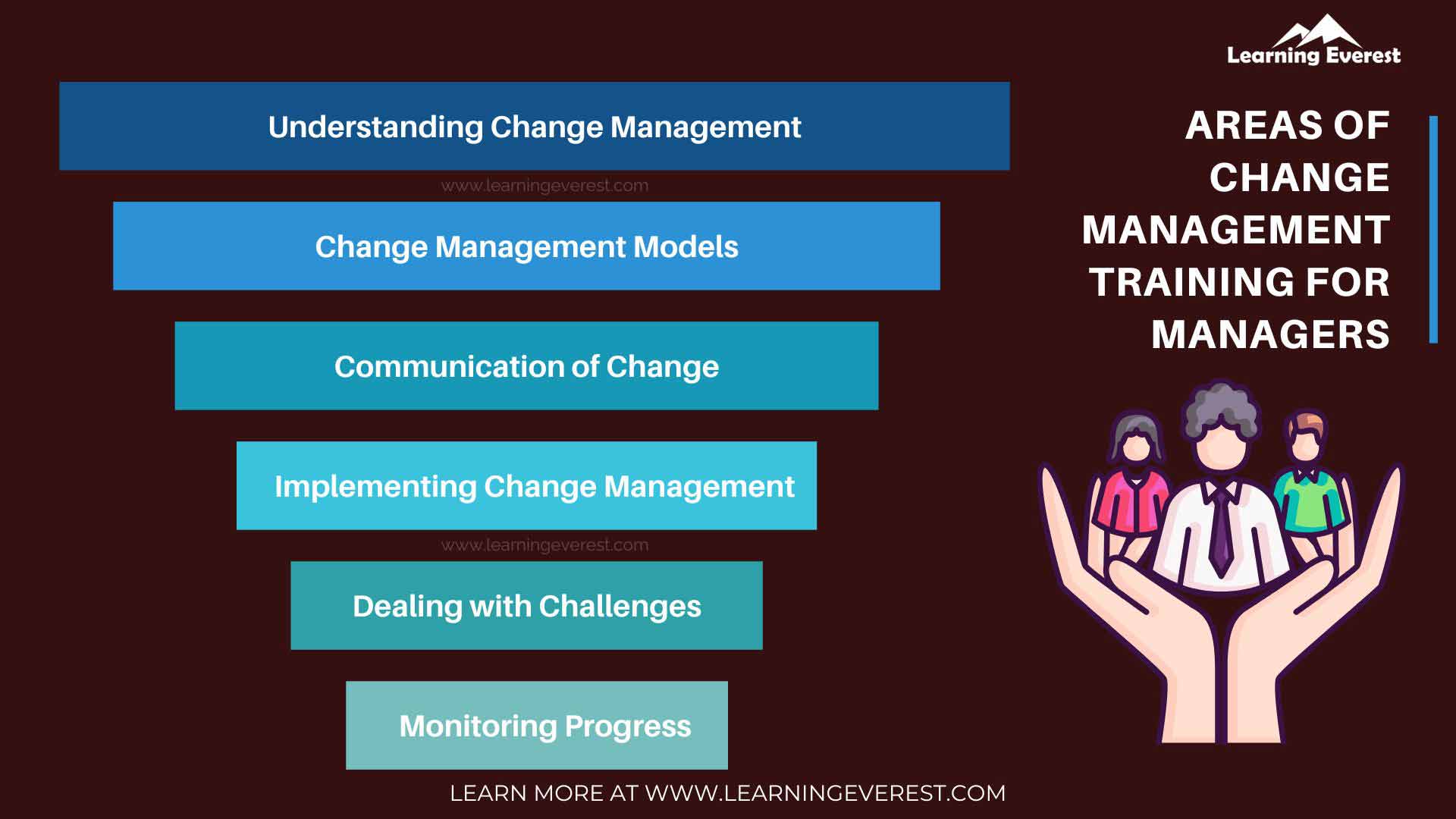
Areas of Change Management Training for Managers
Understanding Change Management
The basic focus area is on the fundamentals of change management by elaborating on transition situations, human responses to change, adopting change management, and roles and responsibilities as a manager.
Change Management Models
An elaborate overview of different change management models and how to apply them in real scenarios. This encourages managers to adopt a proven approach to lead the teams and support the teams effectively.
Communication of Change
Equips managers with the skill to communicate consistently and transparently avoiding ambiguities at the workplace. The training covers crafting clear messages, developing effective communication plans, choosing appropriate channels, encouraging feedback, and reinforcing team members.
Implementing Change Management
Implementing change management aspect of change management training for managers stresses on application of effective management by planning, developing a strategy, implementing new processes and systems, offering support and coaching to employees to perform best with high productivity, and sustaining change.
Dealing with Challenges
The smooth implementation of change management is hindered by certain challenges that can arise such as resistance by the employees to change, fear of the unknown, integration with existing technologies, business continuity challenges, and impact. Change management training for managers addresses all these challenges and offers insights on dealing with and overcoming them.
Monitoring Progress
Monitoring progress includes defining KPIs, outcomes, conducting regular tracking, progress reviews, gathering feedback, and fostering continuous improvement.
Importance of Change Management Training for Managers
Let’s now delve in detail the importance of change management training for managers.
Ensuring Effective Leadership
As managers are the ones employees look upon, especially during situations of change, leaders should be equipped with the tools, knowledge, and plan to lead and communicate effectively. The training equips leaders with the understanding of the need to manage change, knowledge of different change management models such as McKinsey 7S Model, Kurt Lewin’s 3 Stage Model of change, ADKAR Model by Prosci, and Nudge Theory, and application of models in guiding employees while offering them clear direction and confidence.
Enhanced Adaptability
Change management training for managers equips them with the ability to remain adaptable to unforeseen problems or obstacles associated with change and instills in them skills such as agility and strategic decision-making.
Strengthens Strategic Thinking
Strategic thinking refers to the ability of individuals to foresee and anticipate future outcomes ensuring the vision supporting organizational goals. Change management training for managers offers them a bigger picture to see beyond the immediate challenges, analyze future trends and possible challenges, and take proactive steps.
Better Resource Allocation
The training ensures better resource allocation resulting in a smooth transition and continuity of business functions. Trained managers learn to properly utilize resources such as time, budget, people, and technology based on the priorities of the organization and minimizing wastage and duplication
Catering Stakeholder Needs
Change management training for managers caters to diverse stakeholder needs and supports talent retention during times of transition. The stakeholders including the employees, clients, customers, or partners feel informed, supported, and valued when managers uphold the contents comprehended from training.
Enhanced Decision-Making
Managers are empowered with the skill of making apt decisions irrespective of uncertainties with change management training. With deep insights on change models, resource allocation, dealing with challenges and other risk factors, managers can implement sound decisions benefitting the organization
Implementing Effective Change Management Training for Managers
To ensure the utmost effectiveness of the training programs, it is advisable to adopt certain strategies that yield significant outcomes. Some of the strategies include:
- Customizing the training programs to suit the organization’s goals, the changes and challenges that they might encounter, and incorporating relevant content.
- Incorporating real-world challenges, scenarios, role-plays, virtual change scenarios, and case studies on managing change for better understanding.
- Facilitate interactive workshops and immersive learning experiences to teach change management models and their application.
- Incorporate communication activities through simulations and practice exercises on handling such situations.
- Utilizing AI for analyzing emotional trends, and resistance patterns and creating learning objectives considering the situations.
- Hands-on learning to identify potential risks and create strategic plans.
Conclusion
Change management training for managers proves invaluable as change is inevitable and essential for growth and resilience. Managers play a crucial role in change process by bridging strategy and execution, communicating expectations, guiding teams, and tracking performance. Change management training for managers aims to equip managers with the tools, frameworks, and mindset to lead change successfully. The importance of change management training is underscored through the distinct benefits it offers such as building leadership strength, enhancing adaptability, sharpening strategic thinking, enabling resource allocation, catering to stakeholder needs, supporting talent retention, and strengthening decision-making.
Some strategies for implementing effective change management training include tailoring the program to organizational goals, using real-world case studies, fostering interactive and immersive learning, role-playing communication scenarios, and integrating AI for deeper insight and adaptability. Change management training for managers is a strategic investment in leadership, culture, and business continuity.
Infographic
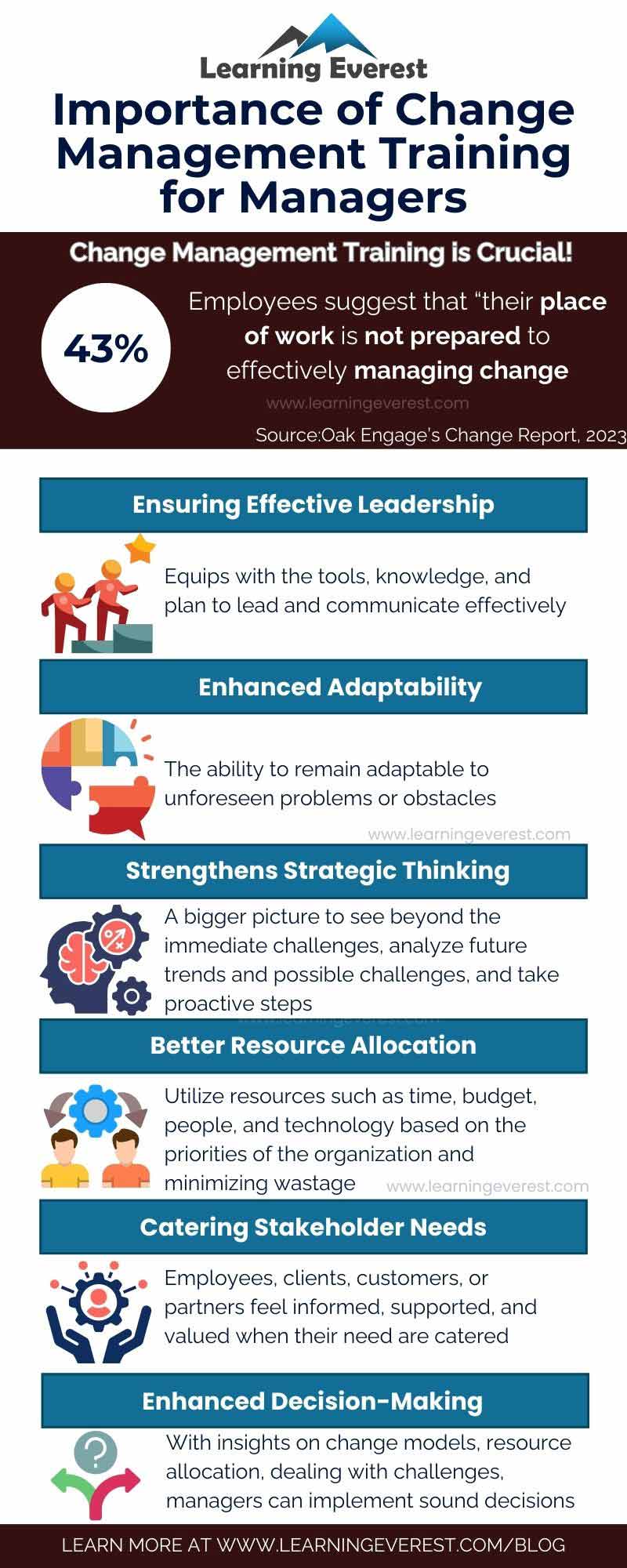
Importance of Change Management Training for Managers
Knowledge Check!
Frequently Asked Questions (FAQs)
What is Change Management?
Change management refers to the structured approach of handling organizational change by preparing, supporting, and guiding employees and organizations.
What is the importance of change management training for managers?
The importance of change management training is underscored through the distinct benefits it offers such as building leadership strength, enhancing adaptability, sharpening strategic thinking, enabling resource allocation, catering to stakeholder needs, supporting talent retention, and strengthening decision-making.
Live Online Certification Trainings




Our Clients Our Work
