

AI in manufacturing is revolutionizing the sector by reshaping the production process and the workflows with intelligent automation. Apart from the benefits to the industry, the role of this technological advancement is massive in training the workforce.
Table of Contents
- Attaining Excellence through AI in Manufacturing
- Key Areas of AI in Manufacturing Training
- How AI in Manufacturing Training Outweighs Traditional Training?
- Conclusion
- Infographic
- Knowledge Check!
- Frequently Asked Questions (FAQs)
- What are the benefits of AI in manufacturing?
- What are the key areas of AI in manufacturing training?
- How does AI in manufacturing training outweigh traditional training?
To explore the role of AI in manufacturing, the areas and techniques to address AI in manufacturing training, and the way AI-enabled training outweighs traditional training, read on!
Attaining Excellence through AI in Manufacturing
The manufacturing industry contributes significantly to the entire life cycle of products, from gathering raw materials to producing goods, and final export with goods encompassing various consumer products ranging from clothing, electronics, industrial equipment, and automobiles to construction materials. With the advancement of technology and artificial intelligence, effective and smarter processes that enable innovation offer transformative growth in the industry.
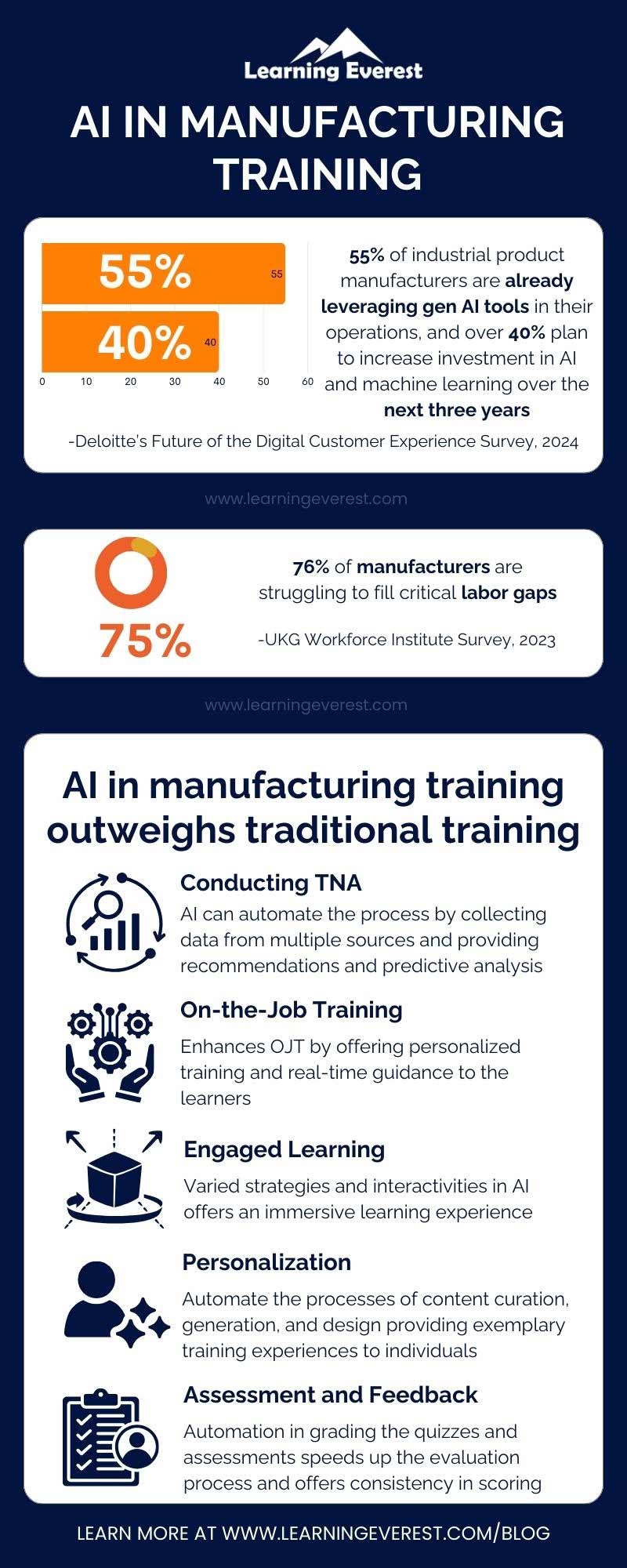
According to Deloitte’s 2024 Future of the Digital Customer Experience survey, “55% of industrial product manufacturers are already leveraging gen AI tools in their operations, and over 40% plan to increase investment in AI and machine learning over the next three years.” This greater shift is due to the practical benefits of AI in manufacturing such as predicting potential failures and threats, effective quality control, inventory management, automation in factories, and personalization of products. AI-driven manufacturing practices increase the quality and product by automating repetitive tasks and eliminating the defects.
Key Areas of AI in Manufacturing Training
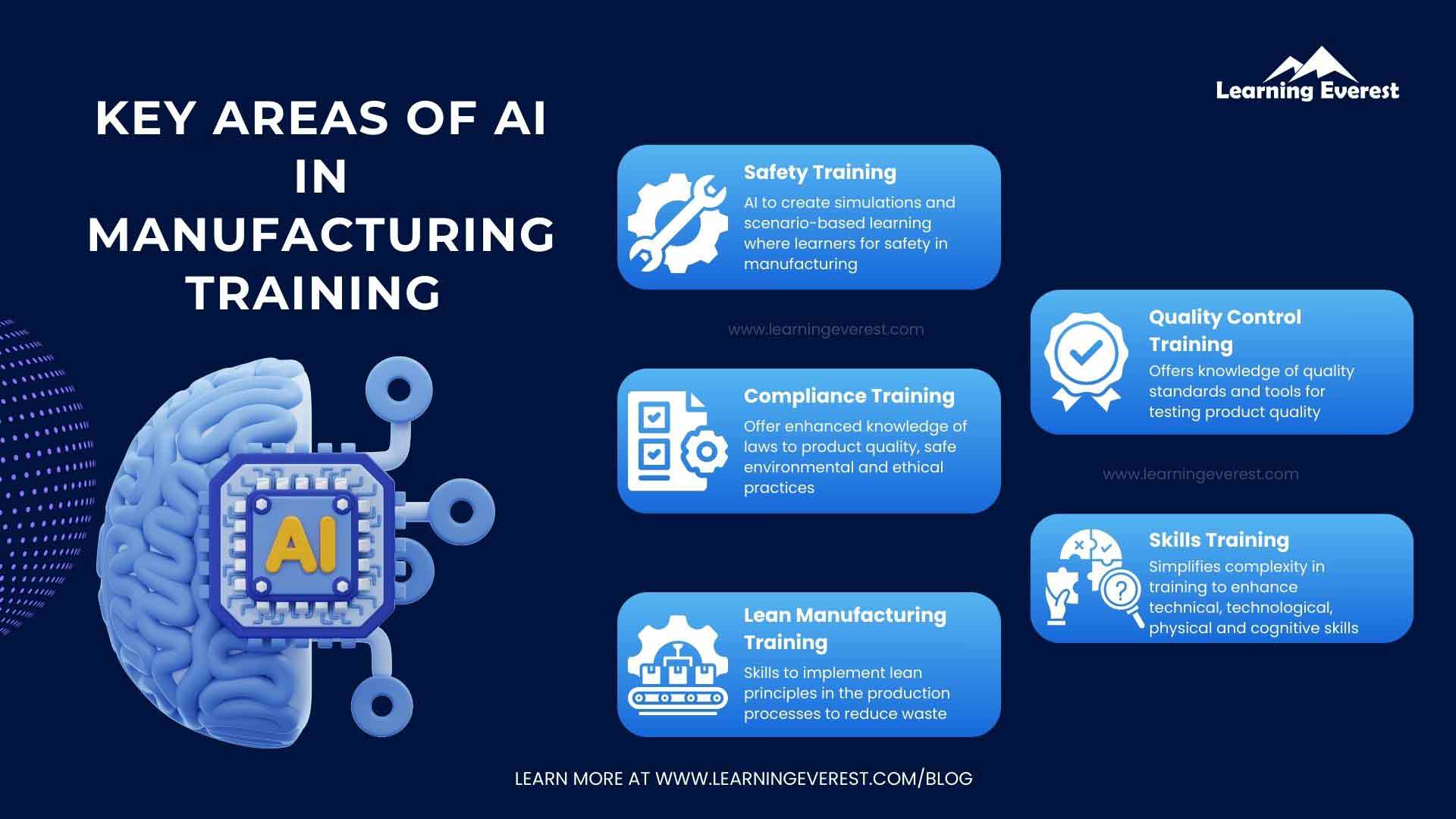
To maximize the impact of manufacturing processes, conducting regular training on varied aspects of the sector is vital. A survey by the UKG Workforce Institute in 2023 revealed that “76% of manufacturers are struggling to fill critical labor gaps.” AI in manufacturing training eliminates the skills gap by enabling impactful onboarding of new hires and effectively upskilling and reskilling the existing employees. Some of the areas where AI-driven manufacturing training can offer maximum impact include:
Key Areas of AI In Manufacturing Training
Safety Training
One of the most crucial training required for employees in the manufacturing sector is safety training as there are inherent risks associated with machinery and equipment. AI offers effective immersive simulations and scenario-based learning where learners can relate to real-world situations on identifying and handling hazardous materials, usage of PPE, fire safety, and emergency response. Furthermore, the participants benefit from predictive analysis for probable incidents of risks by analyzing historical data using AI.
Compliance Training
Incorporating AI in compliance training through gamification, simulations, scenarios, and extended reality helps employees gain enhanced knowledge of laws to maintain product quality, safe environmental practices, and ethical practices. AI provides support in the easy designing of training content to offer interactive experiences to the learners on knowledge about Good Manufacturing Practices and different quality standards like FDA.
Lean Manufacturing Training
Lean Manufacturing Training involves equipping employees and leadership of the organization with the skills to implement lean principles in the production processes to reduce waste. AI can offer personalized training to encourage learners to practice lean principles effectively in the workplace, chatbots, and virtual coaches to clarify the queries in practicing lean concepts leading to improved retention.
Quality Control Training
Ensuring the quality of the manufactured good is critical and requires training to empower employees to follow best practices in production, identifying defects, and resolving them. AI-enabled QC Training provides in-depth knowledge of quality standards and tools for testing and inspection and enhances the capability of participants to confirm product quality and operational excellence.
Skills Training
Apart from role-specific training, employees need to possess vital skill-enhancement training to bridge the skill gaps in performance. This involves technical skills training involving machine operation and maintenance, robotics, and automation in production processes, technological training, time management, and physical and cognitive skills. Utilizing AI in training can simplify complex concepts to enhance better understanding of concepts.
How AI in Manufacturing Training Outweighs Traditional Training?
Although the areas addressed in traditional and AI-integrated training are the same, there are significant benefits of utilizing AI in manufacturing training. With the focus on offering quality content delivered to the right learner at the right moment, AI in manufacturing training offers skillful solutions. Let’s analyze how it outweighs traditional training.
Conducting TNA
Conducting a Training Needs Analysis (TNA) to identify the skill gaps and training requirements is crucial for manufacturing training. The process of gathering data and pinpointing the gaps when performed manually can be subjective and may include flaws. AI can automate the process by collecting data from multiple sources and providing recommendations and predictive analysis for training suitable for individuals.
On-the-Job Training
On-the-job training is the most practical training that can be offered in the manufacturing workplace offering employees hands-on expertise in skill enhancement and knowledge acquisition. This can include job shadowing and simulation-based training with higher efficiency through automated processes. AI enhances OJT by offering personalized training and real-time guidance to the learners which is lacking in traditional training.
Engaged Learning
While traditional training focuses on the trainer offering learning content resulting in dull, mundane learning, integrating AI in manufacturing training creates a dynamic and interactive environment that indulges the participants in the learning process. Through varied strategies and interactivities, AI offers an immersive learning experience. Furthermore, simulations and virtual environments provide hands-on training in a risk-free atmosphere enabling the complete participation of the learners.
Personalization
AI can track the areas that need training for each of the employees rather than adopting ‘one-size-fits-all’ making the learners choose the training that benefits them. This personalization in learning experiences is lacking in traditional training because of the difficulty in crafting training solutions for each individual’s needs. However, AI can automate the processes of content curation, generation, and design providing exemplary training experiences to individuals based on their needs.
Assessment and Feedback
AI can personalize assessments based on individual learners and offer instant feedback on the progress and level of improvement. Moreover, the assessment practices are made more engaging within a shorter time of development through AI in the form of gamification offering rewards and feedback to the learners. Automation in grading the quizzes and assessments speeds up the evaluation process and offers consistency in scoring eliminating human errors. AI can further promote constant tracking of performance enabling improved learning.
Conclusion
In a nutshell, the role of AI in manufacturing industry is huge ranging from predicting potential failures and threats, effective quality control, inventory management, automation in factories, and personalization of products. In manufacturing training, AI plays a significant role in safety training, compliance training, lean manufacturing training, Quality Control training, and skill enhancement training. Employees benefit from the onboarding, reskilling, and upskilling processes through AI in manufacturing training. AI-based training outweighs traditional training by effectiveness in conducting TNA, On-the-Job training, engaging the learners in the training process, offering personalized learning experiences, and conducting assessment and feedback. Manufacturing organizations can decide upon modernized technology integration in the training practices such as AI to maximize the impact of the learning.
Infographic
AI in Manufacturing Training
Knowledge Check!
Frequently Asked Questions (FAQs)
What are the benefits of AI in manufacturing?
The practical benefits of AI in manufacturing such as predicting potential failures and threats, effective quality control, inventory management, automation in factories, and personalization of products.
What are the key areas of AI in manufacturing training?
In manufacturing training, AI plays a significant role in safety training, compliance training, lean manufacturing training, Quality Control training, and skill enhancement training. Employees benefit from the onboarding, reskilling, and upskilling processes through AI in manufacturing training.
How does AI in manufacturing training outweigh traditional training?
AI-based training outweighs traditional training by effectiveness in conducting TNA, On-the-Job training, engaging the learners in the training process, offering personalized learning experiences, and conducting assessment and feedback.
Live Online Certification Trainings


Our Clients Our Work
