

The efficiency of a training program largely depends on how well its intended outcomes are achieved, which is typically evaluated through eLearning assessments. However, traditional assessment methods have certain limitations, resolved effectively by incorporating AI into eLearning assessments
Table of Contents
The following paragraphs explore key areas of integrating AI in eLearning assessments and the key benefits of its integration. Read on!
Importance of eLearning Assessment
eLearning assessment involves evaluating a learner’s knowledge acquisition, skill development, or overall progress within a digital environment. It encompasses not only post-assessments but also pre-assessments, both of which can be conducted through digital platforms. The importance of eLearning assessment lies in its ability to map learner competencies, identify specific training needs, and evaluate prerequisites for the learning process, in the case of pre-assessments along with determining whether learning outcomes have been achieved for certification purposes, track learner progress, and highlight areas where the instructional design may need improvement.
Areas of AI in eLearning Assessment
The role of AI in eLearning is expanding, with more organizations utilizing the distinct benefits that AI provides.” 91% of L&D professionals said they were considering or planning to use AI to assist with digital learning initiatives in 2025; 60% are looking to use AI to assist in content creation, 11% see AI playing a significant role in personalization, and 11% want to use AI to assist with analytics and reporting” (Source: Elucidat State of Digital Learning Report, 2025). eLearning assessments conducted in various formats, such as multiple-choice questions, fill-in-the-blank questions, true-or-false questions, and short-answer questions, are enhanced with AI. Regardless of the format, AI plays a distinct role in eLearning and contributes across different areas such as:
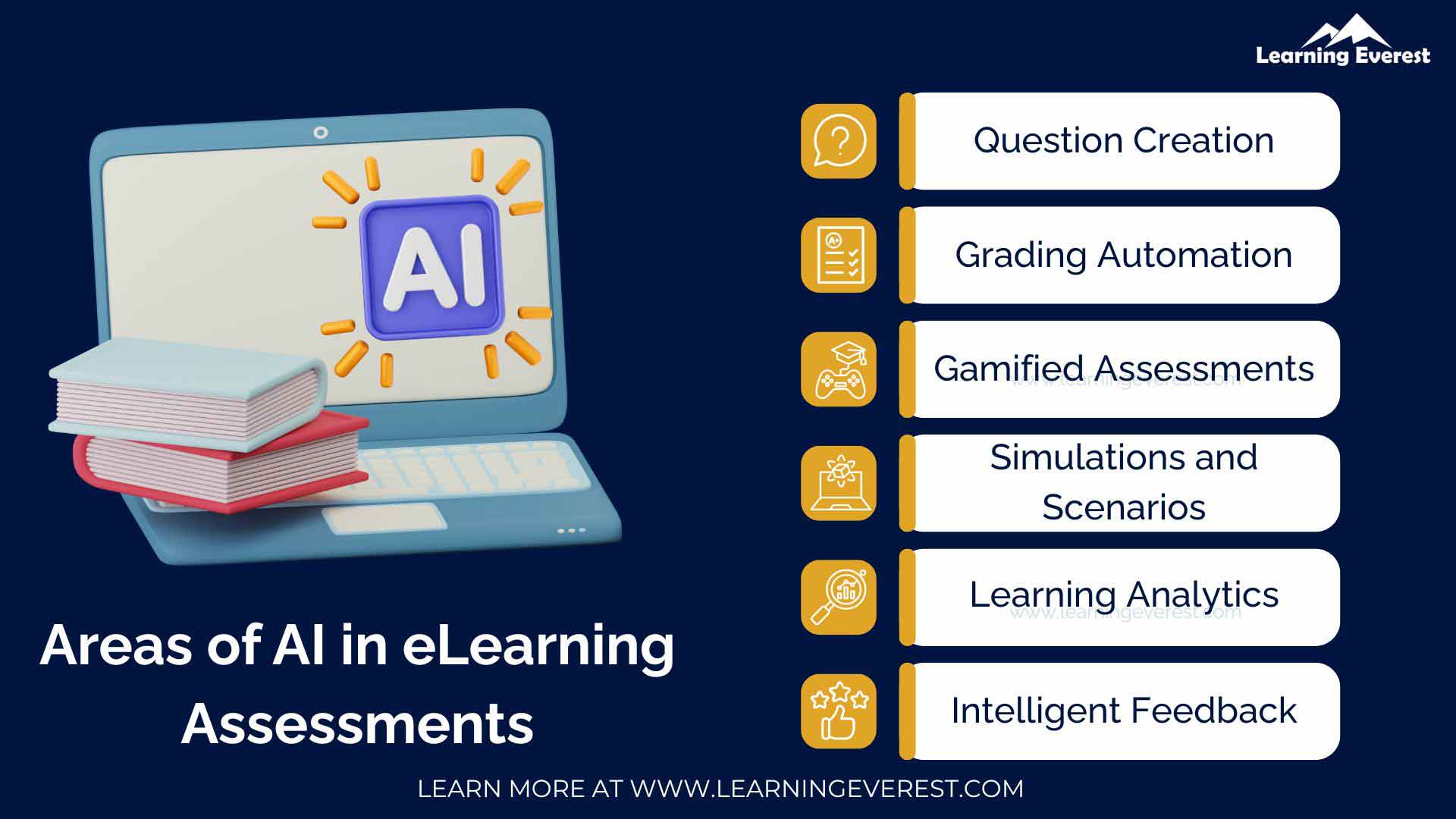
Areas of AI in eLearning Assessments
Question Creation
SMEs and instructional designers often face challenges in crafting well-framed questions and developing intellectually appropriate distractors. AI in eLearning assessment can ease this process by generating relevant questions, from simple to complex, considering the specific learning needs.
Grading Automation
AI incorporates machine learning algorithms and intelligent automation to streamline the grading process. Unlike traditional grading, which may involve bias, emotional influence, or human error, AI offers consistency and accuracy. By automating evaluation, it minimizes flaws and ensures reliable assessment results
Gamified Assessments
Assessments are often met with reluctance from learners, as they can cause stress or anxiety. However, gamified assessments make the process more engaging and enjoyable. While designing such assessments can be time-consuming, AI in eLearning assessments simplifies and accelerates their creation.
Simulations and Scenarios
Simulations and scenario-based eLearning assessments are highly engaging and help learners connect with real-world contexts. AI simplifies the creation of these assessments by reducing the need for complex programming and development, thereby easing the workload.
Learning Analytics
AI-enhanced learning analytics simplify the process of tracking learner progress and analyzing assessment results, making insights accessible and easier to understand for both trainers and learners.
Intelligent Feedback
Creating detailed feedback for each answer in an eLearning assessment can be a daunting task. AI simplifies this by generating tailored feedback, explaining why an answer is correct or incorrect, while also reinforcing learning through positive encouragement and recognition.
Benefits of AI in eLearning Assessment
By offering distinct features across these areas, AI brings a range of benefits to eLearning assessment. Here is a deep exploration of the benefits of AI in eLearning.
Overcomes Bias
A key benefit of AI in eLearning assessment is its ability to eliminate the biases that can occur, consciously or unconsciously, during manual grading. AI evaluates performance solely based on actual skills and recognized patterns, without being influenced by the learner’s identity or relying on fixed benchmarks.
Time Efficiency
Incorporating AI in eLearning assessment significantly enhances time efficiency by reducing the time spent on question creation, developing gamified or engaging assessments, manually evaluating each response, and handling complex programming tasks, all of which traditionally demand substantial effort from trainers and designers, creating a huge workload on them.
Personalized Feedback
Providing personalized feedback in eLearning assessments is an engaging strategy that supports learner growth. AI enables delivering personalized feedback to each learner by highlighting mistakes and suggesting specific improvements for better understanding and performance.
Data-Driven Insights
Integrating AI into eLearning assessments provides data-driven insights into a learner’s understanding, progress, and areas for improvement, while also recommending relevant courses to support continued learning.
Consistency in Assessments
AI in eLearning assessments ensures consistency by using predefined rubrics, eliminating variations in the evaluation process. With the integration of Natural Language Processing (NLP), it can effectively assess subjective responses and provide real-time corrections along with instant feedback to learners.
Considers Accessibility Issues
Utilizing AI in eLearning assessments supports accessibility by addressing diverse learner needs. It can enable features like text-to-speech and speech-to-text, allowing individuals with differences to be completely involved in the learning process. AI further helps meet WCAG requirements by adjusting text size, providing alternative formats, and supporting language localization. Additionally, it assists instructional designers in evaluating how well accessibility standards are integrated into the assessment design.
Assess Plagiarism
Plagiarism is a major concern in the assessment process, often leading to dilemmas in making fair and accurate judgments. AI in eLearning assessment can effectively detect plagiarism and cheating within responses without relying on external applications, thereby helping to maintain the integrity of the assessment process.
Detects Learner Activities
AI in eLearning assessment enhances fairness by monitoring learner behavior to ensure the integrity of the assessment process. It analyzes patterns such as mouse movements, keystrokes, typing speed, navigation paths, clicks, and response times. Furthermore, AI tracks eye movement, detects signs of disengagement, and identifies suspicious activities like tab switching or background noise, helping to uphold an honest assessment environment.
Additional Thoughts on AI in eLearning Assessments
While AI in eLearning assessment has significant advantages, it requires human oversight to ensure maximized outcomes and ensure fairness in the assessment process. This is due to the challenges posed by AI, such as misinterpretation of responses and data privacy threats. Implementing practices like regular audits and combining AI evaluation with human review is essential for ensuring transparency and ethical practices.
Conclusion
In a nutshell, eLearning assessment is essential for evaluating learners’ knowledge and overall progress in a digital environment. AI plays a vital role in enhancing this process through automated question creation, grading, verified assessments, simulations, learning analytics, and intelligent feedback. The benefits of AI in eLearning assessments are extensive, as it eliminates bias, improves time efficiency, provides personalized feedback, delivers data-driven insights, ensures consistency, addresses accessibility needs, detects plagiarism, and monitors learner behavior. However, it is crucial to maintain human oversight to manage potential challenges and ensure fairness. Organizations are encouraged to adopt AI in eLearning assessments to maximize outcomes, reduce workload, and save valuable time.
Infographic
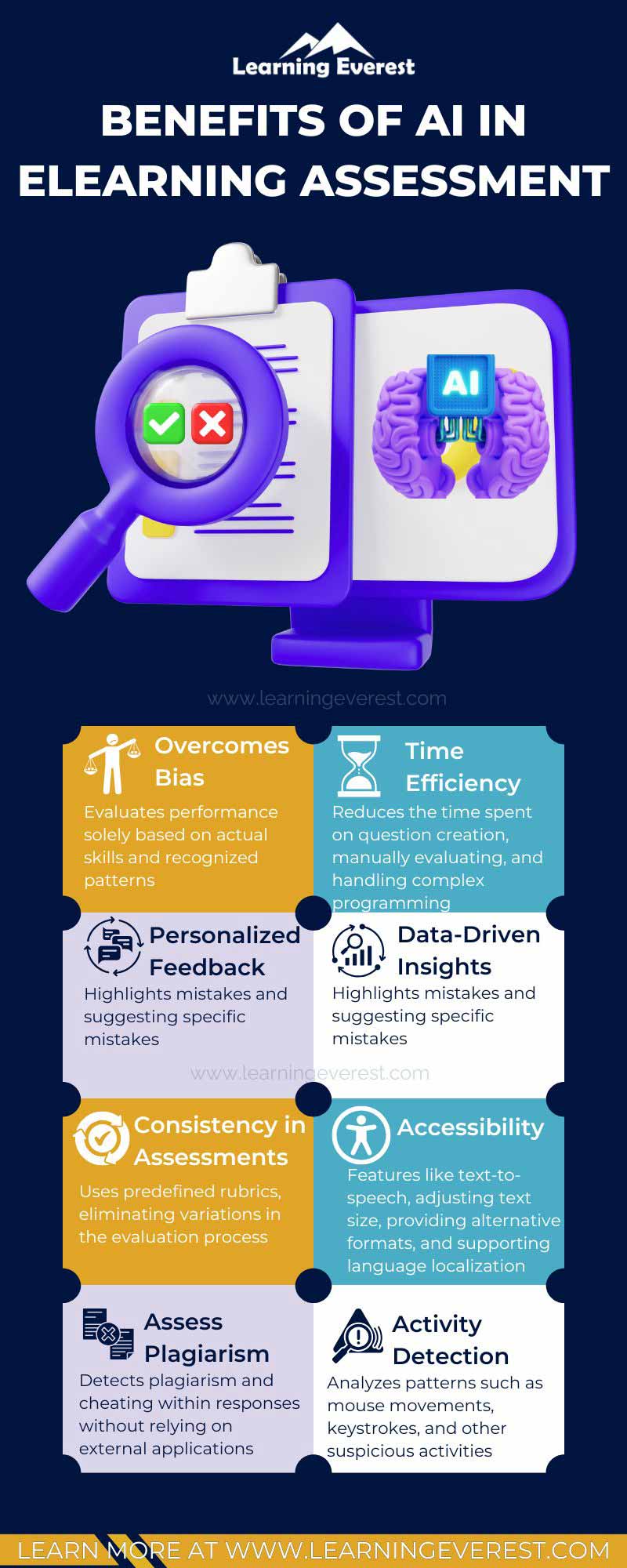
Benefits of AI in eLearning Assessment
Knowledge Check!
Frequently Asked Questions (FAQs)
What is the importance of eLearning assessment?
The importance of eLearning assessment lies in its ability to map learner competencies, identify specific training needs, and evaluate prerequisites for the learning process, in the case of pre-assessments, along with determining whether learning outcomes have been achieved for certification purposes, track learner progress, and highlight areas where the instructional design may need improvement.
What are the areas of AI in eLearning assessment?
AI plays a vital role in eLearning assessment through automated question creation, grading, verified assessments, simulations, learning analytics, and intelligent feedback.
What are the benefits of AI in eLearning assessment?
The benefits of AI in eLearning assessments are extensive, as it eliminates bias, improves time efficiency, provides personalized feedback, delivers data-driven insights, ensures consistency, addresses accessibility needs, detects plagiarism, and monitors learner behavior.
Live Online Certification Trainings




Our Clients Our Work
