

Utilizing AI chatbots as virtual learning assistants is an effective strategy in corporate training, offering an engaging and interactive experience that keeps learners actively involved throughout the process. With the growing presence of AI across every sector, corporate training is no exception, learning is becoming increasingly engaging and easier to understand.
Table of Contents
- Overview of the Terms
- Evolution of AI-Based Chatbots
- Benefits of Utilizing AI Chatbots as Virtual Learning Assistants in Training
- Challenges When Utilizing AI Chatbots as Virtual Learning Assistants
- Areas Utilizing AI Chatbots as Virtual Learning Assistants
- Things to Consider When Utilizing AI Chatbots as Virtual Learning Assistants
- Conclusion
- Infographic
- Knowledge Check!
- Frequently Asked Questions (FAQs)
- What are AI chatbots?
- What are virtual assistants?
- What are the benefits of utilizing AI chatbots as virtual learning assistants in training?
Delve into the entire blog to explore the key benefits of utilizing AI chatbots as virtual training assistants, the challenges associated with their implementation, the areas, and important considerations for their successful use.
Overview of the Terms
Corporate training is becoming increasingly reliant on eLearning due to the vast opportunities it offers for learner engagement. In fact, “90% of L&D professionals surveyed view technology as the key trend shaping the future of digital learning over the next 3-5 years, with 80% highlighting the role of AI.” (Source: Elucidat State of Digital Learning Report, 2025). Two key drivers of AI in eLearning are AI chatbots and virtual assistants.
Chatbots are AI-powered tools designed to automate and simulate text-based communication, mimicking human conversation to provide 24/7 support across platforms such as email, SMS, and website chat. In contrast, virtual assistants are more advanced AI systems capable of handling both simple and complex tasks through voice or text, often integrating with multiple applications and services. By delivering on-demand support, answering questions, and simplifying complex topics anytime, AI chatbots have become virtual learning assistants that enhance corporate training.
Evolution of AI-Based Chatbots
Although chatbots are widely used across various sectors today, they are not a recent invention. The first known chatbot, ELIZA, was developed by Joseph Weizenbaum in 1966. This rule-based chatbot responded to specific keywords provided by users and laid the groundwork for the AI-powered chatbots in use today. PARRY, created in 1972, followed ELIZA, and later in 1995, ALICE (Artificial Linguistic Internet Computer Entity) was developed, utilizing early forms of natural language processing (NLP) to simulate more realistic conversations.
A rapid shift in the tone of conversations was marked after the 2010s, with the introduction of virtual assistants like Siri, Google Assistant, and Alexa, which could understand and respond via voice commands. To mark a significant leap, the advanced generative AI models such as ChatGPT and Google Bard were launched post-2020, the context-aware chatbots offering wider solutions.
Benefits of Utilizing AI Chatbots as Virtual Learning Assistants in Training
Utilizing AI chatbots as virtual learning assistants provides significant advantages for both Learning & Development (L&D) professionals and learners. Some of the key benefits include:
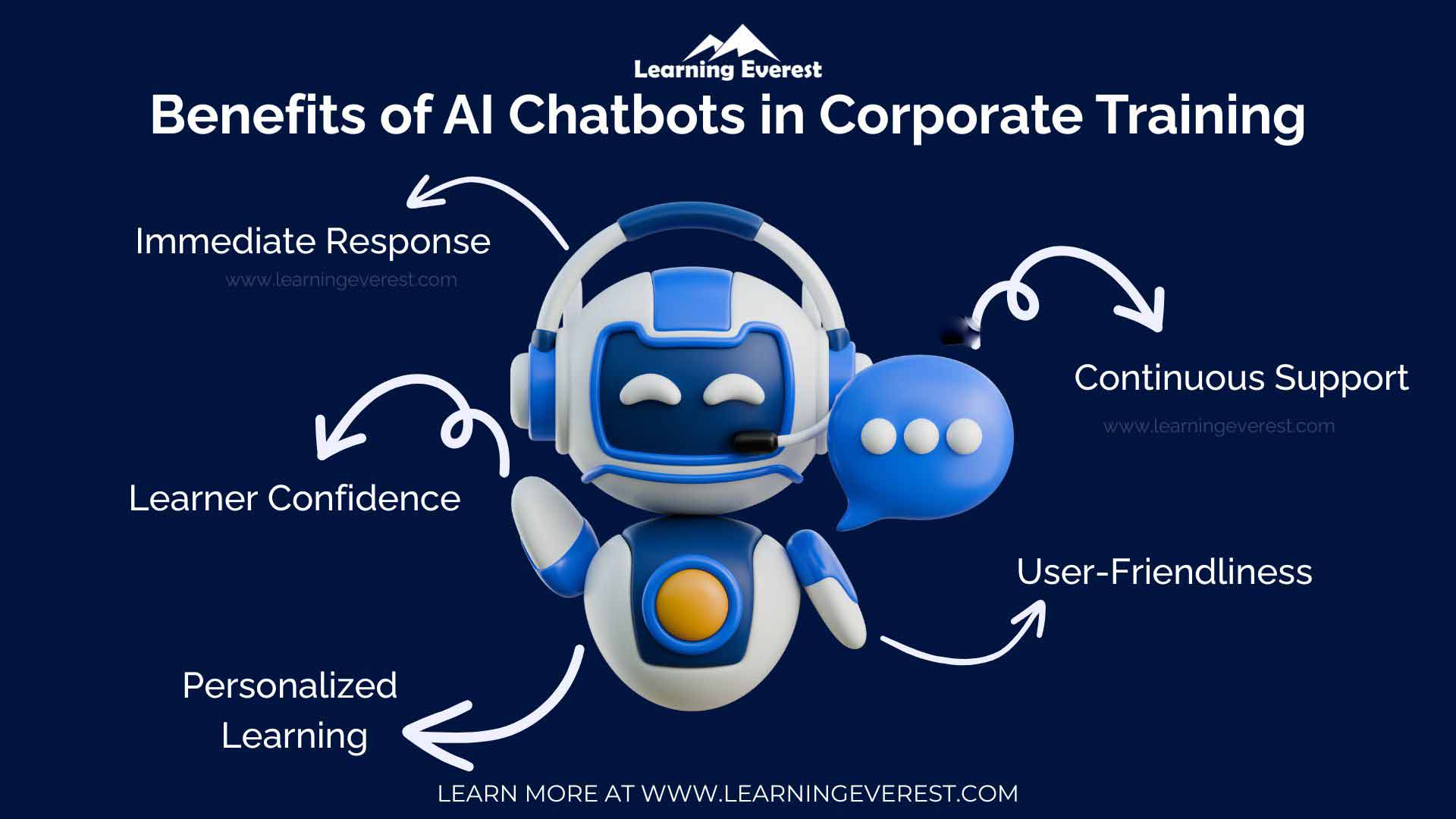
Benefits of AI Chatbots in Corporate Training
Immediate Response
AI chatbots, as virtual possess the ability to provide immediate responses, encouraging learners to receive instant support and feedback at any time. This real-time assistance resolves doubts quickly and delivers immediate feedback on their performance and progress, enhancing the overall learning experience.
Builds Learner Confidence
AI chatbots exhibit human-like proficiency, motivating learners to ask questions or raise doubts freely and confidently. Furthermore, the conversational and human-like response of the learners fosters an engaging and interactive learning experience.
Offers Personalized Learning
Utilizing AI chatbots as virtual learning assistants creates a powerful platform for personalized, self-paced learning. Learners of all styles and interests can engage with content at their own pace, without concerns about trainer availability or hesitation in seeking clarification.
Continuous Support
The around-the-clock availability and flexibility of AI chatbots provide continuous support and emotional encouragement to learners. For trainers, AI chatbots significantly reduce the burden of answering repetitive questions and streamline the assessment process through automated feedback and progress tracking.
User Friendliness
While some software or learning platforms can be complex, AI chatbots are designed to be highly user-friendly. Learners do not need advanced technical skills, making learning simple and stress-free for users at any level.
Challenges When Utilizing AI Chatbots as Virtual Learning Assistants
While utilizing AI chatbots as virtual learning assistants in corporate training offers numerous benefits, certain challenges raise questions about the extent of their effectiveness such as:
- The increased probability of AI hallucinations with chatbots offering misleading or fabricated thoughts.
- AI chatbots may offer unreliable information that is not fact-checked, misleading the learners.
- Chatbots may exhibit bias in their responses, especially in sensitive areas with ethical considerations.
- Due to the risk of fabricated or biased responses, AI chatbots are often not considered a fully reliable source of information by subject matter experts (SMEs) or professionals.
Areas Utilizing AI Chatbots as Virtual Learning Assistants
Beyond providing feedback to learners, AI chatbots as virtual learning assistants contribute to several other key areas of corporate training, enhancing overall effectiveness. They include:
Virtual Tutoring
By interacting with learners anytime they need and offering feedback, support, and personalized guidance, AI chatbots play a vital role in virtual tutoring.
Trainer Support
AI chatbots support trainers by handling routine tasks such as answering FAQs, tracking each learner’s performance and progress, sending reminders and updates, identifying knowledge gaps, and simplifying the trainer’s workload.
Curriculum Development
AI chatbots aid in curriculum development by offering advanced insights to L&D professionals, highlighting areas that require more emphasis based on continuous learner interactions and performance data. This further helps in designing training programs that are targeted to the needs of a specific audience.
Objective Tracking
By monitoring learner interactions, assisting professionals in formulating effective learning objectives, mapping learner progress against those objectives, and providing real-time feedback, AI chatbots benefit from objective tracking.
Personalized Learning Recommendations
Another key application of AI chatbots as virtual learning assistants is in providing personalized learning recommendations. Through analyzing learners’ current skill levels and identifying gaps, chatbots deliver targeted feedback and suggest courses or training programs that align with individual needs and career goals.
Things to Consider When Utilizing AI Chatbots as Virtual Learning Assistants
Ever since the introduction of AI, its use, especially in learning environments, has been met with some scepticism. To ensure effective and responsible implementation, it’s important to consider certain key factors when utilizing AI chatbots as virtual learning assistants.
- Select AI chatbots that seamlessly integrate with the Learning Management System (LMS), align with learner goals and needs, and offer a user-friendly interface.
- Understand the target audience who will primarily interact with the chatbot and design the chatbot’s tone and functionality accordingly.
- Before implementing an AI chatbot, it is desirable to evaluate the budget constraints and select a solution that aligns with financial resources.
- Review the key features of the AI chatbot and understand what sets them apart from other alternatives, such as integration ease, personalization, language support, and automation.
- Consider the scalability of the AI chatbot to ensure it can adapt to the evolving needs of the training process.
Conclusion
In short, utilizing AI chatbots as virtual learning assistants in corporate training transforms the learning experience into one that is engaging and immersive. These tools enhance learning by providing instant responses, boosting learner confidence, enabling personalized learning paths, delivering continuous support, and ensuring ease of use. While the benefits are substantial, there are also important challenges to consider, such as AI hallucinations, potential bias, and the risk of delivering unreliable or unverified information, which can limit their credibility.
AI chatbots as virtual learning assistants are applied in various areas, including virtual tutoring, trainer support, curriculum development, performance tracking, and delivering personalized learning recommendations. However, organizations should carefully evaluate several key factors before implementation, such as system integration capabilities, budget constraints, core features, and scalability to meet evolving training needs. As Learning & Development (L&D) continues to embrace AI, chatbots are opening up broader opportunities for learner performance enhancement.
Infographic
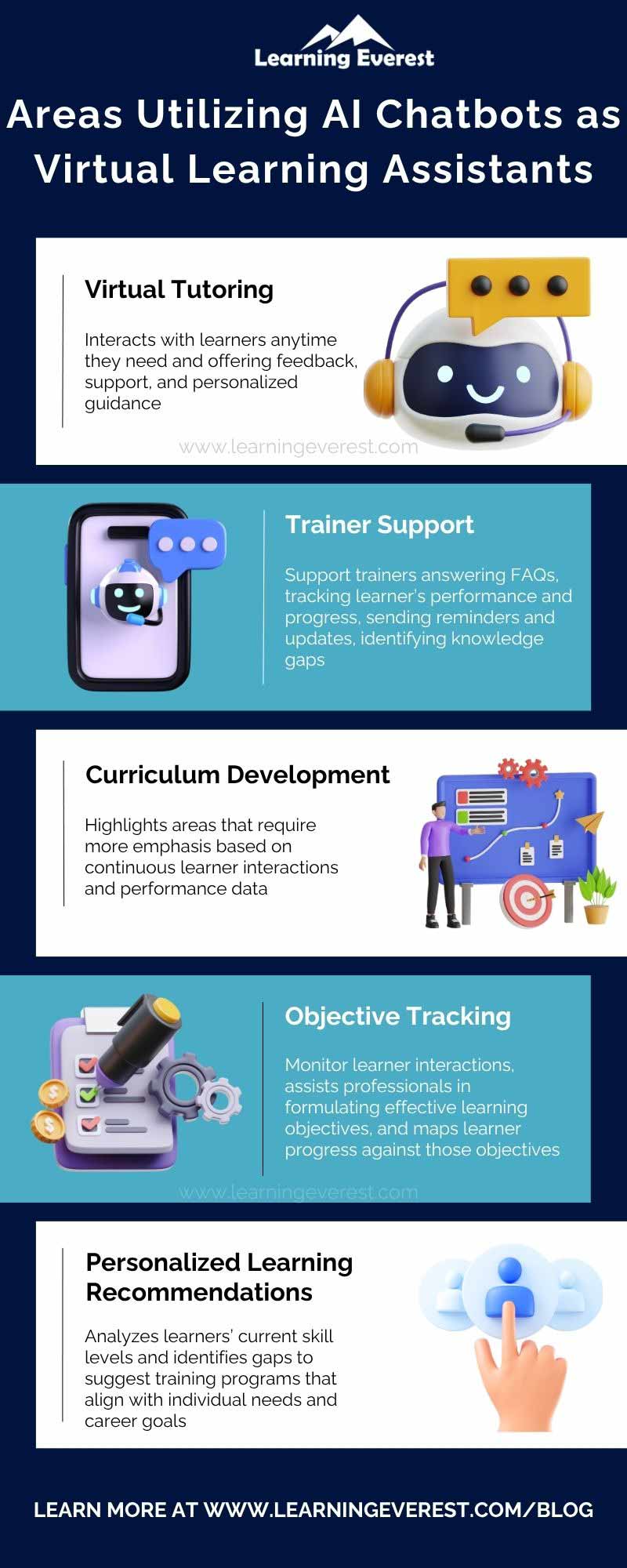
Areas Utilising AI Chatbots as Virtual Learning Assistants
Knowledge Check!
Frequently Asked Questions (FAQs)
What are AI chatbots?
Chatbots are AI-powered tools designed to automate and simulate text-based communication, mimicking human conversation to provide 24/7 support across platforms such as email, SMS, and website chat.
What are virtual assistants?
Virtual assistants are more advanced AI systems capable of handling both simple and complex tasks through voice or text, often integrating with multiple applications and services.
What are the benefits of utilizing AI chatbots as virtual learning assistants in training?
AI chatbots enhance learning by providing instant responses, boosting learner confidence, enabling personalized learning paths, delivering continuous support, and ensuring ease of use.
Live Online Certification Trainings
Our Clients Our Work
