

Change management tools support organizations in managing transitions seamlessly and effectively. Every organization, regardless of its size or industry, undergoes change at various levels, impacting teams, systems, and business goals.
Table of Contents
- What is Change Management?
- Understanding Change Management Tools and its Key Features
- Benefits of Change Management Tools
- Conclusion
- Infographic
- Knowledge Check!
- Frequently Asked Questions (FAQs)
- What is Change management?
- What is a change management tool?
- What are the benefits of change management tools?
- Which are the popular change management tools?
This blog discusses what change management is, key features and benefits of change management tools, and popular change management tools.
What is Change Management?
Change is inevitable in every organization, and it is caused by varying factors, including market competition, competitive pressure, technological advancements, and crisis management. Change management is an approach to dealing with organizational changes by preparing employees with training, providing them with appropriate steps for change, executing and assessing the impact. “47% of organizations that integrate change management are more likely to meet their objectives than the other 30% that did not incorporate it.” (Source: WalkMe).
Change management typically falls into three different levels namely, organizational or transformational change referring to large change management projects, adaptive or gradual change involving smaller changes in products or processes such as new software implementation, and individual change management focusing on individuals including employees and leadership manage change benefitting their roles. Change management helps organizations with improved adaptability to market shifts and equips employees with change management tools to increase productivity.
Understanding Change Management Tools and its Key Features
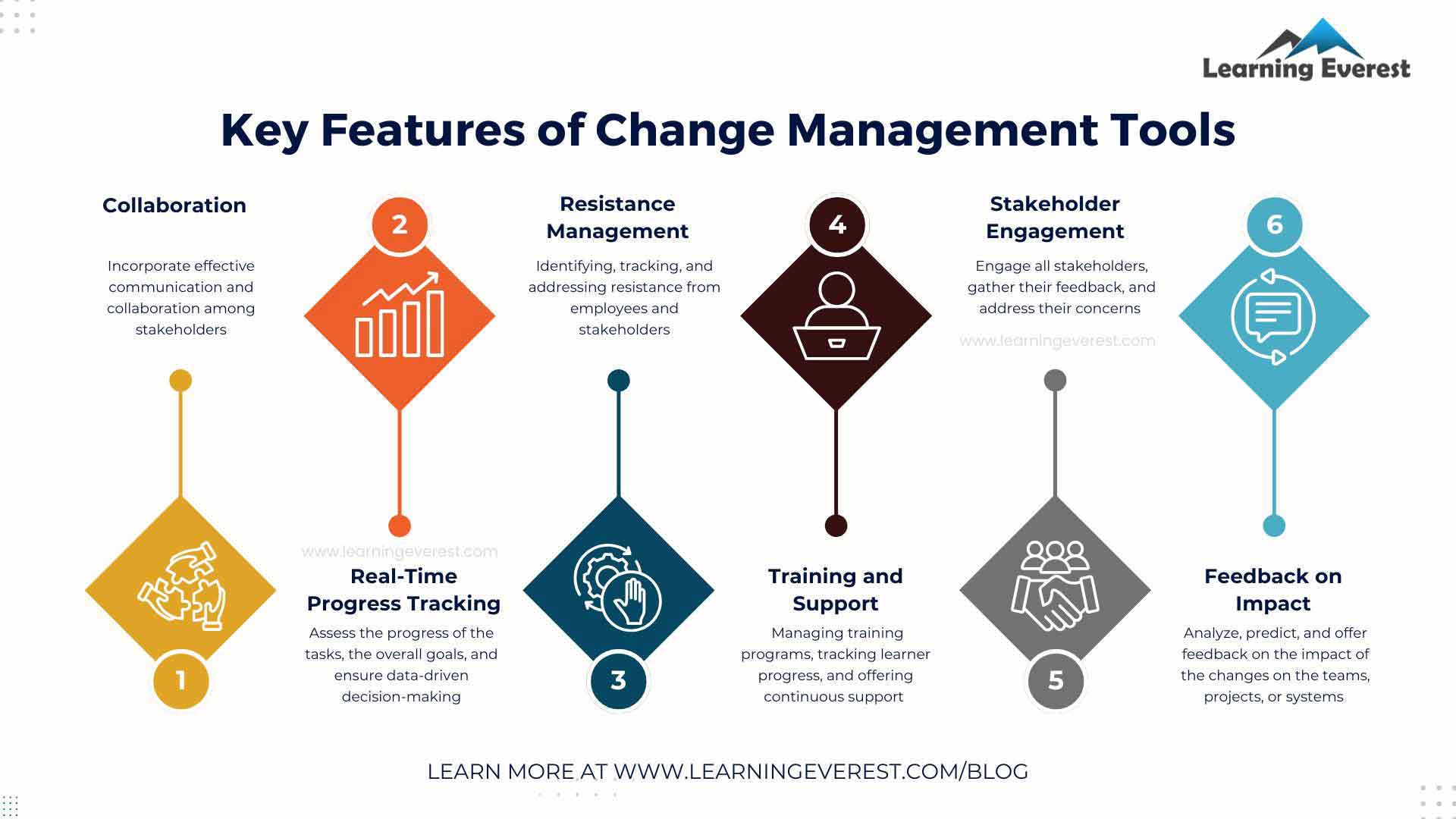
Key Features of Change Management Tools
Change management tools are defined as applications or platforms used in enterprises to guide teams in planning, implementing, and managing organizational changes. These tools support the organization in attaining the desired outcomes of change by minimizing the disruptions thereby improving the overall efficiency. Change management tools prove helpful in situations such as the introduction of new software or systems, facilitating workflow updations, smooth introduction of new projects, offering platforms to engage stakeholders, gathering feedback, and assisting in project planning and tracking. The different change management tools include change management software, project management tools, user onboarding tools, employee engagement and feedback tools, and performance measurement tools. The key features expected from change management tools are:
Collaboration
A change management tool should incorporate effective communication and collaboration among stakeholders to ensure everyone is on the same page.
Real-Time Progress Tracking
The tools should possess real-time progress tracking to assess the progress of the tasks, the overall goals attained, and to ensure data-driven decision-making.
Resistance Management
Identifying, tracking, and addressing resistance from employees and stakeholders is crucial in change management tools. The tools should be equipped with the capability to identify and manage resistance during transition.
Training and Support
Change Management Tools must offer features for managing training programs, tracking learner progress, and offering continuous support to accelerate change adoption.
Stakeholder Engagement
A critical feature expected from the tools is to engage all stakeholders, gather their feedback, and address their concerns during the change process.
Feedback on Impact
Tools should be able to analyze, predict, and offer feedback on the impact of the changes on the teams, projects, or systems within the organizations to update the employees about the operational efficiency transition along with the change.
Benefits of Change Management Tools
Integrating change management tools in an organization offers invaluable benefits to successfully navigate transformations. Here are some of the crucial benefits of incorporating these tools:
Enhanced Operational Efficiency
Incorporating the tools offers a structured approach to assigning tasks and smooth communication enabling the teams to be well-equipped to adapt to every change. Moreover, by sufficiently managing employee resistance, it ensures smooth workflow promoting operational efficiency.
Risk Assessment
In addition to enhanced operational excellence, change management tools contribute to risk assessment by identifying and mitigating potential risks associated with organizational changes. In addition to monitoring risks, the tools report and document the risk factors and the mitigation strategies by analyzing similar instances and decisions.
Improved Collaboration and Engagement
Collaboration and communication between teams, departments, and leadership is a major benefit of change management tools. This inclusion and enhanced communication contribute to employee engagement ensuring the employees feel valued and addressing organizational goals.
Strengthened Organizational Resilience
Adopting the tools to the business contributes to organizational resilience by enabling the stakeholders to adapt to both expected and unforeseen transitions. Resilience, being the ability of the organization to withstand, recover from, and adapt to challenges is elevated through risk identification and empowering the workforce through training and support.
Compliance Support
When organizations encounter changes, maintaining the industry regulations and internal policies is essential. Through change management tools that offer structured documentation and tracking, it ensures that the businesses affirm compliance standards amidst the changes.
Resource Allocation
Similar to the issues with adhering to compliance, allocating resources is a crucial concern during organizational changes. Change management tools provide effective utilization of personnel, time, and assets by prioritizing the tasks and allocating the resources. The tools offer insights into the key areas that require more resources and monitor whether the resources are allocated to the right team in the decided budget.
Popular Change Management Tools
Some popular change management tools and software are available to help organizations manage transitions and implement change. These tools contribute significantly to enabling organizations to attain their overall goals. A popular model is the ADKAR model, a framework focusing on equipping individuals with the skills and knowledge to adapt to change. ADKAR is the shortened form of Awareness, Desire, Knowledge, Ability, and Reinforcement preparing organizations for facing change.
The popular tools include Whatfix, a tool for adopting new software in the organization, Jira for risk assessment, ChangeGear, a standard ITIL-based application employing automation, Freshservice, an automated tool to track changes, and Giva with a change management dashboard with distinctive features. These tools help organizations facilitate smoother change ensuring collaboration, progress tracking, resistance management, stakeholder engagement, and offering support.
Conclusion
As organizations encounter change in varied aspects of their functioning deliberately or unintended, change management is crucial to preparing employees with training, providing them with appropriate steps for change, executing and assessing the impact. Change management tools are applications, platforms, or software used in enterprises to guide teams in planning, implementing, and managing organizational changes. The key features expected from every change management tool are collaboration and communication, real-time progress tracking, resistance management, training and support, stakeholder engagement, and feedback on engagement.
The major benefits of change management tools are enhanced operational efficiency, risk assessment, improved collaboration and employee engagement, strengthened organizational resilience, compliance support, and resource allocation. There are certain popular change management tools and models and the ADKAR Model is one popular model. The popular tools include Whatfix, Jira, ChangeGear, Freshservice, and Giva contributing effectively to managing organizational changes. Organizations should adopt a suitable change management model and tool based on their functioning to ensure smooth functioning despite changes and transitions.
Infographic
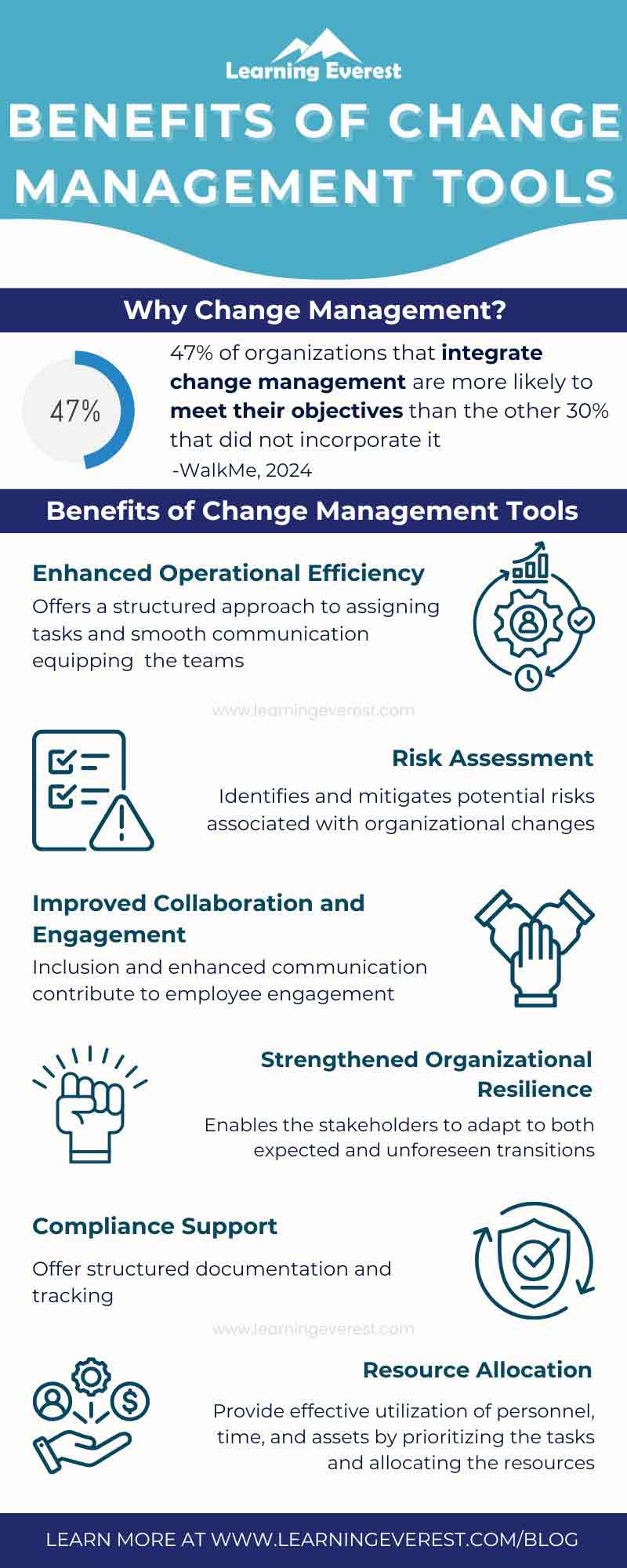
Benefits of Change Management Tools
Knowledge Check!
Frequently Asked Questions (FAQs)
What is Change management?
Change management is an approach to dealing with organizational changes by preparing employees with training, providing them with appropriate steps for change, executing and assessing the impact.
What is a change management tool?
Change management tools are defined as applications or platforms used in enterprises to guide teams in planning, implementing, and managing organizational changes. These tools support the organization in attaining the desired outcomes of change by minimizing the disruptions thereby improving the overall efficiency.
What are the benefits of change management tools?
The major benefits of change management tools are enhanced operational efficiency, risk assessment, improved collaboration and employee engagement, strengthened organizational resilience, compliance support, and resource allocation.
Which are the popular change management tools?
The popular tools include Whatfix, a tool for adopting new software in the organization, Jira for risk assessment, ChangeGear, a standard ITIL-based application employing automation, Freshservice, an automated tool to track changes, and Giva with a change management dashboard with distinctive features.
Live Online Certification Trainings

Our Clients Our Work
