

Emotional intelligence communication techniques are essential for everyone to thrive in the modern workplace. Effective communication within an organization serves as a fundamental pillar for fostering successful relationships and enhancing overall organizational success and integrating emotional intelligence amplifies these effects.
Table of Contents
Delve into this blog to gain critical insights on emotional intelligence communication techniques along with their importance and strategies for improvement.
Understanding Emotional Intelligence
The term emotional intelligence or emotional quotient (EQ) was initially proposed by Michael Beldoch in his research paper in 1964 but gained prominence in the 1990s with Peter Salovey and John Mayer defining and conceptualizing it and Daniel Goleman popularizing it. Emotional Intelligence can be defined as the ability to recognize, manage, and influence one’s own emotions as well as others. It involves a set of skills such as self-awareness, self-regulation, social skills, motivation, and empathy that empower individuals to foster interaction and decision-making enabling them to excel in both personal and professional spheres.
In the workplace, it contributes to enhanced organizational outcomes by building trust and promoting a positive work culture. Studies suggest that “emotional intelligence has a 58% influence on job performance, and more than 90% of top performers in leadership positions possess high emotional intelligence.” (Source: TalentSmartEQ).
Importance of Emotional Intelligence Communication
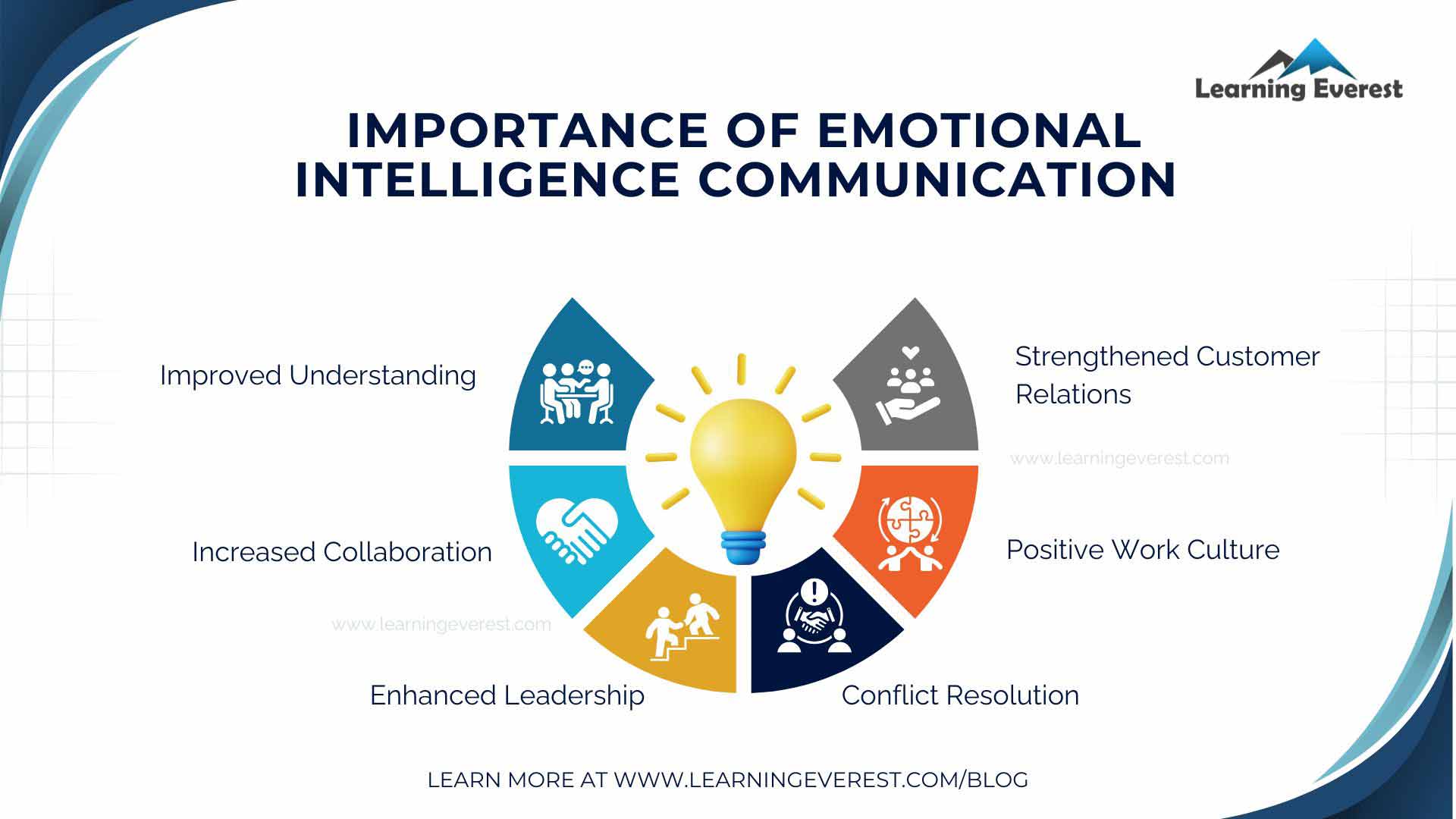
Importance Emotional Intelligence Communication
Emotional intelligence communication refers to the ability of individuals to express emotions in communication effectively while considering the emotions of others. Emotional intelligence communication is crucial in workplaces as it paves the way to open and honest conversations leading to improved understanding. In this manner, it enhances an empathetic dialogue between colleagues resulting in elevated collaboration and teamwork profiting the organization. In addition to building stronger relationships between the employees, emotional intelligence communication maintains morale and productivity by enhancing leadership in effectively motivating and supporting the teams.
Constructive interactions and discussions resolve workplace conflicts and prevent the occurrence of future conflicts, ultimately enabling a positive work culture where every individual feels valued and included and works together in harmony. Moreover, emotional intelligence communication strengthens customer relations through smooth interactions with customers understanding their needs and emotions.
Key Emotional Intelligence Communication Techniques for Workplaces
Embracing emotional intelligence communication techniques in workplaces benefits both the employees and the business by building stronger bonds and rapport within the organization. Here are some key emotional intelligence communication techniques to be followed by the workforce to enhance interactions.
Emotional Intelligence Communication Techniques #1: Adopt Active Listening
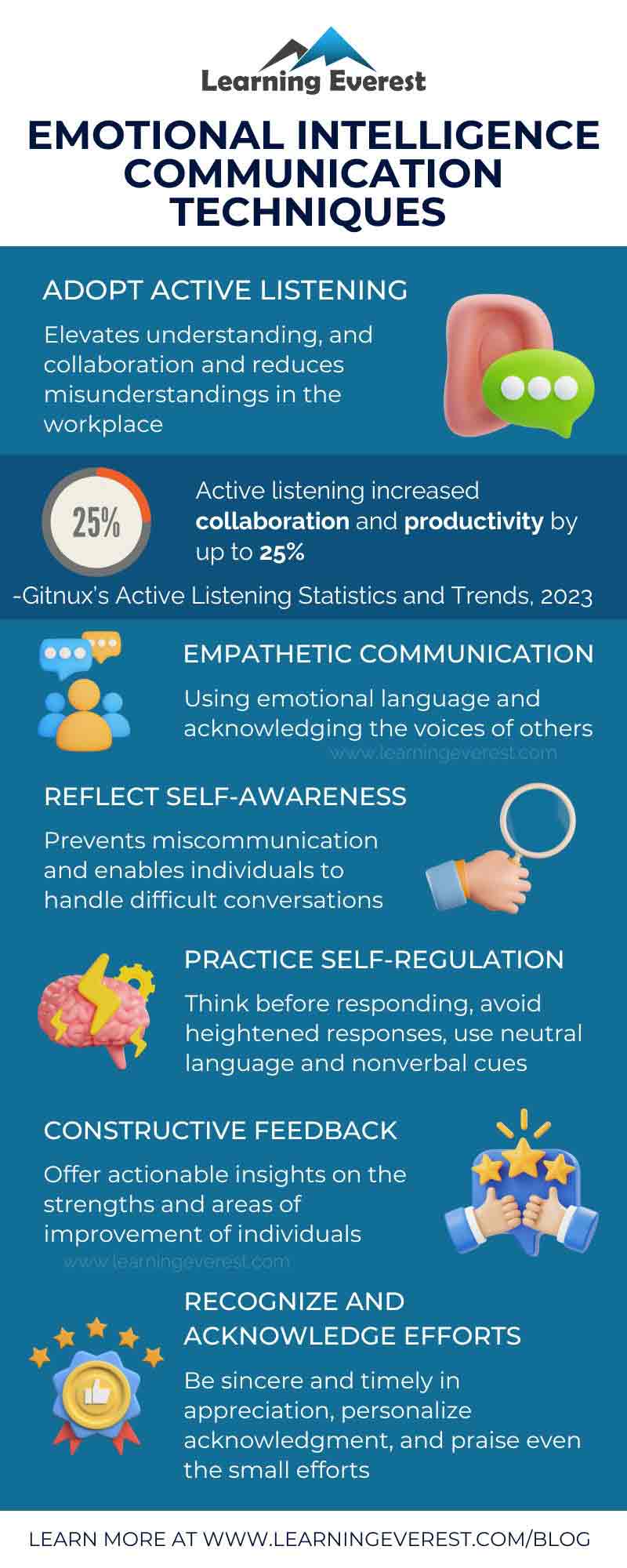
Paying complete attention to the speaker without interrupting or judging them is an important emotional intelligence communication technique. Active listening involves five stages; receiving, understanding, remembering, evaluating, and responding. Listeners should practice asking clarifying questions wherever needed, comprehending non-verbal cues, maintaining eye contact, and relevant nodding throughout every conversation. Active listening elevates understanding, and collaboration and reduces misunderstandings in the workplace. According to Gitnux’s Active Listening Statistics and Trends in 2023 report, “active listening increased collaboration and productivity by up to 25%.” (Source: Workbravely).
Emotional Intelligence Communication Techniques #2: Empathetic Communication
Empathetic communication is an emotional intelligence communication technique that values individuals and offers an inclusive culture within organizations. This involves using emotional language and acknowledging the voices of others. When speaking, adjusting the tone of voice, facial expressions, and gestures to support and understand the teammates is vital. This promotes a culture of stronger professional relationships creating a supportive work environment.
Emotional Intelligence Communication Techniques #3: Reflect Self-Awareness in Communication
Self-awareness refers to the ability of an individual to understand and recognize their own emotions, strengths, areas of improvement, and triggers and adjust their behavior accordingly. When employees possess self-awareness, it is reflected in thoughtful communication that adjusts the tone and language based on the audience. This prevents miscommunication and enables individuals to handle difficult conversations or negative feedback reducing the probability of occurrence of workplace conflicts.
Emotional Intelligence Communication Techniques #4: Practice Self-Regulation in Communication
Self-regulation refers to the ability to manage emotions and impulses and respond thoughtfully even in high-pressure situations. Practicing self-regulation in workplace communication enables individuals to prevent their emotional outbursts and handle situations calmly and professionally. The practice involves thinking before responding, avoiding heightened responses, and using neutral language and nonverbal cues when speaking. Furthermore, it encourages solution-focused discussions and creates a harmonious work culture.
Emotional Intelligence Communication Techniques #5: Deliver Constructive Feedback
Constructive feedback includes offering actionable insights on the strengths and areas of improvement of individuals encouraging growth and development. This enables individuals to improve by increasing engagement, motivation, and productivity. There are different models for delivering constructive feedback to the colleagues such as focusing on the strengths before the weaknesses and being unbiased and non-judgemental. Offering feedback provides opportunities for growth and developing emotional resilience strengthening the workforce.
Emotional Intelligence Communication Techniques #6: Recognize and Acknowledge Efforts
When every individual effort is recognized and appropriately acknowledged, it fosters positive relationships and teamwork in the organization. This emotional intelligence communication technique promotes a culture of appreciation improving the work environment. Recognizing and acknowledging efforts can be performed by being sincere and timely in appreciation, personalizing the acknowledgment, and praising even the small progress and efforts.
Effective Training to Improve Emotional Intelligence Communication
Understanding the importance and the varied emotional intelligence communication techniques, it is pivotal to possess these skills for better workplace dynamics. Effective training enhances these skills by developing self-awareness and self-regulation in communication and enhancing empathy and emotional understanding. Effective training on mindfulness exercises, stress management, emotional intelligence, self-regulation, empathy, conflict resolution, team-building, etc. delivered in multiple modalities such as workshops, role plays, scenarios, journaling exercises, coaching, and mentoring elevate the productivity of the teams. Organizations can implement emotional intelligence communication by assessing the training needs of individuals, defining the learning objectives, utilizing suitable training methods, practicing the skills, providing real-world scenarios and appropriate support, and properly evaluating and measuring progress. Proper training can transform employee interactions and team behaviors.
Conclusion
To sum up, emotional intelligence, the ability to recognize, manage, and influence one’s own emotions as well as others is imperative in every interaction within organizations. Emotional Intelligence communication is the ability of individuals to express emotions in communication effectively while considering the emotions of others. It is important for professionals to possess emotional intelligence communication because it improves understanding through open and honest communication, increases collaboration and teamwork, and enhances leadership by effectively motivating and supporting the team, resolving conflicts, building a positive work culture, and strengthening customer relations.
Key emotional intelligence communication techniques are adopting active listening, empathetic communication, reflecting self-awareness in communication, practicing self-regulation, delivering constructive feedback, and recognizing and acknowledging efforts. To improve emotional intelligence communication in organizations, effective training programs can be implemented by assessing the training needs, defining the learning objectives, utilizing suitable training methods, practicing skills, providing real-world scenarios and support, and evaluating and measuring progress. Individuals can reflect and practice building emotional intelligence communication and organizations can offer a supportive environment to enhance the skill of the employees.
If you’re struggling with implementing appropriate emotional intelligence training, connect with us for interactive and impactful training.
Infographic
Emotional Intelligence Communication Techniques
Knowledge Check!
Frequently Asked Questions (FAQs)
What is emotional intelligence?
Emotional Intelligence can be defined as the ability to recognize, manage, and influence one’s own emotions as well as others.
What are the skills in emotional intelligence?
Emotional intelligence involves a set of skills such as self-awareness, self-regulation, social skills, motivation, and empathy that empower individuals to foster interaction and decision-making enabling them to excel in both personal and professional spheres.
Why is emotional intelligence in communication important?
It is important for professionals to possess emotional intelligence communication because it improves understanding through open and honest communication, increases collaboration and teamwork, and enhances leadership by effectively motivating and supporting the team, resolving conflicts, building a positive work culture, and strengthening customer relations.
What are the key emotional intelligence communication techniques?
Key emotional intelligence communication techniques are adopting active listening, empathetic communication, reflecting self-awareness in communication, practicing self-regulation, delivering constructive feedback, and recognizing and acknowledging efforts.
Live Online Certification Trainings




Our Clients Our Work
