

Staff augmentation is a cost-effective talent solution for businesses offering workforce agility and expertise. This beyond traditional recruitment strategy benefits every sector, particularly in learning and development due to the immense benefits. Explore what staff augmentation is, the types and scenarios that fit staff augmentation, and its impact on learning and development in this blog. Read on!
Table of Contents
- What is Staff Augmentation?
- Types of Staff Augmentation
- Major Contexts for Implementing Staff Augmentation in L&D
- Impact of Staff Augmentation on L&D
- Conclusion
- Infographic
- Knowledge Check!
- Frequently Asked Questions (FAQs)
- What is staff augmentation?
- What are the stages of staff augmentation?
- What are the major contexts for implementing staff augmentation in L&D?
- What impact does staff augmentation have on L&D?
What is Staff Augmentation?
Do you know that “75% of employers report difficulty in filling roles”? (Source: 2024 Global Talent Shortage Report by Manpower Group). This difficulty in finding suitable talent affirms the necessity of staff augmentation in organizations. But, what does staff augmentation mean? Staff augmentation is a flexible outsourcing strategy that allows organizations to expand their teams by bringing in professionals with specific skills without committing to long-term employment.
This approach benefits employers by recruiting qualified resources who can resolve the skill gaps and meet project deadlines. The staff augmentation process includes the stages of identifying the skill gap, determining the number of staff required, communicating the requirements, sourcing the candidates, screening and evaluation, onboarding and integration, performance management, and project completion and offboarding.
In the realm of Learning and Development (L&D), staff augmentation is used to bring in instructional designers, eLearning developers, trainers, and subject matter experts (SMEs) as per project needs in training initiatives. According to The 2024 Future of Recruiting Report by LinkedIn, “91% of recruiting pros say they’re focused on being agile to adapt to hiring needs.” This agile temporary staffing practice enables organizations to meet their immediate requirements in content creation, development, and execution by hiring talent aligning with the skill needs, requirements, and budget without adding a full-time headcount.
Types of Staff Augmentation
Staff augmentation can be categorized based on the engagement or duration and the skill level of the process. Here’s a closer look at each category:
Based on Engagement or Duration
Staff augmentation can be short-term, long-term, and on-demand engagements based on duration and engagement.
Short-term staff augmentation: Suitable for immediate project needs or covering temporary employee absences. This can involve hiring instructional designers or eLearning developers to develop immediate training courses.
Long-term staff augmentation: Used for extended projects for ongoing support, managing large-scale projects, and offering specialized expertise in large-scale L&D initiatives.
On-demand staff augmentation: This approach focuses on instantly bringing professionals for specialized initiatives. It is ideal for handling urgent projects and peak workload management as it offers fast-paced project execution.
Based on Skill Level
Based on skill level, staff augmentation is classified as commodity-based, skill-based, and highly skill-based.
Commodity-based staff augmentation: Aims to recruit general workers for basic tasks. For instance, customer support.
Skill-based augmentation: Utilized for hiring professionals with specific skills suited for the role such as eLearning developers, instructional designers, etc.
Highly skilled: Requires experts with specialized knowledge such as AI specialists, senior L&D strategists, etc.
Major Contexts for Implementing Staff Augmentation in L&D
Understanding the distinct benefits of staff augmentation in L&D including flexibility, agility, diverse talents, and cost-effectiveness, this temporary staffing process is applicable in certain contexts. Let’s delve into each of them.
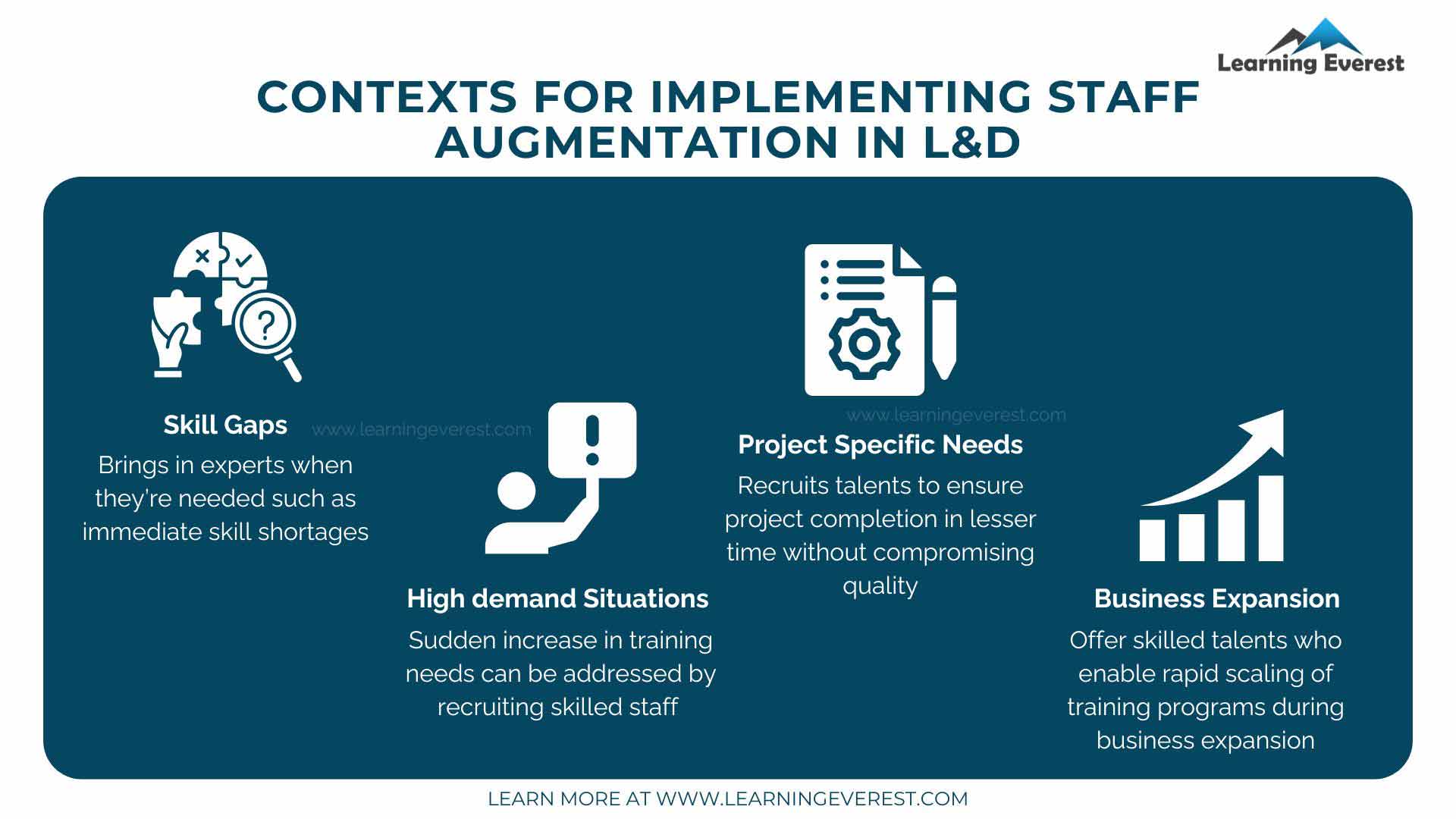
Contexts For Implementing Staff Augmentation in Learning and Development
Filling Skill Gaps
When organizations struggle with urgent skill gaps in specific roles, staff augmentation is applicable to fill the gaps without enduring lengthy hiring processes. This strategy brings in experts when they’re needed such as immediate skill shortages, thereby ensuring the projects stay on track.
High-Demand Situations
Regarding training demands, organizations may experience fluctuating demands in different seasonal situations. To handle the peak workloads during this situation, staff augmentation is the best strategy. This sudden increase in training needs can be addressed effectively by recruiting experts or skilled staff for temporary needs.
Project-specific Needs
Learning and development departments may have specific projects that require temporary expertise. This can include curriculum and course development or technology implementation that requires talents to ensure project completion in less time without compromising its quality. Augmenting staff with the right skill set ensures the completion of the project on schedule and higher standard.
Business Expansion
Expansion of business across the globe is the aim of every organization. However, the growth in terms of new markets or new product launches requires training and development where existing team members may be insufficient. Staff augmentation can offer skilled talents that enable the rapid scaling of training programs.
Impact of Staff Augmentation on L&D
Staff augmentation benefits the organization by resolving the lack of specialized skills, meeting tight deadlines, and offering a quick turnaround. Let’s now evaluate the impact this approach has on L&D.
Scalability
Scalability is considered the ability of an organization to adapt to the changing workload with utmost efficiency. Staff augmentation provides workforce scalability by giving L&D teams the distinct benefit of onboarding experienced professionals on short notice enabling the handling of large-scale projects.
Skilled Expertise and Innovation
Some projects in L&D teams might require highly skilled expertise in certain areas like advanced gamification and the use of AI. Staff augmentation helps the organization in outsourcing top-tier specialists who could bring innovative solutions without long-term commitments. This practice further benefits the existing team members by upskilling them through collaboration with high-quality experts.
Cost Effectiveness
Staff augmentation impacts L&D by avoiding recruitment, onboarding, and training costs and reducing employee benefits. It benefits the organization by enabling scaling up without maintaining an oversized full-time workforce. Moreover, delays in training development and delivery can lead to high business costs which can be resolved with this temporary staffing process.
Resource Allocation
A major impact staff augmentation has on L&D is the improved allocation of resources such as time, budget, talent, and materials. The process encourages the in-house workforce to focus on high-impact projects by removing the strain of administrative or regular tasks and saves improper utilization of materials by ensuring judicious use by the experts. Furthermore, staff augmentation ensures the resources are utilized in necessity, avoiding overstaffing and underutilization of the workforce.
Training Gap Resolution
Through immediate access to talents such as specific subject matter experts or developers, staff augmentation practices resolve the existing talent gap, thereby accelerating training development. In some instances, the internal team may struggle with specialized knowledge of the content and technology resulting in outdated, ineffective, or irrelevant training development. Staff augmentation is a real lifesaver in such instances offering the appropriate human resources to resolve the training gap.
By leveraging staff augmentation, organizations can enhance their learning and development initiatives, ensuring they meet the demands of their evolving workforce.
Conclusion
In short, staff augmentation allows organizations to expand their teams by bringing in professionals with specific skills without long-term employment. This highly effective process can be categorized based on engagement or duration as long-term, short-term, and on-demand and as commodity-based, skill-based, and highly skill-based depending on the skill level. The major contexts where L&D teams can implement staff augmentation are filling skill gaps, high-demand situations, project-specific needs, and business expansion. This highly effective strategy for temporary hiring has a high impact offering scalability, skilled expertise and innovation, cost-effectiveness, resource allocation, and training gap resolution to the L&D teams. It is recommended that organizations implement staff augmentation practices in temporarily outsourcing top talent without long-term commitments to ensure high productivity.
Infographic
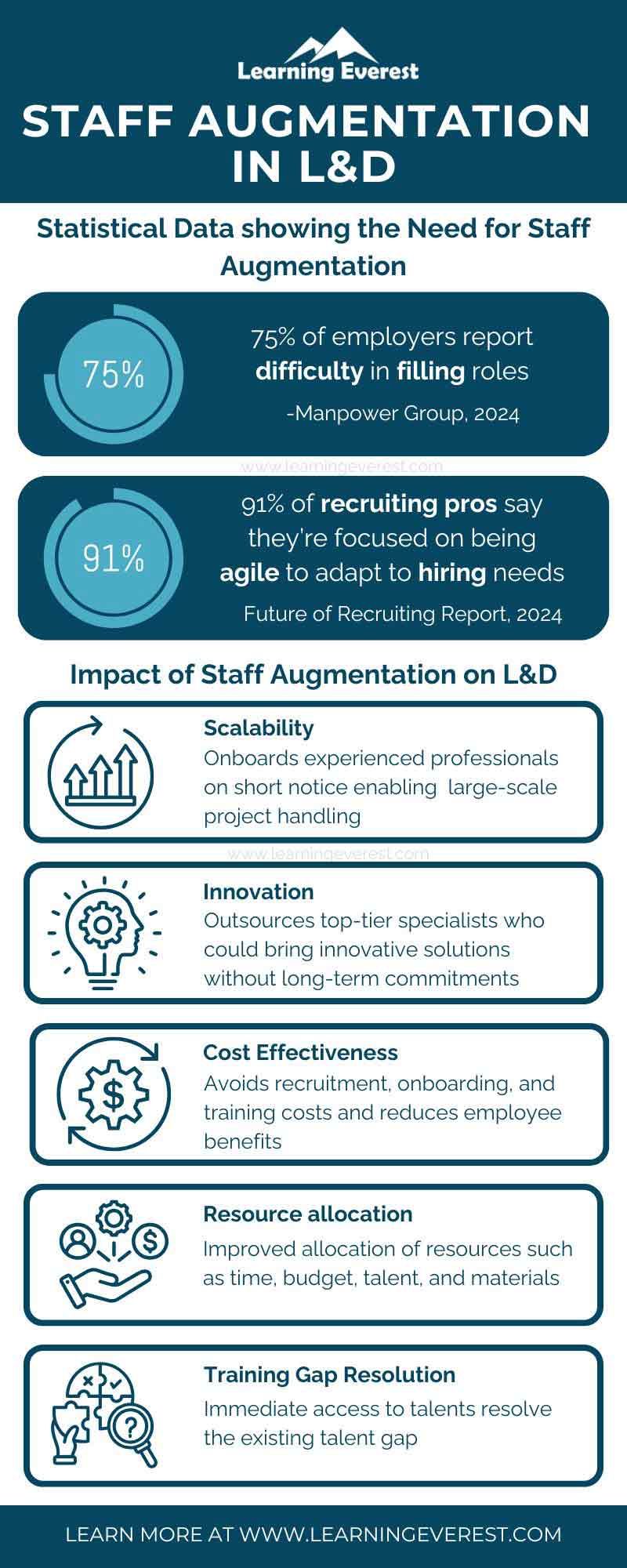
Staff Augmentation in Learning and Development Infographic
Knowledge Check!
Frequently Asked Questions (FAQs)
What is staff augmentation?
Staff augmentation is a flexible outsourcing strategy that allows organizations to expand their teams by bringing in professionals with specific skills without committing to long-term employment. This approach benefits employers by recruiting qualified resources who can resolve skill gaps and meet project deadlines.
What are the stages of staff augmentation?
The staff augmentation process includes the stages of identifying the skill gap, determining the number of staff required, communicating the requirements, sourcing the candidates, screening and evaluation, onboarding and integration, performance management, and project completion and offboarding.
What are the major contexts for implementing staff augmentation in L&D?
The major contexts where L&D teams can implement staff augmentation are filling skill gaps, high-demand situations, project-specific needs, and business expansion.
What impact does staff augmentation have on L&D?
Staff augmentation is a highly effective strategy for temporary hiring and has a high impact offering scalability, skilled expertise and innovation, cost-effectiveness, resource allocation, and training gap resolution to the L&D teams.
Live Online Certification Trainings
Our Clients Our Work
