

Self-directed learning is becoming increasingly preferred by employees for professional growth and skill development. However, this shift toward learner autonomy does not diminish the critical role of Learning & Development (L&D). Instead, L&D plays a pivotal role in enabling and guiding self-directed learning within organizations.
Table of Contents
Let’s explore self-directed learning, its difference from self-paced learning, significant benefits, challenges, and best practices for L&D teams when promoting self-paced learning. Read on!
What is Self-Directed Learning?
Self-directed learning is a training approach that offers learner autonomy to identify their needs, create learning goals, gather the training programs, set the learning strategy, and finally assess the attained outcomes. The foundation of self-directed learning extends to Malcolm S Knowles’ Andragogy theory which emphasizes that adults learn differently than children and prefer autonomy explained in the first principle “Adults need to be involved in the planning and evaluation of their instruction.”
Moreover, he defines self-directed learning as “a process in which individuals take the initiative, with or without the help of others, in diagnosing their learning needs, formulating learning goals, identifying human and material resources for learning, choosing and implementing appropriate learning strategies, and evaluating learning outcomes.” From an L&D point of view, self-directed learning encourages employees to lead their development by identifying knowledge gaps, and needs, and choosing when and how to learn.
Research by 360learning found that “70% of learners feel equipped to declare their own learning needs- yet they still want some oversight from L&D teams.” The role of L&D is crucial in facilitating and supporting self-directed learning by offering access to learning resources, technology, and tools, curating and organizing learning resources, leveraging AI-integrated chatbots, virtual coaches, and discussion forums to support learning, and fostering a culture of continuous learning that encourages exploration and growth.
How is Self-Directed Learning Different from Self-Paced Learning?
Most often self-directed learning is misunderstood with self-paced learning as both offer learner the autonomy to learn and progress at their own pace. However, self-directed learning is different from self-paced learning by letting learners decide upon what, how, and when to learn. Furthermore, self-directed learning encourages learners to choose their learning materials while the content for self-paced learning is pre-selected by instructors. The role of L&D also differs by acting as a support that provides resources and guidance for self-directed learning while providing structured content with flexibility limited to the learning pace in the case of self-paced learning. In short, self-directed learning inherently allows for self-paced progress, but self-paced learning does not imply self-direction.
What are the Benefits of Self-Directed Learning?
A survey conducted by LinkedIn Learning on 2000 Gen Z employees on what they expect from a learning program revealed that “43% of Gen Z prefer a fully self-directed and independent approach to learning.” The major reason why a large number of employees prefer self-directed learning is its immense benefits which include:
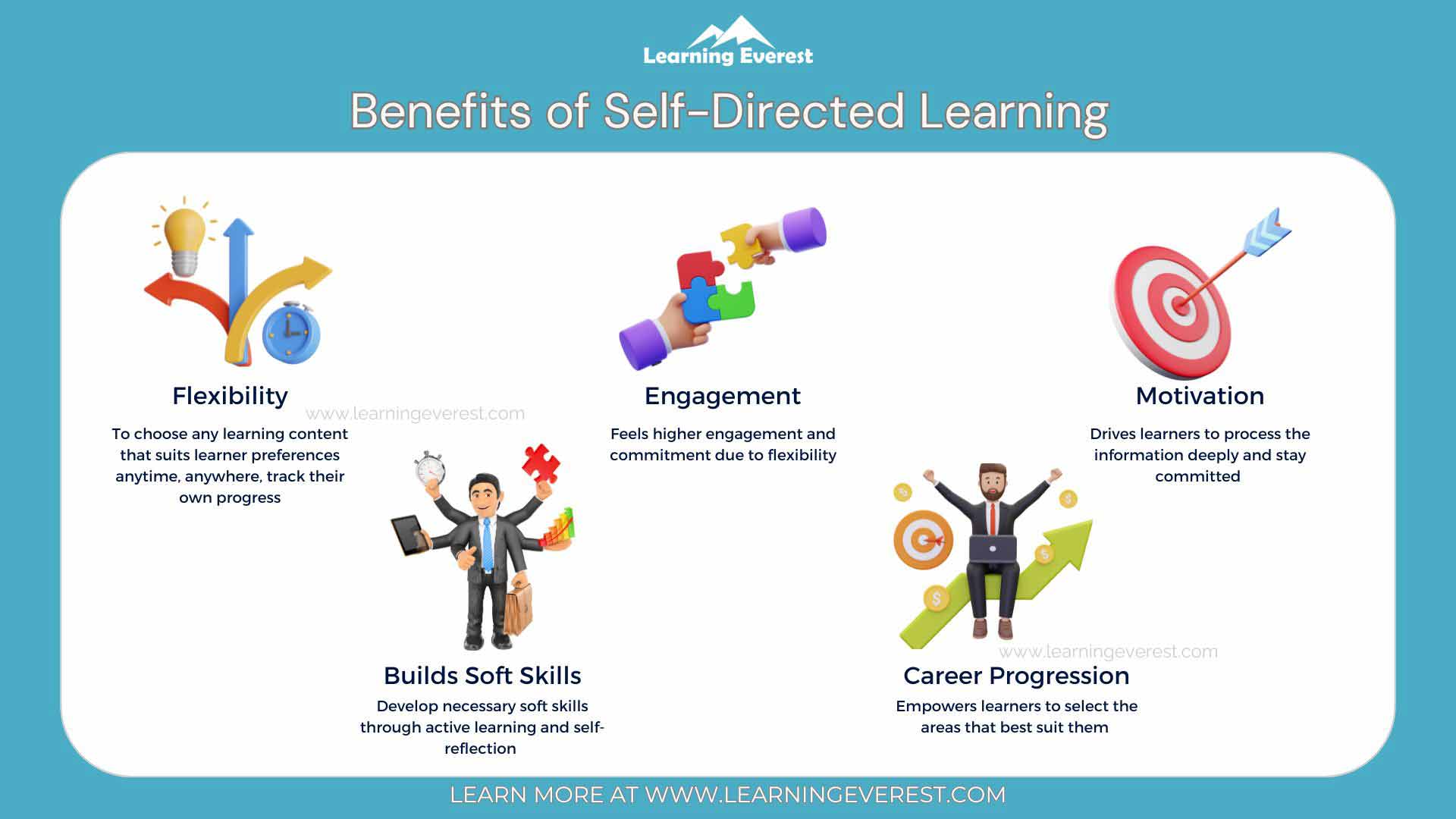
Benefits of Self-Directed Learning
Flexibility
Self-directed learning offers the flexibility to choose any learning content that suits learner preferences anytime, anywhere, track their own progress, and areas of improvement, thereby adjusting the learning journey.
Engagement
With the autonomy to choose the content that aligns with their career goals and the suitable pace of learning, learners feel higher engagement and commitment in the learning process.
Motivation
The learners select the topics and skills that are relevant for their growth and therefore carry intrinsic motivation to progress in the learning. This motivation drives learners to process the information more deeply and encourages them to stay committed to learning even amid obstacles.
Builds Soft Skills
The major purpose of corporate training or other adult learning is to possess the necessary soft and technical skills to excel in the roles. As employees engage in self-directed learning, they develop necessary soft skills such as communication, problem-solving, leadership, etc. through active learning and self-reflection along with participating in networking with online communities and discussion forums.
Career Progression
Self-directed learning contributes to career growth and advancement by empowering learners to select the areas that best suit them rather than focusing on company-mandated training.
Apart from the distinct benefits it offers to the learners, it benefits L&D teams and the business by removing micromanaging learning and encouraging a culture of continuous learning.
Challenges of Self-Directed Learning
Even when there is a large array of merits promoting the need to implement self-directed learning, “Only 1 in 5 L&D pros plan to offer” this learning due to some challenges. (Source: LinkedIn Learning). The major challenges learners face associated with self-directed learning are limited access to resources, assessment and feedback opportunities, lack of motivation, isolated learning, and lack of guidance. Organizations face challenges such as time constraints, ensuring the learning aligns with business goals and uneven learning experiences.
Best Practices for L&D Teams While Integrating Self-Directed Learning
The most common ways organizations promote self-directed learning is by deploying an LMS or encouraging access to other learning pathways. While there are challenges in self-directed learning, following certain best practices reaps the greatest outcomes.
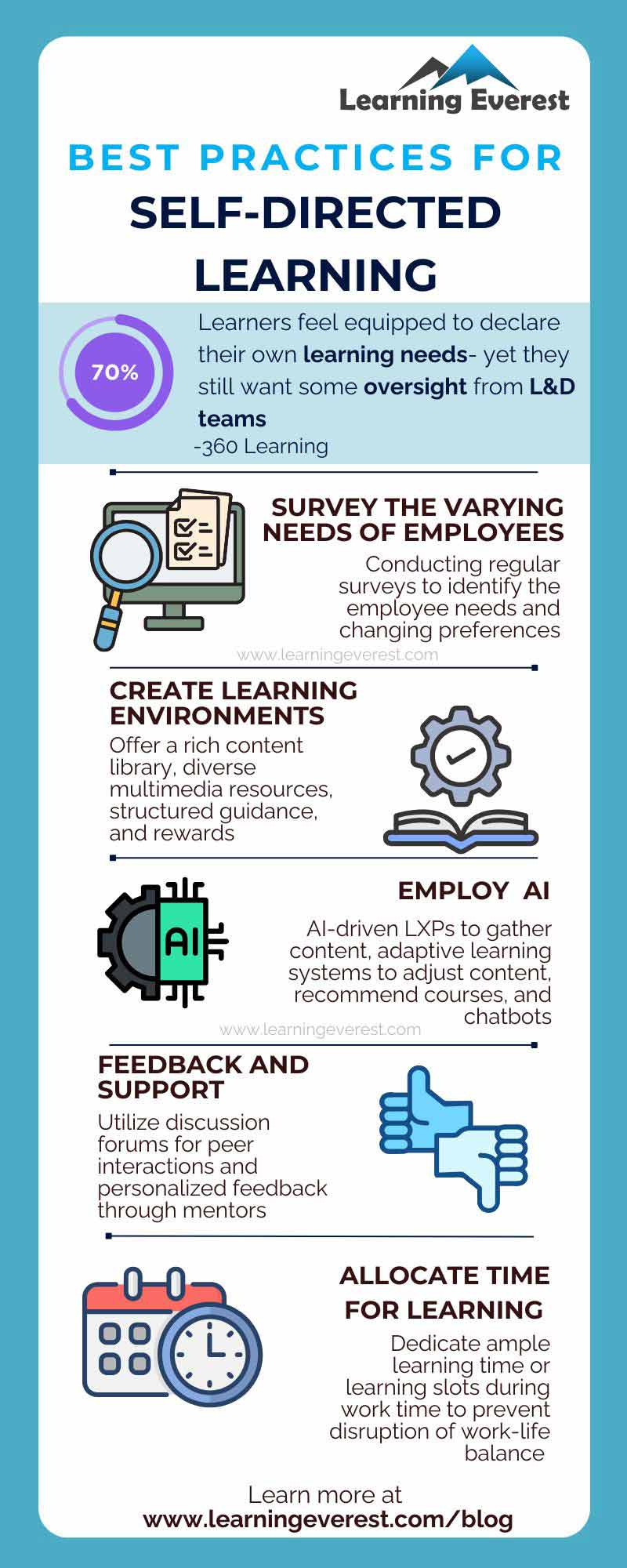
Survey the Varying Needs of Employees
An effective way for L&D teams to integrate self-directed learning is by conducting regular surveys to identify employee needs and changing preferences and utilize the data to offer personalized learning resources that align with both business goals and individual development needs.
Create Learning Environments
A well-structured learning environment is essential to offer self-directed learning. L&D teams can create an effective ecosystem by offering a rich content library, and diverse multimedia resources, providing structured guidance, and implementing rewards to encourage continuous learning. Leveraging interactive resources such as gamified elements, scenario-based learning, etc. can encourage a smooth learning process.
Employ AI
Another best practice to improve self-directed learning is to employ AI in content curation such as AI-driven LXPs to gather content from multiple sources, categorize content automatically to ensure easy accessibility, adaptive learning systems to adjust content based on learner’s knowledge, recommend courses based on learner preferences, and chatbots for continuous support.
Feedback and Support
Enhance the learning experience with timely feedback and support by utilizing discussion forums for peer interactions, personalized feedback through mentors and AI analytics, assess learnability, and provide suggestions.
Allocate Time for Learning
Organizations often implement forced learning of certain courses but fail to allocate time for learning, disrupting employees’ work-life balance and leading to dissatisfaction. A major strategy that can be followed is dedicating ample learning time or learning slots during work time by integrating learning into the workforce.
Conclusion
To sum up, self-directed learning offers learner autonomy to identify their needs, create learning goals, gather programs, set the learning strategy, and assess the outcomes. Self-directed learning is different from self-paced learning as it lets learners decide what, how, and when to learn and encourages them to choose their learning materials. The benefits of self-directed learning include flexibility, engagement, motivation, building soft skills, and career progression. Amidst benefits, both learners and organizations face challenges such as limited resources, lack of motivation, time constraints, and ensuring alignment with business goals.
To overcome these obstacles, L&D teams can implement best practices like surveying employee needs, creating a structured learning environment, leveraging AI for content curation and recommendations, providing continuous feedback and support, and allocating dedicated learning time. Organizations should actively integrate these strategies to foster a culture of continuous learning and professional growth while ensuring learning aligns with business objectives.
Infographic
Best Practices for Self-Directed Learning
Knowledge Check!
Frequently Asked Questions (FAQs)
What is Self-Directed Learning?
Self-directed learning is a training approach that offers learner autonomy to identify their needs, create learning goals, gather the training programs, set the learning strategy, and finally assess the attained outcomes.
How is self-directed learning different from self-paced learning?
Self-directed learning is different from self-paced learning by letting learners decide what, how, and when to learn. Furthermore, self-directed learning encourages learners to choose their learning materials while the content for self-paced learning is pre-selected by instructors.
What are the benefits of self-directed learning?
The benefits of self-directed learning include flexibility, engagement, motivation, building soft skills, and career progression.
Live Online Certification Trainings


Our Clients Our Work
